Scaling B2B Lead Generation with HubSpot: A Powerful Tool for B2B Sales and Marketing Teams
What’s the most effective way for a B2B company to attract high-quality leads and fuel long-term growth?


%20(23).png?width=302&height=302&name=_SD%20web%20assets%202025%20(500%20x%20500%20px)%20(23).png)
Lead generation for IT companies has become increasingly complex as B2B buyers conduct deeper research and evaluate multiple vendors before making a decision. According to Gartner, 61% of B2B buyers prefer a rep-free buying experience, highlighting a major shift in how technology solutions are evaluated and purchased. For IT firms, this means traditional sales-led outreach is no longer enough to consistently generate qualified opportunities.
Effective IT lead generation today requires a combination of inbound strategies, outbound targeting, and data-driven insights that align with how modern technology buyers evaluate solutions. Companies that build structured, multi-channel pipelines are significantly more likely to attract high-intent prospects and convert them into long-term clients.
In this guide, we’ll break down the most effective IT lead generation strategies, when to use specialized services, and how to build a system that consistently delivers qualified leads.
Content marketing is one of the most effective IT lead generation strategies because it attracts buyers actively researching solutions like cybersecurity, cloud migration, and managed IT services. Instead of broad content, IT companies should focus on high-intent assets that align with specific pain points and buying stages.
First, make sure your content is interesting and informative. No one wants to read something boring, so put some thought into what would truly capture your target readers' attention. Second, keep it relevant to your brand and audience. Your content should be aligned with your overall marketing goals and should speak to the needs and interests of your target customers.
Finally, make sure it's well-written and error-free. Even the most groundbreaking piece of content won't be effective if it's full of typos and grammatical mistakes. Content marketing can be a powerful tool for any business - but only if it's done right. So keep these tips in mind as you plan and create your own content marketing strategy. When it comes to content marketing for IT companies, there are a few different types of content you can create:
Educational blog posts targeting IT decision-makers
Cloud migration or cybersecurity how-to guides
Case studies showing measurable ROI
Industry-specific whitepapers or reports
Technical webinars for IT buyers
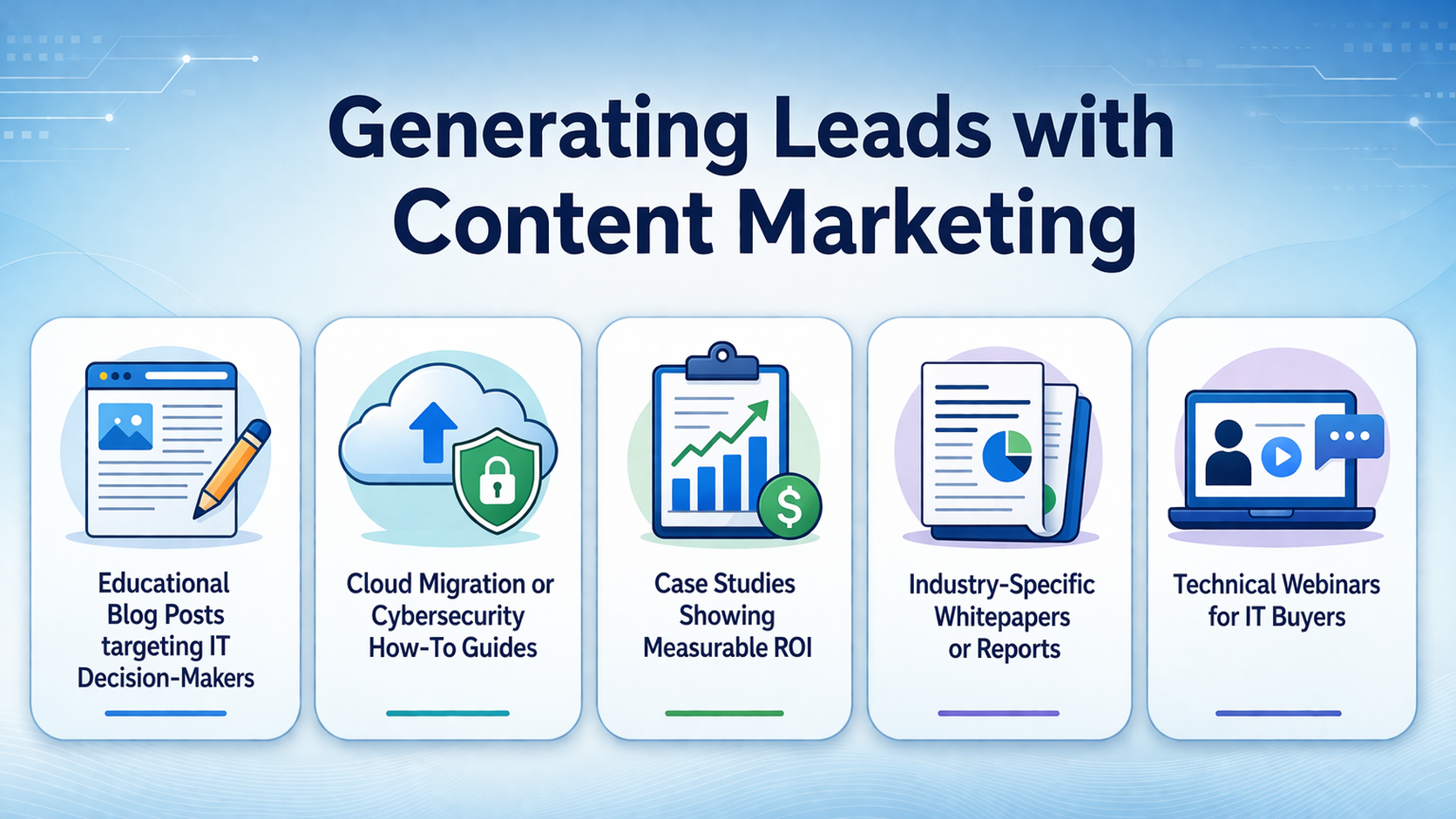
Each piece of content should be carefully crafted with your target audience in mind. It should be relevant to their pain points and needs. For example, if you're targeting small businesses, you might want to create a helpful guide on setting up a secure network. These types of content pieces are not only helpful for generating leads, but they also help establish your company as an authority in the industry.
Another great way to generate leads with content marketing is through gated content. Gated content is simply content that is behind a form fill. In order to access the piece of content, the visitor has to input their contact information. This is a great way to generate leads because you're able to capture contact information up front. Just make sure that the gated content you're offering is truly valuable and worth filling out a form for!
These types of assets not only increase inbound traffic but also help generate sales-qualified leads (SQLs) by addressing real technical challenges buyers are actively trying to solve.
Modern IT lead generation services combine inbound and outbound strategies to help companies capture qualified prospects. These services may include prospect list building, appointment setting, content syndication, and targeted digital campaigns. The key is to evaluate vendors that specialize in technology buyers and understand the IT decision-making process. By leveraging specialized providers, IT companies can shorten sales cycles and ensure their teams spend time only on high-value conversations.
While the terms are often used interchangeably, technology companies and IT service providers face different challenges when it comes to lead generation. Technology companies often focus on product-driven demand, whereas IT firms provide ongoing service and support. Creating separate campaigns for each audience ensures messaging resonates—whether the goal is to highlight innovative software features or showcase reliable managed services.
Successful IT services lead generation requires aligning marketing with the buyer’s pain points. Tactics like offering cybersecurity assessments, hosting webinars on cloud migration, or publishing case studies with measurable ROI are proven to attract interest. These approaches demonstrate credibility and expertise, two factors that heavily influence IT decision-makers.
Tech companies looking to grow their pipeline need a slightly different playbook compared to traditional IT firms. Highlighting product scalability, integrations, and industry-specific use cases can help capture attention from fast-growing businesses. Adding thought leadership content—such as industry trend reports—also positions a tech company as forward-thinking and trustworthy.
Many IT companies eventually face the decision of whether to build an internal lead generation team or partner with a specialized agency. The right choice depends on growth goals, available resources, and how quickly results are needed.
Building an in-house team offers greater control and deep alignment with your services, but it often requires significant time to hire, train, and optimize. For companies aiming to scale quickly, this delay can slow pipeline growth and create inconsistent lead flow.
On the other hand, IT lead generation services provide access to proven systems, data, and expertise that can accelerate results. Many companies achieve this through specialized partners offering demand generation programs designed to build a consistent, qualified pipeline, an approach commonly used by agencies like SmithDigital that focus on B2B and technology markets.
In general, companies with limited internal resources or aggressive growth targets benefit most from outsourcing, while more mature organizations may choose a hybrid approach that combines internal knowledge with external execution.
SEO, or search engine optimization, is a process of improving the visibility and ranking of a website on search engines. The goal of SEO is to attract more visitors to a site by increasing its position in the search engine results pages (SERPs). SEO marketing is the process of using SEO techniques to improve the visibility and ranking of a website on search engines.
SEO marketing involves optimizing a website for the purposes of increasing its visibility and ranking on search engines. The main goal of SEO marketing is to attract more visitors to a site by improving its position in the search engine results pages (SERPs). SEO marketing generally focuses on two main areas: on-page optimization and off-page optimization. On-page optimization refers to the process of optimizing a website’s content and structure for the purpose of improving its visibility and ranking on search engines. Off-page optimization, on the other hand, refers to the process of promoting a website through activities such as link building and social media engagement.
There are many different SEO marketing strategies that can be used to improve the visibility and ranking of a website on search engines. Some common SEO marketing strategies include keyword research, content optimization, link building, and social media engagement. SEO marketing can be an effective way to attract more visitors to a site and improve its overall position in the SERPs. However, it should be noted that SEO marketing is just one part of an overall digital marketing strategy. In order to truly succeed in today’s digital world, businesses need to have an integrated approach that includes other digital marketing channels such as email marketing, social media marketing, and paid advertising.
Vendors like Zoominfo and Bombora provide unique marketing insights referred to as "buyer intent data." This is information that comes from companies that are actively researching a product or service. Bombora collects this data and then makes it available to businesses for marketing purposes. This can be extremely valuable for generating leads, because you know that the people who are included in the data are already interested in what you're selling. Both Bombora and Zoominfo have integrations with leading CRM providers (e.g., HubSpot and Salesforce), making it easy to access this info right from your CRM. Coupling your content marketing efforts with intent data is the ultimate solution for BDR's and AE's looking to find their sales opportunity.
Once you've generated some leads with your killer content strategy, it's time to start nurturing those leads with email marketing. Email marketing is one of the most effective ways to nurture leads and convert them into customers. In fact, according to The Direct Marketing Association, email boasts an ROI of 4200%! That's huge. However, in order for email marketing to be effective, you need two things: segmented lists and targeted emails.
The first step is segmenting your list into different groups based on factors like job title, company size, or location. Once you have your list segmented, you can start crafting targeted emails that speak directly to the needs of each group. These targeted emails will be much more effective than generic emails that get sent to everyone on your list; they'll demonstrate that you understand the needs of your recipient and that you have something valuable to offer them.
Additionally, make sure you're providing value in each email; don't just try to sell them something from the get-go! Provide helpful tips or advice, share an interesting blog post or case study… give them something that will make them want to open each email you send. If you follow these steps, you'll be well on your way to generating quality leads that convert!
IT lead generation has evolved alongside the way B2B buyers research and evaluate solutions. With more decision-making happening independently, IT companies need a structured approach that combines content, SEO, intent data, and targeted outreach to consistently generate qualified opportunities.
The most successful organizations don’t rely on a single tactic. They build integrated, multi-channel strategies that align with how modern technology buyers make decisions. Whether executed in-house or through specialized partners, the key is creating a repeatable system that delivers a steady pipeline of high-intent leads.
If you're looking to accelerate results, partnering with a team experienced in B2B and IT-focused demand generation can help streamline execution and improve lead quality. Want to start exploring ways to scale your pipeline and generate more qualified IT leads? Get in touch with SmithDigital to see how we can help.
A: Combining content marketing, SEO, and intent data creates a reliable funnel that attracts and qualifies prospects. For a deeper breakdown of strategic hiring, see our guide on hiring a lead generation specialist.
A: These services provide prospect data, appointment setting, and campaign support tailored to technology buyers. They are often compared to broader demand generation efforts—learn the distinctions in our resource on demand generation vs lead generation.
A: IT companies focus on ongoing services like managed IT, while tech companies often generate demand for products or platforms. For example, ERP software consultants face unique challenges; our page on ERP lead generation solutions explains how targeted campaigns can make a difference.
A: Pricing varies widely, but most services are billed monthly based on lead volume, targeting, and campaign complexity. Our business broker case study illustrates how investment in specialized campaigns can produce measurable ROI.
A: Email remains one of the highest ROI channels for nurturing leads and moving them through the decision-making process.

What’s the most effective way for a B2B company to attract high-quality leads and fuel long-term growth?

SEO strategies can help increase organic traffic to your website, but it can take months for interested customers to find you. Quality leads can...

 Eric Smith : Sep 23, 2025 4:30:00 PM
What’s the fastest way for a business broker to grow revenue and attract a steady stream of qualified leads?