6 Things to Keep In Mind When Hiring a Lead Generation Specialist
SEO strategies can help increase organic traffic to your website, but it can take months for interested customers to find you. Quality leads can...
%20(23).png?width=302&height=302&name=_SD%20web%20assets%202025%20(500%20x%20500%20px)%20(23).png)
4 min read
Eric Smith
:
Dec 2, 2025 11:15:00 AM
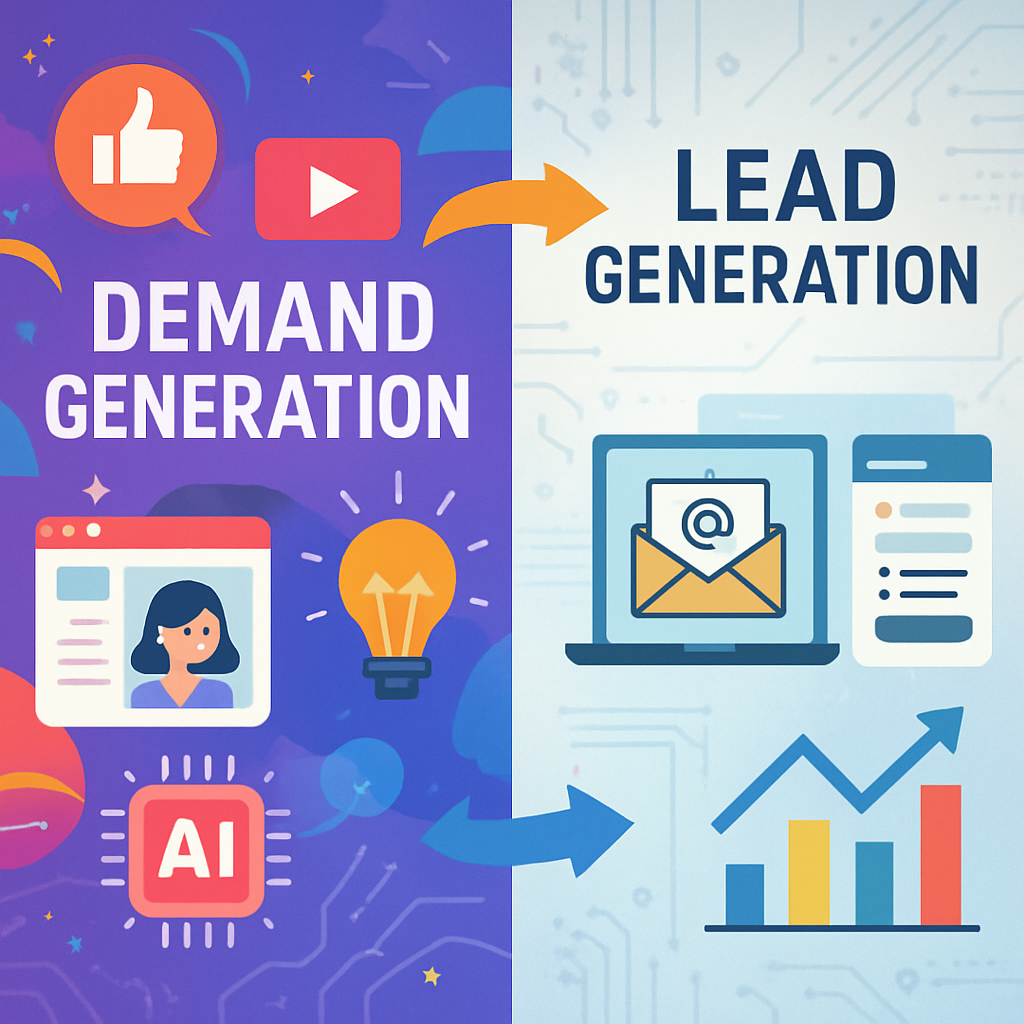
Demand generation remains the strategy to build brand awareness and attract interest. It covers everything from content marketing and educational resources to thought leadership and visibility-building campaigns.
But in 2025, demand generation faces new challenges and opportunities: AI is changing how people find and consume content, which changes the rules of the game.
AI‑powered search engines and assistants increasingly deliver answers directly to users — often via “AI summaries” or “answer boxes” — without requiring a click.
As a result, even web pages that rank first can see substantial declines in traffic: one analysis suggests that top organic results are losing roughly a third of their clicks when AI answer boxes appear.
Practically, that means more users are getting “what they need” from the AI interface itself, without ever visiting your site. That erodes the impact of traditional SEO and content‑based demand generation.
This makes conventional demand‑gen more complex — but it does not make it obsolete. It simply raises the bar for how you structure, position, and differentiate your content so you still attract and engage your ideal audience.
Because of the shift toward AI‑powered discovery, many marketing teams are now talking about Generative Engine Optimization (GEO) — essentially the next evolution of SEO for a landscape where AI engines (not just human‑driven search) surface answers and recommendations.
Practically, that means optimizing not just for traditional search algorithms, but for how AI tools parse, interpret, and rank your content: clean information architecture, clear and direct language, strong semantic and entity signals, and content that delivers real expertise and value — not thin, keyword‑stuffed copy.
Interestingly, AI hasn’t just stolen traffic — it’s also creating new sources of referrals. One recent report found that from July 2024 to February 2025, web traffic from AI‑driven referrals in the U.S. grew more than 10×.
For marketers, that signals a clear opportunity: by intentionally optimizing for AI referrals and aligning your content with how generative‑AI tools source, evaluate, and surface recommendations, you can access a newer, less‑crowded stream of qualified traffic.
In short: demand generation still matters — but it now requires adapting to a landscape where AI fundamentally changes how attention is created, found, and distributed.
Where demand generation builds awareness, lead generation is about converting that interest into measurable action — form fills, demo requests, trial signups, or purchases. Traditional tactics like newsletters, gated content, sales‑driven landing pages, and email campaigns still form the backbone of this stage.
AI is now reshaping this layer of the funnel as well — creating significant upside, but also introducing new operational and strategic risks.
According to a 2025 survey, 63% of marketers now use AI tools in their email programs.
When implemented thoughtfully, AI‑driven email campaigns can deliver materially stronger personalization and segmentation, which in turn lifts performance. Some studies report up to 13–40% higher open or click‑through rates compared with traditional, non‑AI‑assisted campaigns.
AI also meaningfully improves efficiency: marketers report saving substantial time on content creation, audience targeting, and campaign planning — freeing teams to focus on strategy instead of manual production.
At the same time, there are real headwinds:
Deliverability is slipping. One recent benchmark shows average email deliverability falling to around 83.1% — meaning nearly one in six emails either bounce or land in spam rather than the inbox.
With inboxes increasingly crowded by AI‑generated or automated emails, differentiation and value delivery are harder. Generic, low‑quality AI emails not only fail to engage recipients — they can also increase spam complaints and damage sender reputation.
The implication for lead generation is clear: AI can absolutely power outbound and lifecycle campaigns at scale, but quality, relevance, and trust now matter more than ever if you want those emails to reach, resonate with, and convert your best‑fit prospects.
Because AI can now automate large portions of content production, segmentation, and personalization, it absolutely can make lead generation cheaper, faster, and more scalable. But it also changes where the real bottleneck sits: the hardest work is now creating authentic value, clear differentiation, and trust at every touchpoint. A templated, AI‑generated pitch or email sequence won’t move the needle — especially when your prospects are getting hit with dozens of similar messages every week.
The programs that win will be the ones that pair AI‑driven efficiency with human insight, a distinctive and consistent brand voice, compelling offers, and tightly defined targeting aligned to your ideal customer profile.
Given these AI‑driven changes, it’s no longer enough to simply do “some content” at the top of the funnel and “an email blast” at the bottom.
Start with demand generation — but update it for 2025: optimize content not just for search engines, but for AI answer engines (i.e. GEO), and aim to earn exposure via AI referrals.
Follow up with lead generation — but with added care: use AI tools to scale personalization and automation, but prioritize value, relevance, and authenticity to stand out in crowded, AI-saturated inboxes and digital spaces.
That said, the balance must shift: more resources should go toward adaptive demand‑gen (GEO, AI referrals, content value) — because the old “SEO + backlinks + blog” playbook doesn’t guarantee the same traffic it once did.
If you’re updating your blog or marketing strategy in 2025:
Audit content for user value: ensure everything is high‑quality, genuinely helpful, and not just keyword‑optimized.
Optimize for AI discovery: think about how AI systems parse and cite content. Structure, clarity, authoritative info, and semantic signals matter.
Diversify traffic sources: don’t rely solely on traditional search — explore AI‑driven referrals, social platforms, email, community and niche channels.
Use AI for efficiency — but make human judgment, creativity, and editing the core of your content to stand out.
Prioritize deliverability and trust in email/lead gen: keep lists clean, “humanize” messaging, avoid spam triggers, and deliver genuine value to recipients.
AI is neither an enemy nor a magic bullet — it’s a powerful “force multiplier” that’s reshaping both demand generation and lead generation.
The fundamentals remain: you still need visibility to attract interest, and you still need trust + value to convert that interest into action. But how you get there — and what works — is changing fast.
By intentionally updating your strategy for 2025, using AI where it creates measurable value, and doubling down on authority, depth, and credibility, you can build a marketing funnel that not only holds up under these changes, but becomes a durable, scalable engine for growth in this new landscape.
SEO strategies can help increase organic traffic to your website, but it can take months for interested customers to find you. Quality leads can...
ERP lead generation in 2025 has become a mission-critical skill, as providers must capture qualified lead ERP opportunities despite fierce...
What’s the fastest way for a business broker to grow revenue and attract a steady stream of qualified leads?