18 min read

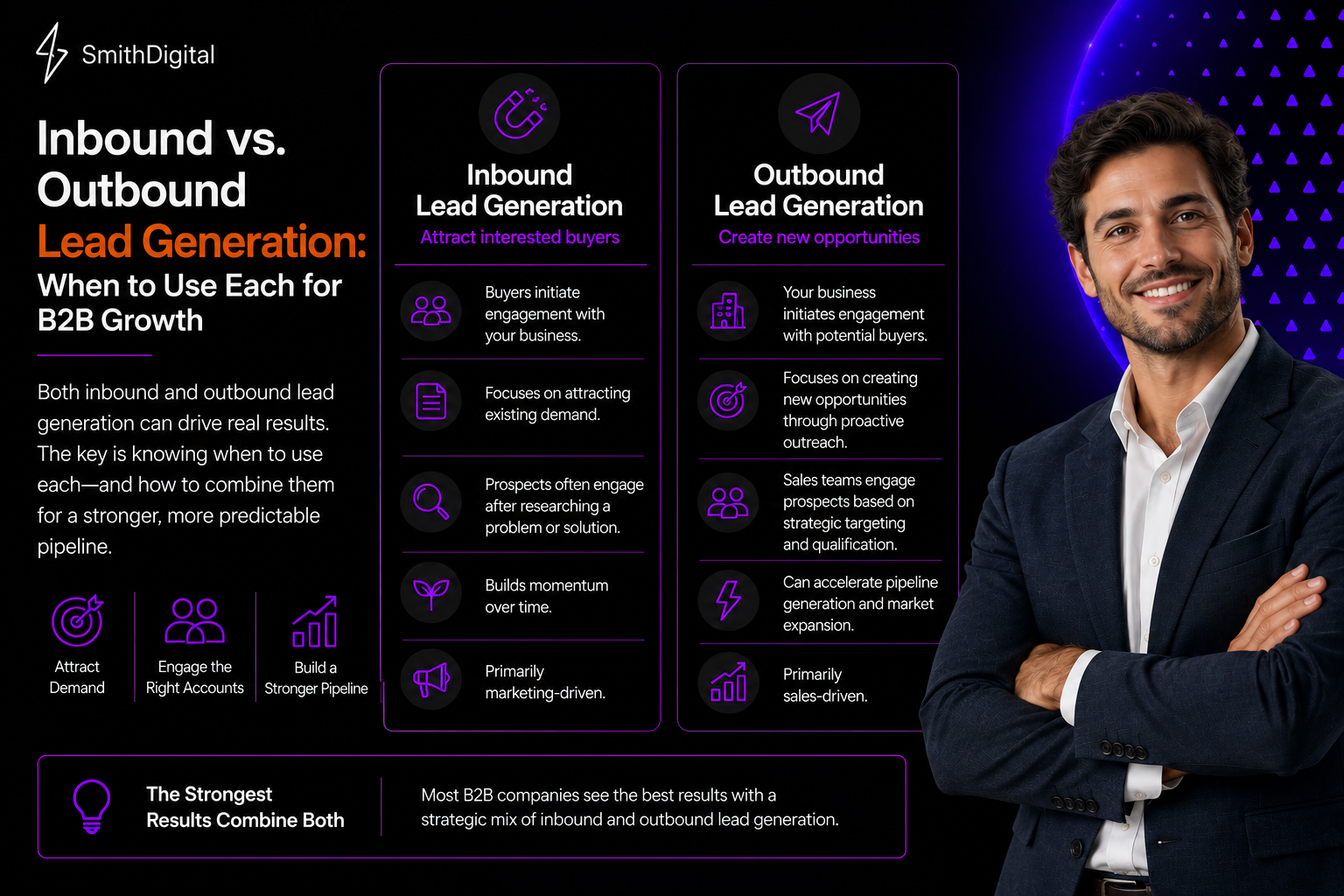
Use inbound lead generation when buyers are actively researching your category and you want to build a durable source of demand. Use outbound lead generation when you need to reach specific accounts, test a market, or create sales conversations more quickly. For many B2B companies, the strongest approach is a deliberate mix of both.
Buyer behavior supports that balance. Gartner reported in June 2025 that 61% of B2B buyers prefer an overall rep-free buying experience, showing how important search, content, websites, and other self-directed research channels have become before a sales conversation begins. That preference for self-directed research does not eliminate the role of sales, particularly when buyers need help evaluating how a solution fits their specific requirements.
That makes the inbound-versus-outbound decision less about choosing one channel and more about understanding what each should do. This guide compares them across cost, speed, scalability, lead quality, and ROI, then explains when to prioritize inbound, outbound, or a coordinated combination based on your sales cycle and growth goals.
Inbound vs Outbound Lead Generation: Key Differences
The main difference between inbound and outbound lead generation is how the conversation starts.
With inbound lead generation, the prospect finds your company through channels such as search, content, paid media, referrals, social media, or AI-assisted research. With outbound lead generation, your sales team identifies a target account and reaches out directly through cold email, cold calling, LinkedIn, or another outbound channel.
That difference affects how each approach performs across speed, targeting, cost structure, scalability, and buyer intent.
For B2B companies, the practical question is rarely whether one approach is universally better. The more useful question is which approach fits the current growth problem.
A company with strong search demand but weak website conversion may need to improve its inbound system before investing in more traffic. A company entering a new market with a defined list of target accounts may get faster feedback from outbound. A business with both visibility and a capable sales team may benefit from connecting the two so inbound engagement helps prioritize outbound follow-up.
That distinction will matter throughout the rest of this comparison because cost, lead quality, ROI, and scalability look very different depending on the role each channel plays.
What is Inbound Lead Generation?
Inbound lead generation is the process of attracting potential buyers by helping them find useful information while they research a problem, solution, or provider.
Rather than beginning with direct sales outreach, inbound puts the company in front of buyers through channels such as search, content, paid media, AI-assisted research, and conversion-focused website experiences. The buyer usually controls when and how the relationship begins. A typical B2B inbound journey may look like this:
The journey is rarely this linear in practice. Buyers may leave and return several times, involve other stakeholders, or encounter the company through multiple channels before speaking with sales. Each interaction can still reveal what the buyer is researching and how their intent is developing.
SmithDigital approaches inbound as part of a broader growth system that connects visibility, content, conversion, HubSpot automation, analytics, and sales follow-up. Within that system, SmithDigital’s Inbound Marketing Services focus on attracting the right buyers, improving conversion paths, and connecting inbound activity to qualified pipeline.
Common Inbound Lead Generation Channels
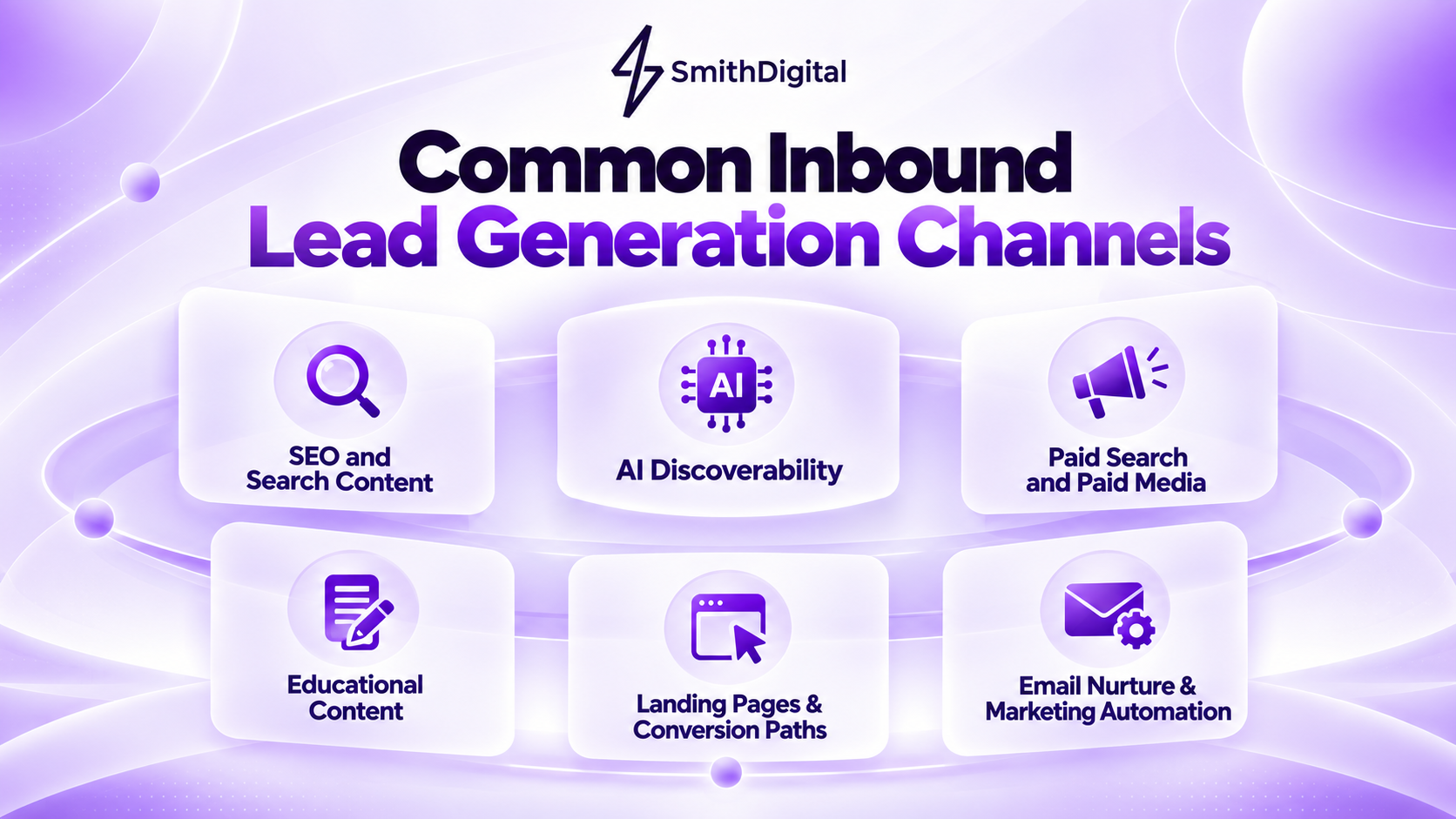
Most B2B inbound programs rely on several channels working together because buyers rarely go from initial discovery to a sales conversation through a single touchpoint. Each channel plays a different role in creating visibility, supporting research, and converting interest into action.
-
SEO and search content help buyers find the company while researching specific problems, services, comparisons, or solutions.
-
AI discoverability extends visibility into platforms such as ChatGPT, Perplexity, Claude, Gemini, and other AI-assisted research experiences. Like SEO, it depends on creating clear, authoritative content that helps buyers and AI platforms understand your expertise.
-
Paid search and paid media can capture demand more quickly, particularly for high-intent commercial searches where waiting for organic visibility may take too long.
-
Educational content such as guides, webinars, articles, case studies, and comparison resources helps buyers answer questions before they are ready to speak with sales.
-
Landing pages and website conversion paths turn interest into identifiable engagement through forms, meeting links, assessments, downloads, and other offers.
-
Email nurture and marketing automation help companies stay relevant when a lead is interested but not yet ready for a sales conversation.
The strongest inbound systems connect these channels around the same audience, messaging, conversion paths, and follow-up process. That makes it easier to turn buyer activity into qualified pipeline rather than treating each channel as a separate campaign.
Read More: 10 Inbound Marketing Examples Behind High-Performing B2B Campaigns in 2026
When Inbound Lead Generation Tends to Work Well
Inbound tends to work well when buyers already research the category before contacting a provider. That is common in ERP consulting, managed IT services, cybersecurity, SaaS, and professional services, where buyers often need to compare options, understand trade-offs, and build internal alignment before speaking with sales.
Inbound is especially useful when education and credibility influence the purchase. A strong article, case study, service page, or comparison resource can attract a buyer through search, support further research, answer questions during the sales process, and continue creating value after publication.
Where Inbound Programs Commonly Break Down
More traffic does not automatically create more pipeline. Inbound tends to underperform when content attracts the wrong audience, conversion points do not reflect buyer intent, or sales receives leads without enough context to follow up effectively. Common breakdown points include:
-
Content attracting people outside the ideal customer profile.
-
Conversion paths that do not match the buyer’s level of intent.
-
Leads entering the CRM without enough behavioral or account context for useful follow-up.
SmithDigital’s inbound methodology connects conversion paths, intent signals, HubSpot lifecycle data, reporting, and sales follow-up so meaningful engagement can be turned into action. Engagement with pages such as pricing, comparison, demo, contact, or case study content can provide additional intent signals and help prioritize accounts for follow-up.
Inbound performs best when visibility, conversion, qualification, and follow-up operate as a connected system.
What is Outbound Lead Generation?
Outbound lead generation is the process of identifying specific companies and decision-makers, then reaching out directly to create sales conversations.
The process starts with targeting. Sales or business development teams define the ideal customer profile, identify relevant accounts, research the right contacts, and then engage them through channels such as cold email, cold calling, LinkedIn, and account-based outreach. That gives outbound teams more control over which accounts enter the prospecting process and which segments receive the most attention.
A typical B2B outbound process looks like this:
SmithDigital approaches outbound as a managed sales development function that combines people, data, technology, and process. Programs may combine SDR and BDR support with buyer intent intelligence, prospect research, multichannel outreach, appointment setting, CRM administration, automation, analytics, and ongoing optimization.
Common Outbound Lead Generation Channels
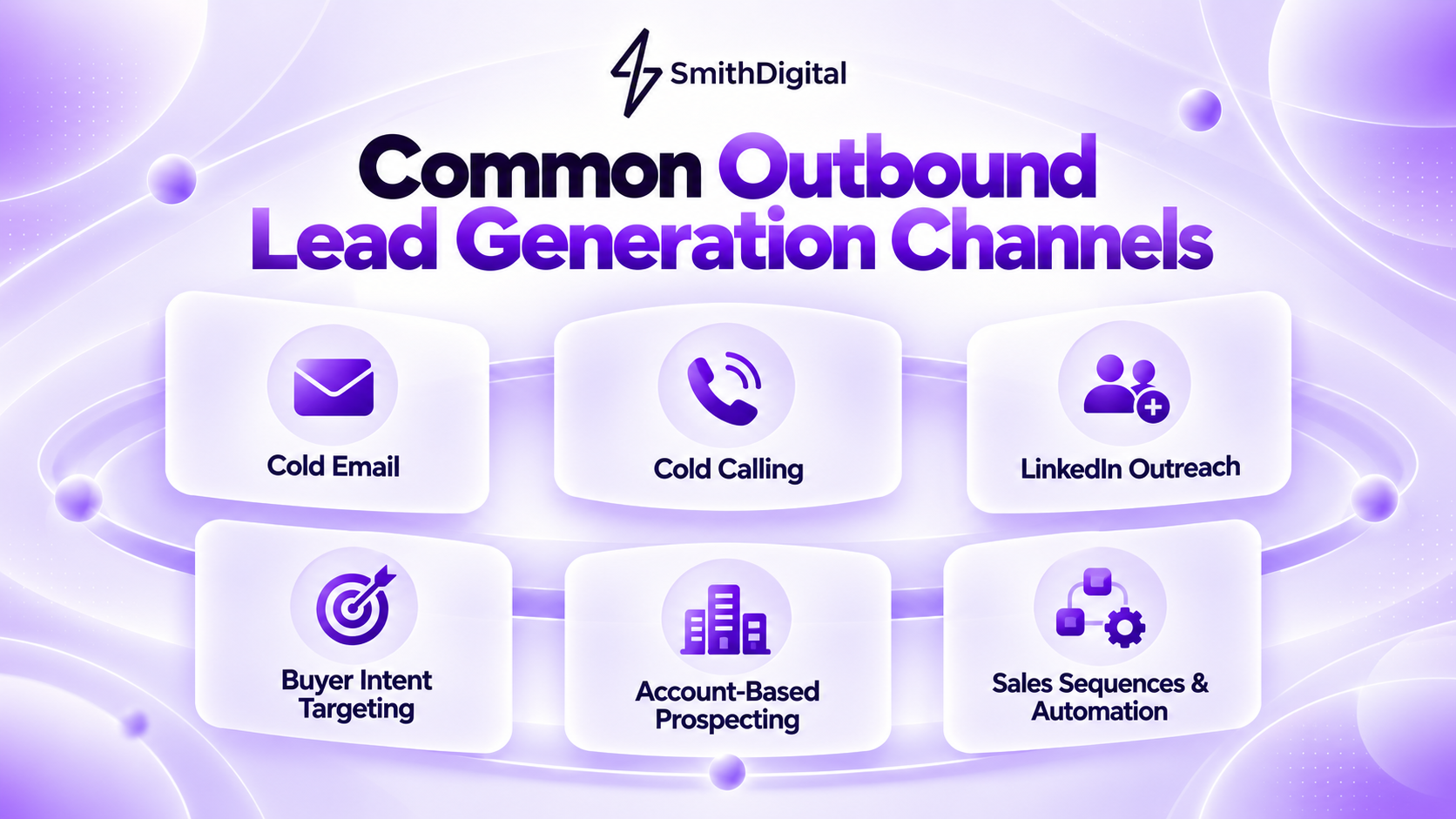
Most B2B outbound programs use several channels because prospects respond differently depending on their role, timing, and preferred method of communication. The goal is to coordinate those touchpoints around the same target-account strategy rather than treat each channel independently.
-
Cold email gives sales teams a scalable way to reach specific prospects with messaging tied to their role, company, or business challenge.
-
Cold calling creates direct conversations and provides immediate feedback on interest, objections, timing, and account fit.
-
LinkedIn outreach supports account research, relationship building, and direct engagement with decision-makers in professional buying environments.
-
Buyer intent targeting helps prioritize companies showing signs of active research or increased interest in relevant topics. When first-party engagement is limited, SmithDigital’s 3rd Party Buyer Intent Data can help identify in-market accounts showing relevant research activity and give sales another signal for prioritizing outreach.
-
Account-based prospecting focuses sales effort on a defined set of high-value companies instead of spreading activity evenly across a large market.
-
Sales sequences and automation help coordinate follow-up across email, phone, and other channels while keeping activity consistent and measurable.
The strongest outbound programs coordinate these channels around the same ICP, messaging, qualification criteria, and CRM process. That makes it easier to understand which accounts are engaging and where sales time should be concentrated.
Read More: 7 Outbound Lead Generation Strategies for Modern B2B Companies
When Outbound Lead Generation Tends to Work Well
Outbound tends to perform well when a company can clearly identify the businesses and decision-makers it wants to reach.
That is often the case in B2B markets with higher deal values, identifiable buying committees, and a defined group of target accounts. ERP consulting firms, SaaS companies, MSPs, technology providers, and professional services firms can often narrow their market by company size, industry, geography, technology environment, or other firmographic criteria.
Outbound can also be useful when entering a new market or testing a new offer. Direct outreach gives the sales team faster feedback on which messages resonate, which objections appear repeatedly, and whether the target segment has a meaningful need.
Where Outbound Programs Commonly Break Down
Outbound usually struggles when activity scales faster than targeting and messaging quality can support. A larger prospect list will not compensate for a poorly defined ICP. More cold email will not fix an offer that lacks relevance. And a high number of booked meetings means little if the prospects do not match the qualification criteria required to become real opportunities.
SmithDigital’s outbound methodology emphasizes ICP development, buyer intent, prospecting infrastructure, sales messaging, CRM execution, and continuous optimization because those elements determine whether outreach turns into qualified pipeline.
Outbound performs best when targeting, messaging, qualification, and follow-up are disciplined enough to convert direct outreach into credible sales opportunities.
How Inbound and Outbound Lead Generation Costs Compare
There is no universal answer because inbound and outbound lead generation have different cost structures. The more useful question is how each strategy uses budget and how efficiently that investment turns into qualified pipeline. A lower cost per lead does not automatically mean a lower cost of acquisition, and a higher monthly spend can still be justified if it produces better-fit opportunities.
Inbound and Outbound Have Different Cost Models
Inbound investment tends to be more asset-focused. Budget often goes toward SEO, content, service pages, case studies, landing pages, paid media, conversion optimization, marketing automation, and analytics. Some of those assets can continue creating value after the initial investment by supporting search visibility, AI-assisted research, paid campaigns, nurture, and sales conversations.
The tradeoff is that inbound usually takes longer to mature. Search visibility, authority, content depth, and reliable conversion paths are built over time.
Outbound investment tends to be more execution-focused. Budget is typically tied to SDR or BDR capacity, prospect data, buyer intent tools, cold email infrastructure, dialing technology, LinkedIn prospecting, CRM support, messaging, and ongoing campaign management. Outbound can reach the market faster, but it also depends more heavily on continued activity.
If outreach slows, the flow of new conversations usually slows with it.
The Same Budget Can Produce Very Different Results
Consider two B2B companies investing the same amount each month.
One puts most of that budget into inbound. Early results may be slower while the company builds search visibility, stronger content, and better conversion paths. Over time, those assets can continue attracting and influencing buyers without requiring a new outreach action for every prospect.
The other puts the same budget into outbound. It may generate more immediate conversations because the team can begin targeting specific accounts right away. Maintaining that pace, however, requires continued investment in people, data, technology, and outreach.
Neither cost model is inherently better. The right fit depends on how quickly pipeline is needed, how much existing demand already exists, and whether the business is optimizing for near-term market coverage or longer-term demand generation.
Cost Per Lead Can Hide the Real Economics
Cost per lead is useful for monitoring campaign efficiency, but it can be misleading when comparing inbound and outbound.
An inbound campaign might generate a large number of inexpensive leads while only a small percentage match the ideal customer profile. An outbound campaign may generate fewer leads at a higher cost, but more of those contacts could turn into real sales opportunities. For that reason, B2B companies should look further down the funnel. A more useful measure is:
Cost Per Qualified Opportunity = Total Channel Investment ÷ Qualified Opportunities Created
From there, leadership can compare pipeline generated, opportunity conversion, customer acquisition cost, average deal value, and closed revenue. If outbound gives the company faster access to a defined market, a higher ongoing operating cost may be justified. If inbound is building assets that continue generating visibility and demand over time, a slower initial return may also make sense.
The right comparison is the cost of creating qualified pipeline, not the cost of producing the cheapest lead.
How Long Inbound and Outbound Lead Generation Take to Work
Outbound can usually begin generating conversations sooner because sales can reach target accounts as soon as the targeting, messaging, data, and outreach process are ready. Inbound usually takes longer to build because visibility, content, and conversion paths need time to gain traction. The more important distinction is what kind of result you are measuring.
Outbound Can Produce Early Market Feedback Faster
Outbound gives sales teams a direct way to test the market.
Once a campaign launches, reps can quickly learn whether prospects respond to the positioning, which objections come up repeatedly, and whether the chosen accounts actually fit the offer. That makes outbound useful when a company is entering a new market, testing a new service, or needs more sales conversations in the near term.
Faster engagement, however, does not necessarily mean faster revenue. A prospect may agree to a meeting within days and still require months to move through discovery, technical evaluation, budgeting, procurement, and internal approval.
Inbound Usually Has a Longer Ramp
Inbound depends more heavily on the company’s existing foundation.
A business starting with limited search visibility, little useful content, and weak conversion paths will usually need more time to generate consistent inbound leads. A company that already has strong search visibility, an established content library, and steady website traffic may see results much sooner.
Paid search can also shorten the ramp by putting the company in front of buyers who are already searching while SEO and content continue developing. Once the inbound foundation becomes productive, new content and existing pages can continue attracting buyer activity without requiring a new outreach action for every prospect.
Pipeline Speed Depends on More Than the Channel
The sales cycle ultimately determines how quickly a lead can progress to closed revenue. A complex B2B purchase involving several decision-makers, technical requirements, budget approval, or procurement will still take time, whether the opportunity started through inbound or outbound. For planning purposes, it helps to separate three timelines:
-
Time to launch: How quickly can the program begin?
-
Time to qualified opportunity: How quickly can it produce sales-ready conversations?
-
Time to revenue: How long does the normal sales process take after an opportunity is created?
That distinction gives leadership a much more realistic way to compare the two approaches. If the immediate priority is reaching the market and generating feedback, outbound usually has the advantage. If the goal is to build a source of demand that becomes more productive over time, inbound requires a longer runway but can create more leverage as the foundation matures.
Read More: 10 Best B2B Lead Generation Services for Long Sales Cycles in 2026
How Inbound and Outbound Lead Generation Scale Differently
A lead generation program can work well at a small scale and still struggle once the company tries to increase volume. The pressure points usually show up in different places depending on whether the motion is inbound or outbound.
For inbound, growth can expose weaknesses in content quality, search authority, conversion paths, and lead relevance. For outbound, the strain tends to appear in rep capacity, data quality, deliverability, segmentation, and follow-up. In both cases, the challenge is maintaining opportunity quality as activity increases.
That makes scalability less about producing more traffic, leads, emails, or calls and more about whether the system can generate additional qualified opportunities without efficiency declining.
For inbound, the common scaling mistake is increasing content production before proving that the topics, audience, and conversion paths are generating qualified demand. More pages can increase traffic without improving pipeline.
For outbound, the equivalent mistake is increasing send volume, calls, or account coverage before the ICP, messaging, and qualification process are working consistently. That can increase activity while meeting quality declines.
The practical test is whether additional investment produces more qualified opportunities without causing efficiency or lead quality to deteriorate. That is a better definition of scale than simply producing more traffic, leads, emails, or calls.
Read More: Should You Outsource Sales Development? A Buyer's Guide for B2B Companies
Lead Quality and ROI: Which Approach Produces Better Opportunities?
Lead quality is where the inbound versus outbound comparison becomes more nuanced. Inbound often provides stronger evidence of intent because the buyer has already taken an action, while outbound gives you more control over account fit because you decide which companies and decision-makers to pursue.
Neither channel has an automatic advantage. A high-intent inbound lead can still fall outside the ideal customer profile, while an outbound prospect can be a strong fit but have little urgency. The best opportunities usually appear where account fit and buyer intent overlap.
Inbound Gives You More Intent Data
Inbound leads often arrive with useful context. A buyer may have searched for a specific problem, visited a service page, read a case study, returned to the website several times, or engaged with other high-intent content before converting.
That activity can help sales and marketing judge how far the buyer may be into their research. Repeated visits to service, comparison, or case study pages can provide stronger intent signals than a single engagement with a broad educational resource.
Intent still needs to be qualified against account fit. Strong engagement from a company outside the target market may be less valuable than moderate engagement from an account that closely matches the ICP.
Outbound Gives You More Control Over Fit
Outbound starts with account selection, which gives the sales team more control over who enters the funnel. Prospects can be prioritized by factors such as industry, company size, geography, job role, technology environment, or other qualification criteria. That makes outbound particularly useful when the business has a clearly defined market and knows which accounts are most worth pursuing.
The tradeoff is timing. A company can be an excellent fit and still have no immediate need. Outreach therefore has to establish whether there is a real business problem, sufficient urgency, and a reason for the conversation to move forward.
ROI Should Be Measured Further Down the Funnel
Lead volume and booked meetings are useful operating metrics, but they do not show which channel is creating more commercial value.
An inbound program may generate a large number of leads while producing relatively few qualified opportunities. An outbound campaign may generate fewer leads but produce a higher share of target accounts. The reverse can also be true when inbound traffic is tightly aligned to high-intent buyer searches. A stronger comparison looks at:
-
Qualified opportunities created
-
Pipeline generated
-
Opportunity-to-customer conversion
-
Customer acquisition cost
-
Average deal value
-
Closed revenue
The practical question is:
Which channel produces the strongest qualified pipeline relative to the investment required?
That gives leadership a more useful basis for deciding where to allocate additional budget and whether inbound, outbound, or a coordinated mix is producing the better return.
Read More: BDR Lead Qualification: How to Turn MQLs into Sales-Ready Opportunities
How to Build the Right Inbound and Outbound Mix
The right lead generation mix usually depends on where the pipeline is underperforming.
If a company has strong search visibility but weak conversion, adding more outbound activity may not solve the underlying problem. If the target market is narrow and well-defined but the company has little organic visibility, waiting for inbound demand to develop may leave too much of the market untouched. The better approach is to decide what job each channel needs to do.
Lean More Heavily on Inbound When Buyers Are Already Researching
Inbound deserves more investment when buyers actively search for the problems, services, or solutions you sell.
That is especially relevant in complex B2B categories where prospects compare providers, review case studies, evaluate expertise, and involve multiple stakeholders before speaking with sales. In those environments, SEO, AI discoverability, educational content, service pages, and conversion-focused website experiences can support buyers throughout the research process.
Inbound should usually carry more weight when the business already has meaningful demand to capture, needs stronger visibility, or receives website traffic that is not converting effectively.
Lean More Heavily on Outbound When the Market Is Clearly Defined
Outbound becomes more valuable when you know exactly which companies and decision-makers you want to reach. A specialized technology provider, ERP consultancy, MSP, or professional services firm may have a finite group of accounts that closely match the ICP. Direct prospecting gives the sales team a way to cover that market without waiting for every buyer to discover the company organically.
Outbound is also useful when entering a new vertical, testing a new offer, or generating conversations while inbound visibility is still developing. Those conversations can reveal recurring objections, buying triggers, and language that marketing can use to improve future content and positioning.
Use Both When the Sales Cycle Requires Visibility and Direct Engagement
Many B2B companies eventually need both. Inbound can create visibility, support buyer research, and produce intent signals. Outbound gives sales a way to act on those signals and engage high-value accounts directly. A practical flow might look like this:
Create visibility → capture intent → prioritize accounts → activate sales → measure pipeline
For example, a prospect may first discover the company through search, return later to review a case study or service page, and then become a higher-priority account for sales outreach. The outbound motion benefits from the context created by inbound, while the inbound program benefits from what sales learns in direct conversations.
This is also where HubSpot and Revenue Operations become critical for connecting lifecycle data, account activity, intent signals, sales follow-up, and pipeline reporting. That shared view helps sales and marketing operate as part of the same growth system instead of managing two separate funnels.
Match the Mix to the Constraint
A useful way to decide where to invest next is to identify the current bottleneck:
-
Not enough visibility? Strengthen inbound.
-
Not enough target-account coverage? Increase outbound.
-
Plenty of traffic but weak pipeline? Improve conversion and qualification.
-
Good engagement but limited follow-up? Activate outbound around intent.
-
Too dependent on constant prospecting? Build a stronger inbound foundation.
-
Inbound and outbound operating separately? Connect them through shared targeting, CRM data, and pipeline reporting.
This integrated approach is central to SmithDigital’s growth model, which combines inbound visibility, buyer intent, HubSpot, conversion optimization, and outbound sales development within the same pipeline system.
For B2B companies looking to strengthen the marketing side of that system, SmithDigital’s Demand Generation Services bring together SEO, content, conversion optimization, HubSpot automation, and campaign strategy to create a more coordinated path from visibility to qualified pipeline.
Read More: Why Aligning Sales & Marketing BDR Teams Boosts Pipeline Growth
Build the Lead Generation Mix Around Your Pipeline Goals
Inbound and outbound lead generation solve different problems, so the right choice depends on what your business needs most right now.
If buyers are actively researching your category and you need a stronger source of long-term demand, inbound deserves more attention. If your market is clearly defined and you need faster access to specific accounts, outbound can create conversations sooner. For many B2B companies, the strongest approach is a coordinated mix that connects visibility, buyer intent, sales outreach, and CRM data around the same pipeline goals.
The decision should ultimately come back to qualified opportunities. Look at where your current system is underperforming, which channel can address that constraint, and whether the investment is producing pipeline at a cost the business can sustain.
SmithDigital helps B2B companies connect inbound marketing, outbound sales development, buyer intent, HubSpot, and conversion strategy into a more coordinated growth system. If your current lead generation efforts are producing activity without enough qualified pipeline, talk to a Growth Strategist to identify the constraint, determine where the strongest opportunity sits, and build the right mix of inbound and outbound around your sales cycle.
Read Next: 10 Proven B2B Lead Generation Strategies to Generate More Qualified Leads and Pipeline
Frequently Asked Questions
What is the difference between inbound and outbound lead generation in B2B?
The main difference between inbound and outbound lead generation is who initiates the relationship. Inbound strategies attract leads through search engines, valuable content, paid media, referrals, and other channels buyers use during research. Outbound strategies put the sales team in front of potential customers directly through cold outreach, LinkedIn, phone calls, and other outbound tactics.
For B2B lead generation, both approaches can work. The better choice depends on how buyers research, how clearly you can identify target accounts, and how quickly the business needs pipeline.
Should a B2B company use inbound or outbound lead generation first?
Start with the channel that addresses the clearest pipeline constraint. If buyers already search for your category but your company has limited visibility, inbound content, SEO, and conversion optimization may deserve priority. If you have a well-defined market and need to generate leads from specific accounts sooner, outbound approaches may make more sense initially.
Many B2B companies eventually use both, but the investment mix should reflect current demand, sales capacity, and growth goals.
How does lead qualification differ for inbound and outbound leads?
Inbound lead qualification usually starts with buyer behavior and account fit. Marketing and sales teams may look at lead capture source, pages viewed, repeat visits, content engagement, company profile, and other intent signals. Lead scoring can help prioritize warmer leads, but it should not replace actual qualification.
Outbound lead qualification starts with a targeted account and then confirms whether there is a real need, relevant stakeholder, appropriate timing, and credible opportunity. In both cases, the goal is to identify qualified leads that have a realistic path to pipeline.
How can sales and marketing teams combine inbound and outbound strategies?
Combining inbound and outbound works best when both teams share the same ICP, CRM data, qualification criteria, and pipeline goals. Inbound efforts can attract leads and reveal which accounts are researching relevant topics, while outbound efforts give sales a direct way to engage those accounts.
Outbound conversations can also improve inbound content by revealing recurring objections, questions, and buying triggers. That creates a feedback loop where marketing strategies support prospecting and sales insights improve future demand generation.
Which lead generation strategies are best for pipeline generation?
The strongest lead generation strategies depend on the market and sales model. Search-focused inbound strategies work well when buyers actively research the category, while outbound channels are useful when the sales team can clearly identify the companies it wants to reach.
For many complex B2B sales cycles, the most effective approach combines inbound and outbound efforts around a shared pipeline goal. The focus should stay on qualified opportunities and revenue contribution rather than raw lead gen volume.