
<img src="https://secure.seat6worn.com/219576.png" style="display:none;">

14 min read

What Is a BDR? How Business Development Representatives Accelerate Sales & ROI

“Why does pipeline break down even when marketing is generating leads and sales is actively working them?”

In many B2B organizations, the issue isn’t effort. It’s structure. Teams invest in driving traffic, capturing leads, and running outreach, yet conversion from initial interest to qualified opportunity remains inconsistent. Some high-intent prospects never get engaged. Others enter the funnel but aren’t properly qualified before reaching sales.

A big reason for this is unclear ownership within the sales development process. Who is responsible for outbound prospecting? Who owns inbound lead follow-up? What qualifies as a sales-ready opportunity? When these roles are not clearly defined, teams default to activity instead of execution, and pipeline quality suffers.

This is where the distinction between Business Development Representatives (BDRs) and Sales Development Representatives (SDRs) becomes critical.

This post breaks down how each role contributes to pipeline creation, where their responsibilities differ, and how to determine which structure best supports your sales process.P.S. Before you invest in more outbound activity or add headcount, it helps to know whether your account targeting, follow-up process, and handoff standards are strong enough to support qualified pipeline creation. At Smith Digital, we help B2B teams improve outbound execution through focused business development representative services.

Book a strategy session to improve BDR execution and reduce wasted pipeline effort.

Quick Takeaways

What to Evaluate

What Actually Matters

BDR role definition

A business development representative helps generate new business opportunities through prospect research, outbound sales outreach, qualification, and a clean handoff to an account executive.

BDR vs SDR scope

BDRs usually focus on outbound prospecting and new account creation, while SDRs usually qualify inbound leads already generated by marketing.

Qualification standard

A meeting should not be passed until the record shows company fit, contact role, pain point, urgency, and a clear reason the prospect agreed to meet.

Tool stack

Prospecting tools like ZoomInfo, intent data, CRM workflows, and sequencing platforms matter only if they improve targeting, timing, and handoff quality.

Performance review

Sales calls and emails alone are weak indicators. Review reply quality, meeting acceptance, no-show rates, sales acceptance, and downstream pipeline contribution.

Hiring decision

In-house makes sense when you can recruit, train, manage, and equip the role well. Outsourcing can help prototype the motion faster with less overhead.

Failure warning signs

Weak BDR programs usually show up as poor ICP targeting, shallow CRM notes, low-context meetings, and inconsistent follow-up.


What is a BDR? How Business Development Representatives Drive Growth

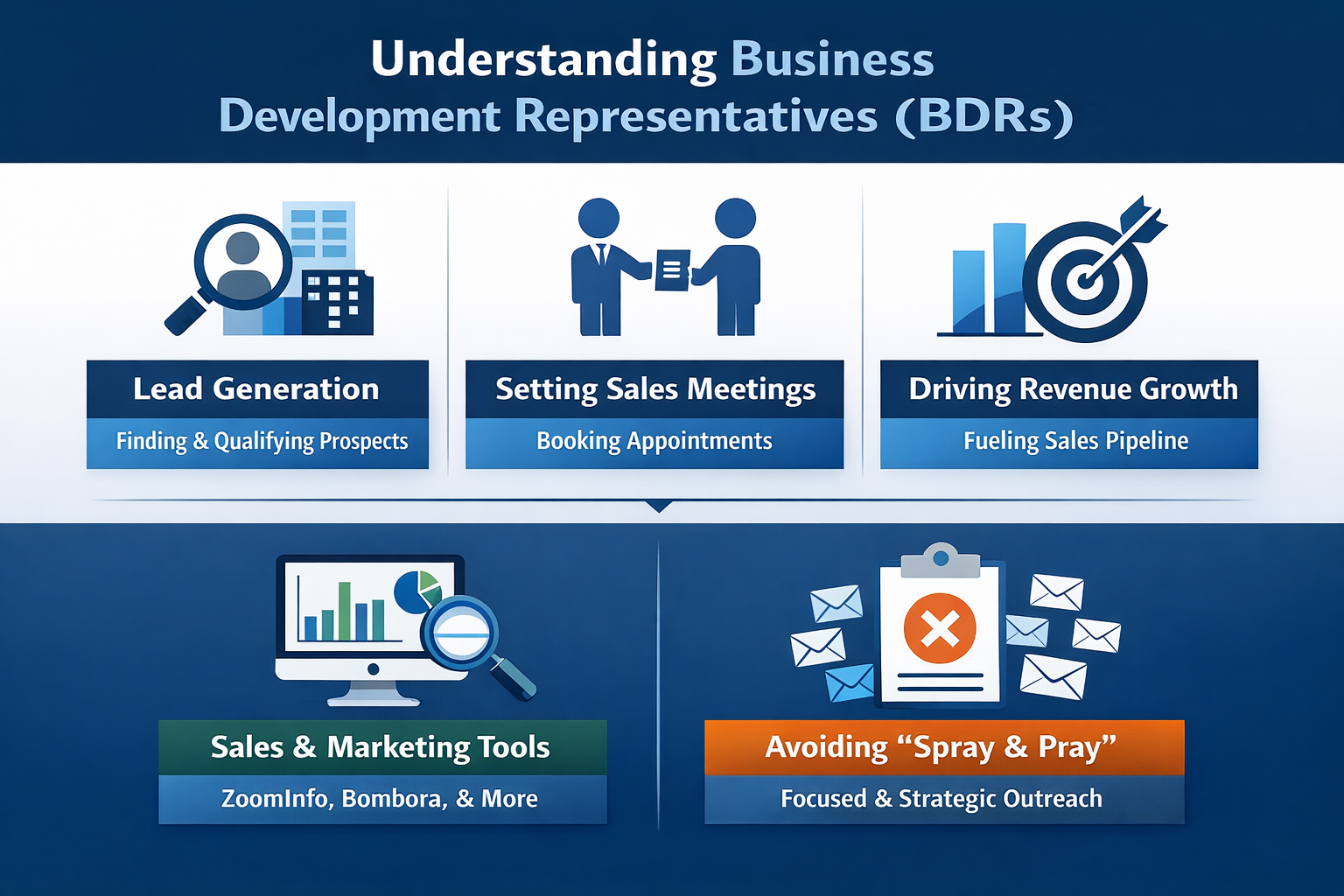
Business Development Representatives (BDRs) are sales professionals focused on generating new leads for their company's sales team. They are responsible for identifying and researching potential prospects and ultimately securing meetings for your Sales Account Executives.

BDRs work closely with Sales Managers and Account Executives to ensure their activities align with the company's overall sales strategy. While some BDRs are entry-level roles, others require several years of experience, especially in industries where sales cycles are long and products or services are highly complex.

Regardless of experience level, all BDRs must be excellent communicators and have a strong understanding of the sales process. They play a vital role in the success of any organization that relies on sales to generate revenue. In fact, studies show that companies using dedicated sales development teams generate 208% more pipeline revenue compared to those without one.

Understanding BDRs

At their best, BDRs can identify the right prospect, engage the right contacts, and reach out at the right time. However, to do this consistently, they require a solid digital marketing program and a significant investment in modern sales and marketing tools.

For example, a BDR leveraging buyer intent data from providers like Bombora or sales intelligence tools such as ZoomInfo can prioritize outreach to high-intent leads, ensuring their messaging is timely and compelling. This proactive approach can significantly improve conversion rates and generate additional sales opportunities.

At their worst, BDRs are handed a list of companies and contacts with little strategy or insight, relying on sheer volume and luck to generate meetings. This outdated "spray and pray" approach generally does not yield the type of consistent results sales leaders expect, which is why many turn to structured BDR programs like those offered by SmithDigital.

BDR Use Case: Turning Data into Sales Opportunities

The BDR use case we're about to describe is not easy to pull off, nor is it cheap. But if you sell large, complex products or services, keep reading to see how you can build or leverage a team like SmithDigital to execute this strategy successfully.

This starts with having two critical components in place:

  1. Real-time intent data

  2. Solid web traffic with bottom-of-the-funnel visitors

Say, for example, you are a sales or marketing leader for a SaaS ERP software company that sells software and professional services. Your typical sale ranges from $50K to $250K, with a sales cycle of 3-6 months.

Since ERP selection is a high-consideration process, buyers conduct extensive research before engaging with vendors. Most prospects will:

  • Look up customer reviews on G2 Crowd and other software comparison sites.

  • Visit product and pricing pages, download brochures and whitepapers.

  • Read reports from industry analysts (e.g., Gartner) to compare ERP solutions.

A smart BDR, armed with the right tools and data, can follow the digital breadcrumbs left behind by potential buyers. Instead of passively waiting for a prospect to fill out a form, engage in chat, or make an inbound phone call, a BDR can take a proactive approach, engaging prospects with helpful and timely information that aids the buying process and influences the sales cycle.

This is the type of value a BDR can bring to the table.

What is the Role of a Business Development Representative in a B2B Sales Process

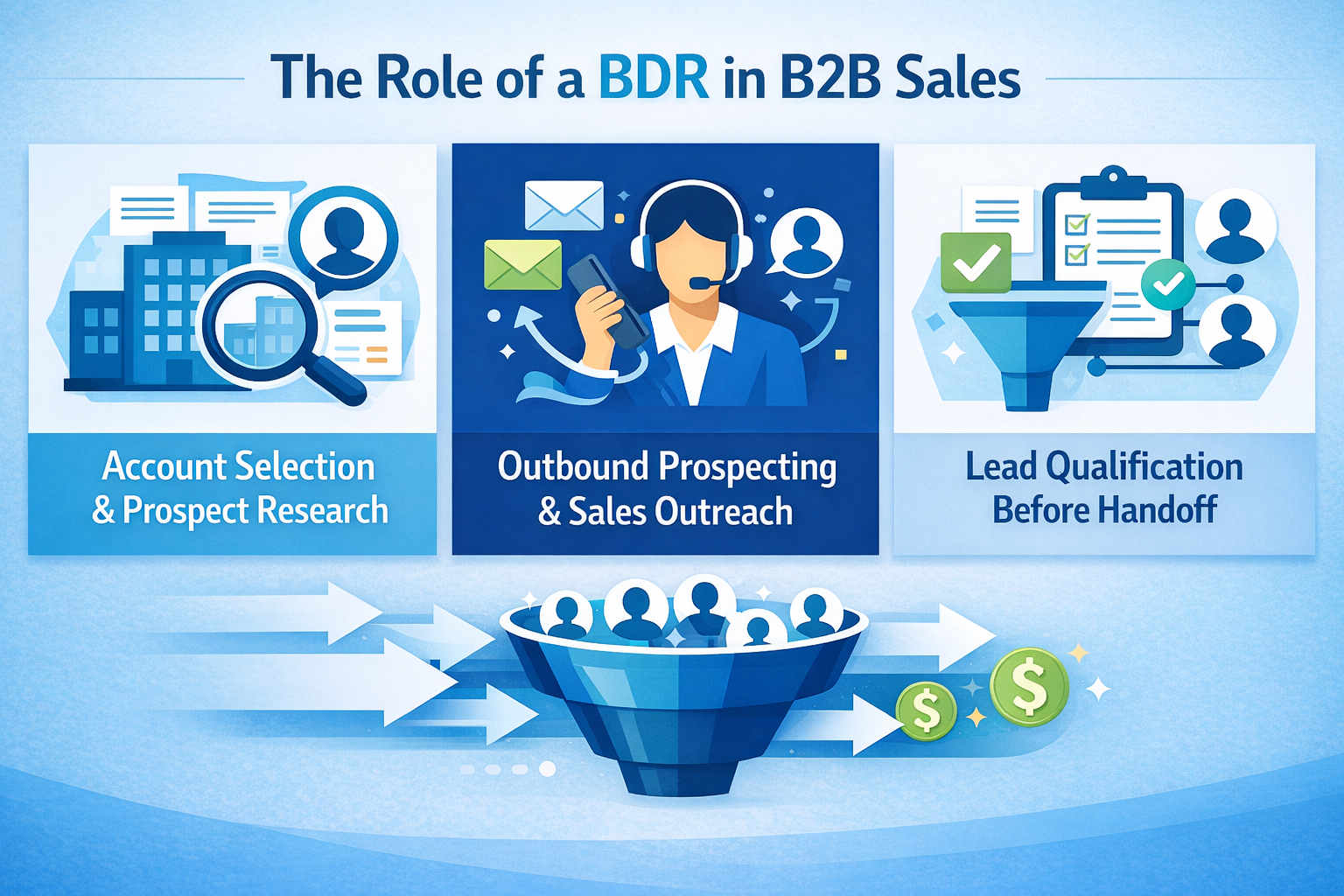
A business development representative creates new business opportunities by turning account research, outbound prospecting, and early qualification into meetings that the sales team can act on. The work usually starts well before a prospect fills out a form or requests a demo. In many B2B sales environments, the BDR role is responsible for identifying which accounts fit, which contacts matter, and when outreach has the best chance of producing a useful conversation. That work sits at the front of the sales funnel and directly affects lead quality, handoff quality, and pipeline efficiency.

The Role of a BDR in B2B Sales

Account Selection and Prospect Research

Strong prospecting starts with account selection. If a rep is working from weak targeting criteria, the outreach volume may look healthy while the actual sales pipeline stays thin. The BDR should know what the ideal customer looks like, which accounts are worth pursuing first, and what signs suggest real timing.

  • Ideal Customer Profile Fit: Use criteria such as industry, company size, service model, geography, technology environment, and deal size so the rep is not spending time on poor-fit accounts.

  • Contact Mapping: Identify potential clients most likely to influence the buying decision instead of relying on a single job title match.

  • Buying Signals: Prioritize companies showing intent through research behavior, product-page engagement, category interest, recent hiring, or other signs of movement.

  • Account Prioritization: Separate high-fit target accounts from lower-priority lists so the rep focuses effort where new business opportunities are most likely to develop.

  • Research Quality: Before outreach begins, the rep should know what the company does, why it may care, and which message angle has the best chance of landing.

At this stage, poor targeting usually leads to low reply quality, weaker qualification, and unnecessary sequence volume.

Read Next: Signal-Based Prospecting Sounds New—It’s Actually Been Table Stakes for Years

Outbound Prospecting and Sales Outreach

Outbound sales process discipline matters because most prospects do not respond to the first touch. The role is not just to send emails or make cold calling attempts. The role is to build enough informed, repeated contact to earn a response from accounts that fit your market.

  • Sequence Logic: Use a structured sequence across emails or call over a defined period so follow-up does not stop after one or two touches.

  • Message Relevance: Tie the outreach to an account problem, market pressure, buying trigger, or observed activity instead of generic prospecting language.

  • Channel Coordination: Use each channel for a different purpose, with email providing context, calls creating direct contact, and LinkedIn supporting visibility and social selling.

  • Response Handling: Once a contact replies, the rep should shift quickly from outreach mode to qualification mode so potential sales momentum is not lost.

  • Follow-Up Discipline: A rep who starts strong and disappears after the first few touches will leave a large share of potential business untouched.

This is often where the difference between activity and effective sales development becomes obvious. A rep may complete tasks, but an experienced BDR runs a repeatable outbound prospecting process that gives qualified accounts multiple chances to engage.

Need a consistent pipeline without hiring in-house?


Lead Qualification Before Handoff

A BDR should qualify leads well enough that the next conversation starts with real context. That usually means confirming that the account fits, the contact matters, and there is a practical reason for the meeting to happen now. The rep does not need to run a full discovery process or manage the entire sales cycle, but they do need to protect account executives from low-context meetings that are unlikely to progress.

In practice, lead qualification often comes down to a few specific questions. Does the account match the ideal customer profile? Is the contact involved in the evaluation or buying process? What problem is the buyer trying to solve? Why are they willing to take the meeting now instead of later? What expectation have they set for the conversation? If those points are missing, the handoff is usually weak even if the calendar is full.

One of the easiest ways to damage sales performance is to reward booked meetings without reviewing whether those meetings were actually qualified. That creates the appearance of output while pushing cleanup work downstream.

Read Next: BDR Lead Qualification: How to Turn MQLs into Sales-Ready Opportunities

What a BDR Should Document in the CRM

CRM quality shapes whether a booked meeting becomes a useful opportunity or a frustrating reset. If a rep passes a meeting without enough context in the CRM, the account executive has to restart the conversation and re-qualify basic facts. That weakens handoff quality and makes pipeline reporting harder to trust.

  • Contact Role: Record whether the person is the decision-maker, recommender, evaluator, budget owner, etc. 

  • Pain Point: Capture the specific issue discussed, such as low lead conversion, weak follow-up coverage, missed pipeline targets, or stalled new business creation.

  • Trigger Event: Note what created urgency, whether that was growth pressure, recent engagement, a system change, an internal initiative, or an outside market factor.

  • Qualification Notes: Record fit, timing, current process, and anything that affects whether the meeting belongs in the active sales pipeline.

  • Objections: Include pricing concerns, timing objections, internal ownership issues, or uncertainty about next steps, so the sales representative is not walking in blind.

  • Agreed Next Step: State what the prospect agreed to do and what the account executive should expect from the meeting.

  • Source History: Keep the activity path visible so the team can see whether the conversation came through outbound, inbound, intent data, or other engagement.

Clean CRM habits also make it easier for sales managers to review qualification patterns, disqualification reasons, and handoff consistency across reps.

Read Next: 4 Ways Outsourced BDRs Improve Your Database Hygiene

Where the BDR Role Stops, and Sales Ownership Begins

The BDR role is focused on creating qualified entry points into the funnel. The account executive or sales rep owns the later stages of the process, including deeper discovery, opportunity strategy, proposal work, objection management, and closing deals. That separation is important because it keeps prospecting, qualification, and pipeline creation from getting buried under full-cycle sales responsibilities.

When the role boundary is too loose, one of two things usually happens. Either the BDR starts passing weak meetings just to maintain activity volume, or the rep gets pulled too far into later-stage selling and stops creating enough new business opportunities at the top of the funnel. A strong sales structure depends on keeping those responsibilities clear.

What is a Sales Development Representative (SDR) and How Do They Differ?

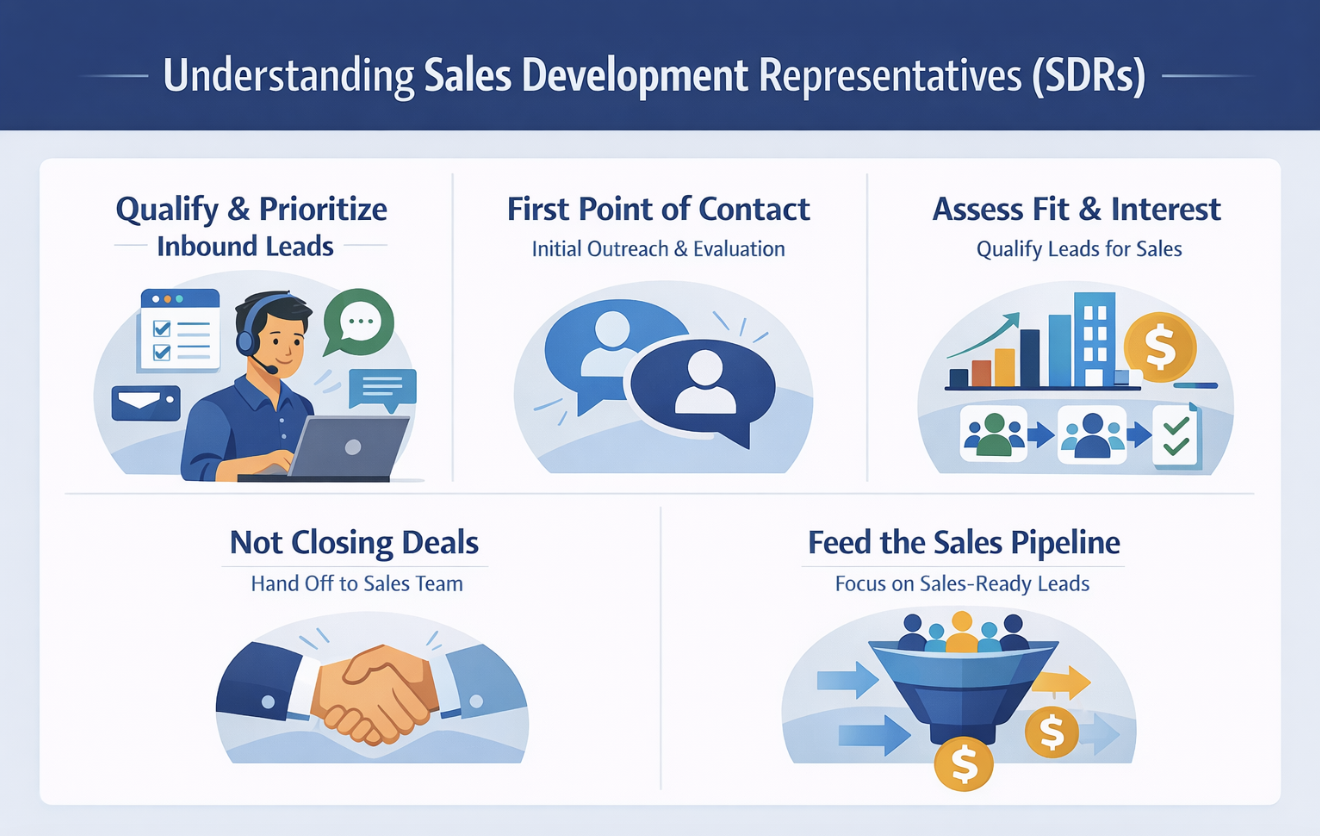
A Sales Development Representative (SDR) works on qualifying and prioritizing inbound marketing leads—these are leads that have already expressed interest in your products or services by filling out a form, engaging in chat, or downloading a resource from your website.

SDRs serve as the first point of contact for prospects who have engaged with your brand. Their primary goal is to assess whether an inbound lead is a good fit for your business by evaluating key factors such as company size, industry, budget, and level of interest.

Neither a BDR nor an SDR is responsible for running sales cycles and closing deals. That’s the role of a Sales Rep or Account Executive. Instead, BDRs and SDRs focus on feeding high-quality leads into the sales pipeline.

SDRs play a critical role in ensuring that sales teams spend their time on the right prospects. By identifying sales-ready leads and filtering out those that are not yet qualified, SDRs help shorten the sales cycle and improve conversion rates.


SDR Use Case: Converting Inbound Leads into Sales-Ready Prospects

Let’s assume you're an ERP reseller (VAR) generating several lead conversions per month from various marketing offers such as:

  • Pricing requests

  • Software demos

  • Free software trials

  • Competitive whitepapers

While you're seeing high engagement, you're struggling to turn these leads into sales opportunities. Many prospects don't return calls or emails, and they miss scheduled meetings.

Adding an SDR to your marketing-to-sales handoff process can help prioritize leads based on their level of urgency, activity type, and engagement. By maintaining consistent touchpoints, an SDR ensures that prospects who engaged with your marketing efforts stay top-of-mind and convert at a higher rate.

One of the biggest challenges in this situation is getting uninterrupted time from busy decision-makers. It’s not that they don’t need your solution. It’s just that they have limited time.

A persistent SDR with a multi-touch approach over a defined period can help close the gap between lead conversions and sales opportunity creation. With 80% of sales requiring five or more follow-ups, but 44% of reps giving up after just one, an SDR ensures your company stays engaged with potential buyers (Invesp).

Differences Between BDR vs SDR vs Account Executive in Practice

These roles work best when each one has a clear job inside the sales organization. A BDR usually handles outbound prospecting and new business creation. An SDR usually handles inbound qualification. An account executive runs the sales cycle after a qualified handoff. Keeping those boundaries visible helps prevent duplicate work, missed follow-up, and low-quality meeting creation.

Role

Primary Focus

Typical Lead Source

Main Responsibility

Handoff Point

What Goes Wrong If Unclear

BDR

Outbound sales and new business opportunities

Prospect lists, intent signals, target accounts, outbound research

Identify prospects, run sales outreach, qualify early fit, and book meetings

Passes qualified meeting to sales rep or account executive

Reps chase low-fit accounts, book weak meetings, or drift into unstructured prospecting

SDR

Inbound lead qualification and prioritization

Demo requests, content downloads, chat, trial signups, inbound forms

Respond quickly, qualify inbound interest, prioritize urgency, and route sales-ready leads

Passes qualified inbound opportunity to sales rep or account executive

Inbound leads sit untouched, routing slows down, and high-intent buyers lose momentum

Account Executive

Opportunity development and deal progression

Qualified meetings from BDRs, SDRs, partners, or direct engagement

Run discovery, manage the sales cycle, build solution fit, and close deals

Owns the deal after a qualified handoff

Early-stage reps end up doing discovery badly, or closers inherit low-context meetings


Read Next: What’s the Difference Between a BDR and an SDR?

How to Know Whether Your Business Needs BDRs, SDRs, or Both

The right role mix depends on where your opportunities originate and where the sales funnel is breaking down. Some teams need help creating new business opportunities from outbound prospecting. Others already have inbound attention but lack the follow-up speed and qualification discipline to convert it. In more complex sales environments, both roles may be necessary because outbound and inbound solve different pipeline problems.

When Hiring a Dedicated BDR Makes Sense

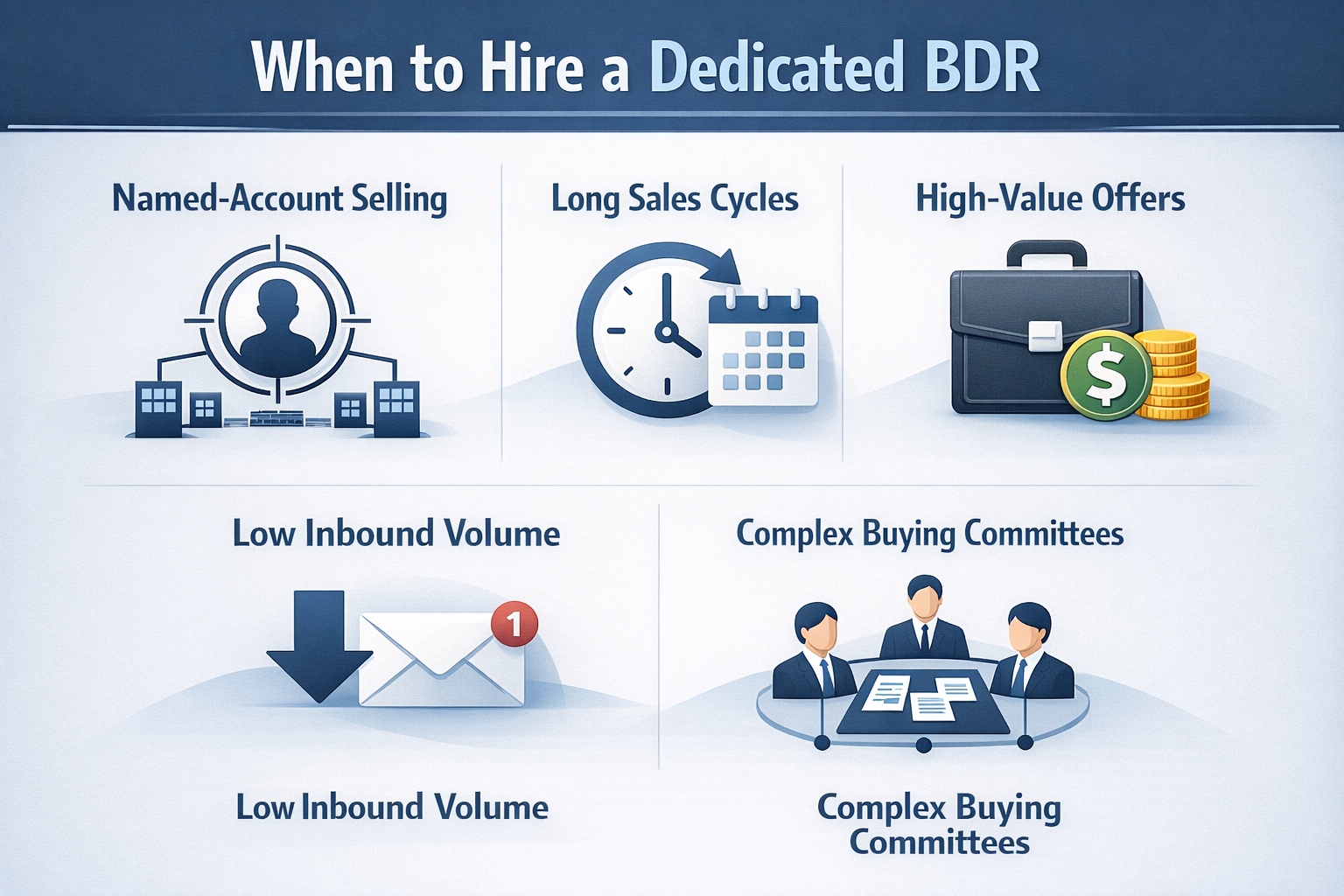
A dedicated BDR is often the right move when outbound sales play a direct role in revenue creation. This usually applies when the company sells into defined accounts, works longer sales cycles, or needs to create conversations before a prospect ever fills out a form.

When Hiring a Dedicated BDR Makes Sense

  • Named-Account Selling: A BDR helps when the sales team needs to target a specific market, list, or account segment rather than waiting for inbound demand.

  • Long Sales Cycles: Early access to buying signals matters more when the path from first conversation to closing deals takes months.

  • High-Value Offers: More expensive solutions can justify deeper account research, tighter qualification, and more persistent follow-up.

  • Low Inbound Volume: If inbound leads are inconsistent, a BDR role helps create a pipeline without waiting for the market to come to you.

  • Complex Buying Committees: A rep can identify prospects across multiple roles and help sales reps enter the account with better context.

When an SDR Solves the Bigger Problem

An SDR motion usually makes more sense when marketing teams are already generating inbound leads, but the company is not qualifying and routing them well. The problem in that case is not top-of-funnel demand. It is a follow-up execution.

  • Demo and Pricing Requests: High-intent inbound leads need a fast response and clear qualification before they cool off.

  • Offer-Driven Lead Flow: If content, trials, or forms are already generating conversions, the bigger issue may be how those leads are prioritized.

  • Sales Rep Capacity: Full-cycle sales reps often cannot respond to every inbound lead fast enough while managing active deals.

  • Lead Quality Spread: Some inbound leads are ready now, while others need lead nurturing, disqualification, or more context before handoff.

  • Routing Gaps: Weak ownership rules, lifecycle stages, or lead status definitions can slow the entire inbound process.

Read Next: 

When to Combine BDR and SDR Coverage

A company may need both a business development representative and a sales rep when inbound leads exist, but they are not enough on their own to support pipeline targets. In that model, SDRs protect inbound conversion and qualification speed, while BDRs create outbound access to high-value accounts that have not yet raised their hand.

This structure works better when the roles are documented clearly. Marketing should know what qualifies as an inbound lead worth fast follow-up. SDRs should know the response standard, routing rules, and qualification threshold. BDRs should know which accounts to pursue, what outreach process to run, and what counts as a valid meeting. Account executives should know what information they will receive at handoff and what qualifies as sales-ready.

Hiring a BDR/SDR Team: In-House vs. Outsourcing – What’s Best for You?

More and more businesses are considering outsourcing their BDR and SDR functions. While these roles are crucial, they can be expensive to keep in-house. Before deciding, consider:

  1. What is the cost of hiring a BDR/SDR team?

  2. How essential is the BDR/SDR function to your business growth?

  3. Do you have the internal resources to support and train a BDR/SDR team?

  4. Are you willing to invest in the right sales intelligence tools?

Before committing to full-time hires, many companies prototype their BDR/SDR strategy through outsourcing. This allows them to test the impact of a structured sales development process without the long-term overhead of hiring, training, and managing full-time employees.

Whether you hire internally or outsource, having strong marketing and sales alignment is key to making your BDR/SDR investment worthwhile.

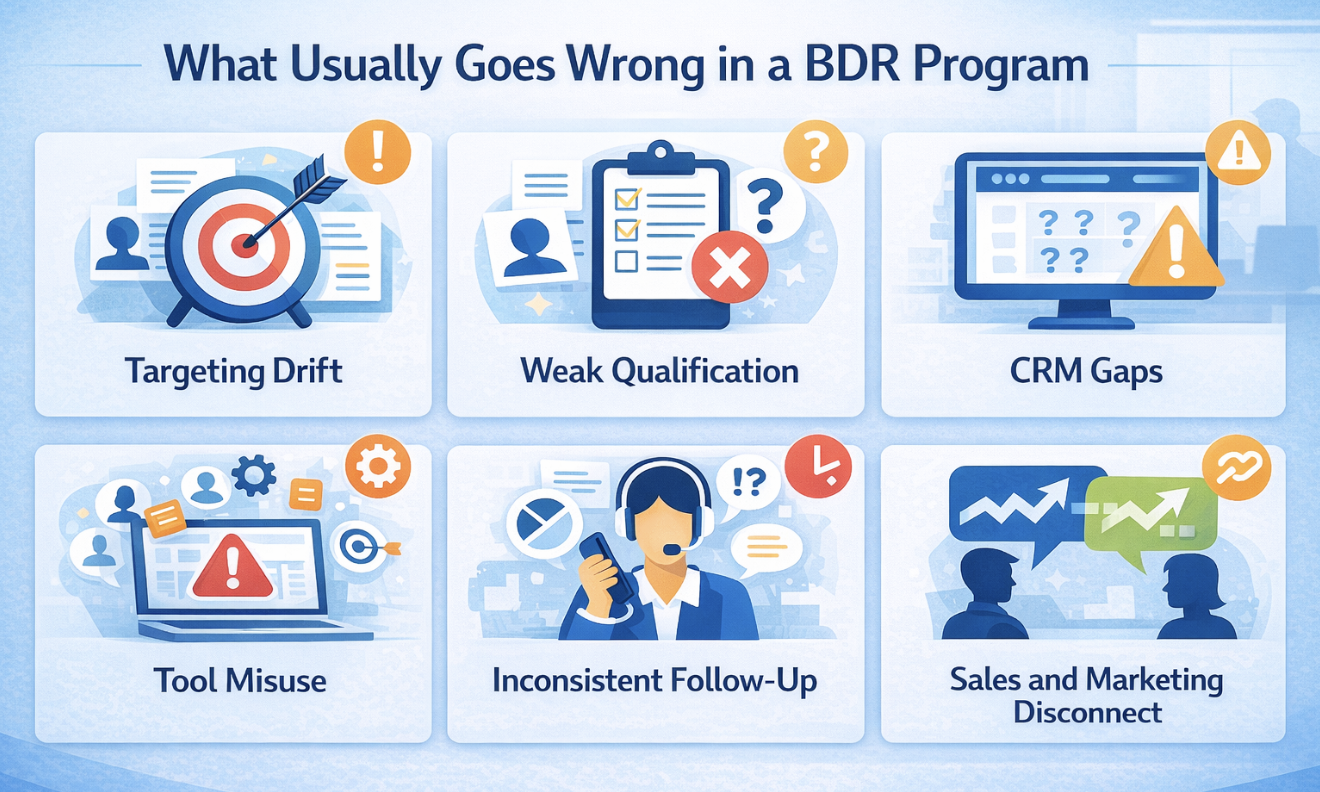
What Usually Goes Wrong in a BDR Program

Most weak BDR programs break down in the setup and management layer. The role gets added, but the team never defines how accounts should be selected, how qualifications should work, what belongs in the CRM, or how sales should judge success. When those standards are missing, the sales organization ends up with more activity and very little improvement in the qualified pipeline.


  • Targeting Drift: Reps move outside the ideal potential customer profile, which lowers reply quality and fills the funnel with weaker accounts.

  • Weak Qualification: Meetings get booked without enough information on fit, role, pain point, urgency, or next-step value.

  • CRM Gaps: Handoff notes are shallow, ownership is unclear, and the activity trail is incomplete.

  • Tool Misuse: Teams buy prospecting tools but never define how to validate contact quality, buying signals, or account priority.

  • Inconsistent Follow-Up: Reps stop too early, even though many B2B sales require multiple touches before a buyer responds.

  • Sales and Marketing Disconnect: Engagement signals from marketing never make it into the outbound process, so the BDR works without enough context.

Getting Started with BDR and SDR Services: Next Steps to Scale Your Sales Pipeline

BDR services can be an invaluable asset to any business, helping to drive sales and growth.

When selecting a BDR service provider, it is important to choose a company that has experience working with businesses in your industry.

The best BDR providers will have a deep understanding of your target market and will be able to customize their services to your specific needs.

In addition, you should look for a provider that offers a comprehensive suite of services, including lead generation, appointment setting, market research, and more. By working with a top-rated BDR service provider, you can take your business to the next level.

The right BDR structure becomes much easier to trust when qualification, CRM discipline, and outreach process are clearly defined.

  • Clarify Role Ownership: Define where BDR responsibilities end, what sales-ready means, and when the account executive should take over.

  • Review Qualification Rules: Check whether reps are confirming fit, contact relevance, buyer need, urgency, and agreed next step before handoff.

  • Check Execution Support: Make sure the rep has the process, tools, and CRM standards needed to create qualified opportunities consistently.

If you need a more reliable way to create a qualified pipeline from outbound sales, Smith Digital provides focused business development representative services designed to improve prospecting, qualification, and handoff quality.

Book a strategy session to strengthen BDR execution and increase the qualified pipeline.

See how an Outsourced BDR Model can improve pipeline quality


Frequently Asked Questions

What is a BDR?

A BDR is a business development representative. This sales role focuses on identifying potential accounts, researching decision-makers, running outbound sales outreach, and creating qualified meetings for the sales team. The role supports new business creation at the front of the funnel rather than closing deals.

What does a BDR do?

A BDR researches accounts, identifies prospects, reaches out through channels like email, calls, and LinkedIn, follows up consistently, qualifies early interest, and passes useful conversations to an account executive or sales rep. The exact process varies by company, but the core job is to create qualified entry points into the sales pipeline.

What is the difference between a BDR and an SDR?

A BDR usually focuses on outbound prospecting and creating new business opportunities from target accounts that have not yet converted. An SDR usually focuses on qualifying inbound leads that have already engaged with marketing through forms, demos, chat, or content offers. Both roles support sales development, but they usually begin from different lead sources.

What is the role of a BDR in sales?

The role of a BDR in sales is to create a front-end pipeline through research, outreach, qualification, and handoff. A strong BDR helps the sales organization spend more time with accounts that fit and less time on poor-quality meetings. This can improve sales funnel efficiency and reduce wasted effort across the team.

What skills does a BDR need?

A good BDR needs communication skills, research ability, qualification judgment, persistence, organization, CRM discipline, and the ability to connect account context to relevant outreach. In more complex sales environments, the role also benefits from stronger objection handling, industry awareness, and the ability to recognize whether a lead should be nurtured, disqualified, or handed off quickly.

SDR vs BDR: What Every Sales Executive Needs to Know Before Building Their Team

1 min read

SDR vs BDR: What Every Sales Executive Needs to Know Before Building Their Team

If you've spent any time in the world of sales, you've probably encountered the titles SDR and BDR thrown around interchangeably and walked away more...

Read More
Outsourcing BDR Checklist: How to Choose the Right Partner

1 min read

Outsourcing BDR Checklist: How to Choose the Right Partner

Outsourcing your BDR team can unlock serious growth—but only if you choose the right partner. Are your reps stuck chasing cold leads while qualified...

Read More
4 Ways Outsourced BDRs Improve Your Database Hygiene

1 min read

4 Ways Outsourced BDRs Improve Your Database Hygiene

How much pipeline are you losing to dirty data?

Read More