1 min read
10 Enterprise B2B Lead Generation Companies That Drive Growth
For enterprise B2B teams, the top lead generation partners to evaluate are SmithDigital, Belkins, Callbox, Martal Group, SalesRoads, CIENCE, LevelUp...
10 min read
Eric Smith is the founder of SmithDigital, a revenue-focused growth partner that helps B2B companies generate qualified pipeline through a combination of SEO, AI discoverability, HubSpot optimization, outbound prospecting, and conversion-focused marketing. Over the past two decades, Eric has worked with software companies, ERP consulting firms, managed service providers, business brokers, technology consultants, and other B2B organizations looking to accelerate growth without building large inte...
Hiring a lead generation company makes sense when your sales team can't consistently generate enough qualified pipeline to support your growth goals. Common signs include relying too heavily on referrals, spending more time prospecting than selling, struggling to generate qualified B2B leads, or lacking the internal resources to scale outbound efforts.
Many companies assume they need more leads when the real issue is somewhere else in the sales process. Weak lead qualification, inconsistent follow-up, poor CRM management, or misalignment between sales and marketing can all limit pipeline growth. Before you outsource lead generation, it's important to identify where your revenue engine is actually breaking down.
According to Salesforce’s 2026 State of Sales report, sales reps spend only 40% of their time selling, with the remaining 60% spent on non-selling tasks such as prospecting, research, admin, and internal work. This guide will help you determine whether hiring a lead generation company is the right next step, the seven signs to watch for, and what to evaluate before making the investment
Referral-based growth becomes difficult to scale. If most new business comes from referrals, you'll have limited control over pipeline volume and revenue forecasting.
Sales reps spend too much time prospecting. When experienced account executives are responsible for sourcing leads, they have less time to move qualified opportunities through the sales process.
Marketing generates leads that don't become opportunities. Low conversion rates often indicate gaps in lead qualification, follow-up, or sales and marketing alignment.
Previous outbound campaigns haven't produced consistent results. Effective outbound programs require accurate data, targeted messaging, structured outreach, and continuous optimization.
Your CRM contains untapped opportunities. Existing contacts may generate additional pipeline through better segmentation, lead nurturing, and follow-up before you invest in new lead generation efforts.
Building an internal SDR team requires significant time and investment. Recruiting, onboarding, managing, and retaining prospecting talent can delay pipeline growth for many B2B companies.
Hiring a lead generation company works best when your sales process is already defined. Clear qualification criteria, CRM ownership, and sales capacity allow an external partner to contribute more effectively.
Hiring a lead generation company makes sense when the business has a clear sales process but lacks the capacity, tools, or consistency to create enough qualified conversations. It is less effective when the core problem is poor lead qualification, slow follow-up, unclear CRM ownership, or disagreement between sales and marketing.
Before you outsource lead generation, identify where the pipeline is breaking down. A company with strong sales follow-up and limited prospecting capacity may benefit quickly from outsourced lead generation. A company with weak routing, messy CRM data, or unclear qualification standards may need to fix those issues first.
| Current Business Situation | The Likely Issue | Should You Hire a Lead Generation Company? |
|---|---|---|
| Website traffic is increasing, but qualified opportunities are not | Weak conversion paths, poor lead qualification, or slow follow-up | Maybe. Review landing pages, forms, lifecycle stages, and follow-up before increasing lead volume. |
| Sales reps spend much of the week sourcing prospects | Limited outbound capacity | Yes. Outsourced prospecting can help account executives spend more time on discovery, proposals, and closing deals. |
| Pipeline relies heavily on referrals | No repeatable demand generation or outbound prospecting system | Yes. A lead generation company can help create a more predictable source of qualified opportunities. |
| Sales and marketing disagree on lead quality | Unclear ICP, lifecycle stages, or sales-ready lead definitions | Not yet. Align qualification criteria before adding more leads to the funnel. |
| The CRM contains thousands of inactive contacts | Weak segmentation, lead nurturing, or CRM governance | Maybe. Existing contacts may produce a pipeline through better segmentation and follow-up before new prospecting begins. |
| The company needs to enter a new market quickly | Limited prospecting resources and limited market feedback | Yes. An experienced partner can help test targeting, messaging, and outreach faster than building an in-house team from scratch. |
A successful lead generation partnership usually starts with a few basics already in place. Sales and marketing should agree on the ideal customer profile, what counts as a qualified sales conversation, who owns follow-up, and how leads move through the CRM. Without those definitions, even an experienced lead generation specialist or outsourced SDR team will struggle to produce consistent results.
Use outsourcing when the company needs more qualified prospecting activity than the internal team can support. Fix the internal process first when leads already exist but fail to convert because of poor routing, weak nurture, unclear ownership, or inconsistent sales execution.
Read Next: Outsourcing BDR Checklist: How to Choose the Right Partner

Most companies don't decide to hire a lead generation company because they want more leads. They do it because their current approach no longer produces enough qualified pipeline to support their revenue goals. Sales teams spend more time prospecting than closing, marketing generates contacts that don't become opportunities, and leadership struggles to forecast future growth with confidence.
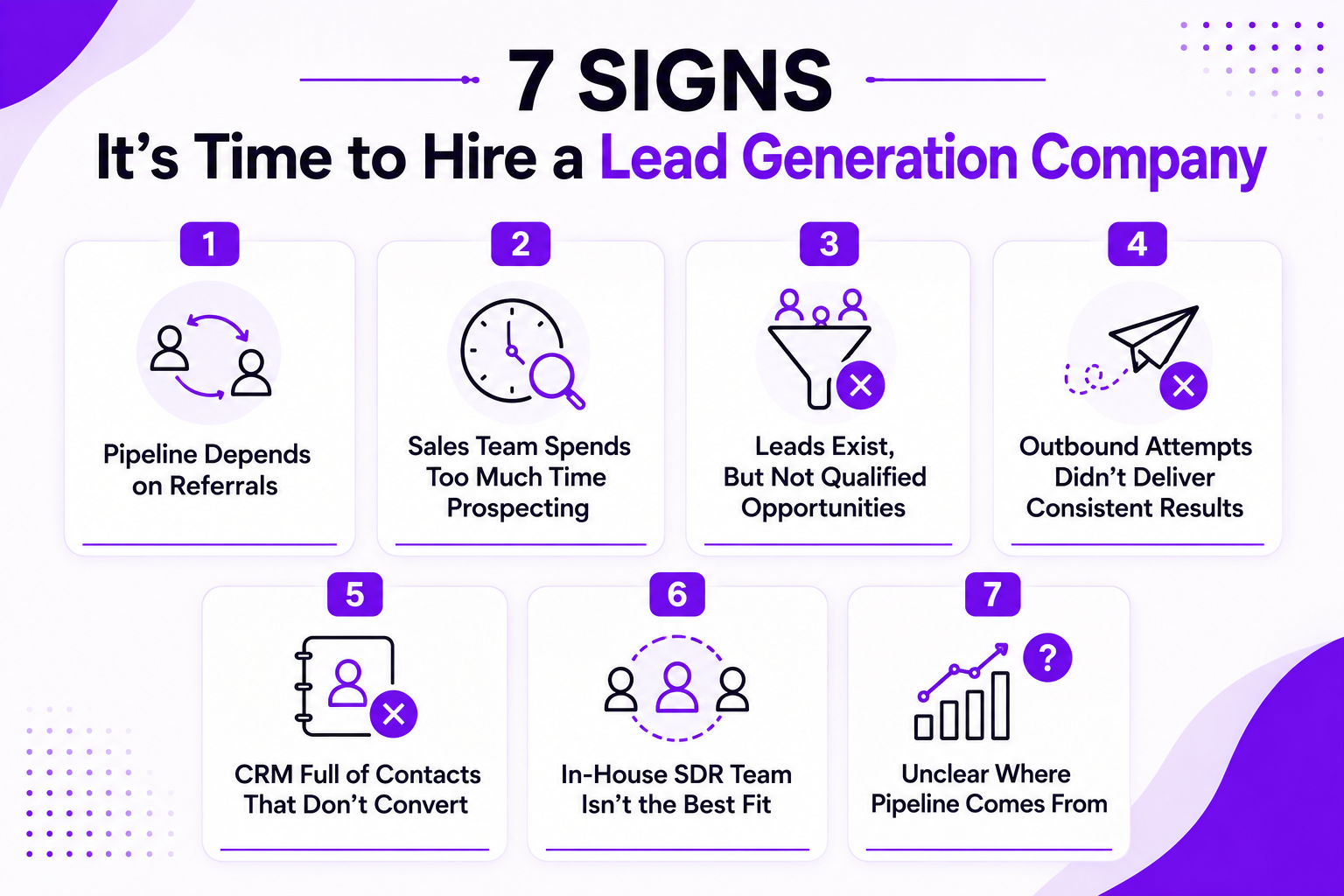
The seven signs below can help you determine whether your business has reached that point. While no single issue confirms that outsourcing is the right decision, seeing several of these patterns together often indicates that your current lead generation strategy is limiting pipeline growth.
Referrals are valuable because they often become high-quality opportunities. The problem is that they aren't predictable. You can't control when referrals happen or whether they'll generate enough pipeline to support your revenue goals.
Many B2B companies don't notice this until growth slows. When referrals decline, there isn't another reliable source of qualified opportunities to replace them.
If this sounds familiar, it may be time to build a repeatable lead generation strategy. A lead generation company can help you generate a qualified pipeline through outbound prospecting, LinkedIn outreach, and other demand generation activities while referrals continue to support your growth.
Ask yourself:
Would your pipeline slow significantly if referrals stopped?
Can you consistently generate qualified opportunities without referrals?
Can leadership confidently forecast the future pipeline?
If the answer to most of these questions is no, you're likely relying too heavily on referrals to support growth.
As your business grows, asking account executives to manage both prospecting and closing becomes increasingly difficult. Researching prospects, building lists, writing outreach, and booking meetings all take time away from discovery calls, proposals, and customer conversations.
Many companies reach a point where pipeline growth slows, not because the sales team lacks ability, but because there aren't enough hours in the week. Prospecting becomes a full-time responsibility, yet it's competing with the work that actually moves deals toward a decision.
If your sales team spends more time finding opportunities than advancing them, it may be time to add dedicated prospecting support. A lead generation company can take ownership of top-of-funnel outreach, allowing account executives to focus on building relationships and closing qualified opportunities.
Read More: Benefits of Outsourcing BDR Services: How to Cut Costs and 10x Your Pipeline
A steady flow of leads doesn't always translate into a qualified pipeline. If marketing reports strong campaign performance while sales struggles to find sales-ready opportunities, the issue often lies in lead qualification, follow-up, or the handoff between marketing and sales.
This is a common challenge for B2B companies with long sales cycles. Content marketing, SEO, webinars, and other lead generation efforts can attract plenty of interest, but not every prospect is ready to buy. Without clear qualification criteria and timely follow-up, sales teams spend valuable time pursuing leads that are unlikely to convert.
| What You're Seeing | What It Usually Means |
|---|---|
| Plenty of leads but few sales conversations | Lead qualification or follow-up needs improvement. |
| Marketing celebrates campaign performance, while sales questions lead quality | Sales and marketing use different qualification criteria. |
| Prospects download content but don't engage with sales | Buyers need additional nurturing or aren't ready to purchase. |
| Pipeline isn't growing despite steady lead volume | The problem is likely conversion, not lead generation. |
If these patterns sound familiar, hiring a lead generation company may help, but only if the provider can support lead qualification, CRM management, and sales follow-up alongside outbound prospecting.
Read Next: BDR Lead Qualification: How to Turn MQLs into Sales-Ready Opportunities
Many B2B companies give up on outbound after one disappointing campaign. They hire an SDR, buy a contact list, launch a cold email sequence, and expect meetings to follow. When results fall short, they assume outbound prospecting doesn't work.
In most cases, the problem isn't the outbound itself. Successful lead generation depends on several factors working together, including a well-defined ideal customer profile, accurate contact data, relevant messaging, consistent follow-up, and clear lead qualification. Weakness in any one of these areas can limit campaign performance.
Common mistake: Judging outbound based on a single campaign instead of the overall process. Effective outbound programs improve over time as messaging, targeting, and outreach are refined using real campaign data.
If your outbound efforts have been inconsistent, it may be worth evaluating the process before ruling out the channel. An experienced lead generation company can help identify what's working, what isn't, and where improvements are likely to have the biggest impact.
Read more: Why Persistent SDR Cadence Matters (And How to Sustain It)
Many B2B companies already have a database full of potential customers. Years of website forms, webinar registrations, event attendees, and previous outreach campaigns often leave hundreds or thousands of contacts sitting in the CRM with little or no follow-up.
That doesn't always mean you need more lead generation. It may mean you're not getting enough value from the leads you've already generated. Without clear ownership, lead nurturing, and regular follow-up, prospects who were interested six months ago are easy to overlook, even though some may now be ready to buy.
A lead generation company can help reactivate those contacts through CRM segmentation, targeted outreach, and structured follow-up while your sales team focuses on active opportunities. For many businesses, improving how existing leads are managed creates additional pipeline before investing in new acquisition channels.
Building an in-house SDR team involves more than hiring a few sales development representatives. Recruiting, onboarding, coaching, managing prospecting tools, and maintaining consistent outreach all require time, budget, and leadership. For many growing B2B companies, that's a significant investment before seeing consistent pipeline results.
If you're still developing your outbound strategy or need to generate a pipeline quickly, outsourcing can be a practical way to build momentum while avoiding the overhead of building an internal function from scratch.
| Your Situation | Recommended Approach |
|---|---|
| You have experienced SDR leadership, a proven outbound process, and plans to expand your sales team. | Build an in-house SDR function. |
| You're launching outbound for the first time or entering a new market. | Partner with a lead generation company to validate your strategy before hiring internally. |
| Hiring SDRs has been slow, and pipeline growth can't wait. | Outsource prospecting while continuing to build your internal team. |
| Sales leaders already manage quotas, forecasting, and customer relationships. | Reduce management overhead by outsourcing top-of-funnel prospecting. |
The right approach depends on your resources, sales maturity, and growth objectives. Many B2B companies begin with an outsourced lead generation partner, then build an internal SDR team once they have a proven outbound process and a predictable pipeline.
Read More: What to Expect During Your First 90 Days with an Outsourced BDR Team
As your business grows, decisions become harder to make without reliable reporting. Leadership should be able to identify which lead generation efforts create qualified opportunities, which marketing channels influence revenue, and where prospects drop out of the sales process.
When that visibility is missing, it's difficult to know where to invest. Marketing reports website traffic, sales reports, meetings, and finance reports revenue, but none of those metrics explain how the pipeline is actually being created.
A lead generation company should contribute more than qualified meetings. It should provide clear reporting that helps leadership understand what's working, where opportunities come from, and how lead generation contributes to revenue growth.
Before investing in additional lead generation, ask a simple question:
If you doubled your marketing budget tomorrow, would you know which channels deserve the investment, and why?
If the answer is no, improving reporting and pipeline visibility may have just as much impact as generating more leads.
Read Next: BDR Success Metrics: KPIs You Should Track for Your Outsourced BDR Program
The seven signs in this guide can help you identify where your lead generation strategy is falling short. The next step is choosing the approach that best addresses the underlying issue.
| Your Biggest Challenge | Recommended Next Step |
|---|---|
| Lead quality is low, follow-up is inconsistent, or your CRM isn't supporting the sales process. | Improve your lead management process before investing in additional lead generation. |
| Your sales team doesn't have the capacity to generate enough qualified opportunities. | Hire a lead generation company to strengthen prospecting and pipeline generation. |
| Your outbound strategy is proven, and you're ready to scale. | Build or expand an in-house SDR team. |
The best decision depends on where your current sales process is breaking down. Solving the right problem first is more likely to improve the pipeline than simply generating more leads.
Choosing a lead generation company involves more than comparing pricing or the number of meetings they promise. Before making a decision, make sure you understand how the partnership will work and how success will be measured.
| Ask Before You Sign | Why It Matters |
|---|---|
| Who owns communication with prospects? | Establishes clear expectations for your team and protects the customer experience. |
| What does your onboarding process look like? | A structured onboarding process helps the provider understand your business, ideal customers, and sales process before launching outreach. |
| How will success be measured? | Qualified pipeline, accepted opportunities, and revenue are more meaningful than activity metrics alone. |
| How often will performance be reviewed? | Regular reviews allow both teams to improve messaging, targeting, and campaign performance over time. |
| What happens if our strategy changes? | Your lead generation partner should be able to adapt as your products, markets, or growth objectives evolve. |
| What level of involvement is expected from our internal team? | Understanding responsibilities upfront helps avoid delays and keeps sales and marketing aligned throughout the engagement. |
The strongest partnerships operate as an extension of your sales and marketing team. Both sides understand their responsibilities, communicate regularly, and work toward shared pipeline goals.
Hiring a lead generation company can help you generate more qualified pipeline, but only if it addresses the right problem. Before you outsource, determine whether your biggest challenge is prospecting, lead qualification, CRM management, or alignment between sales and marketing.
As you evaluate your next steps, keep these principles in mind:
Build a repeatable pipeline. Sustainable growth comes from a consistent demand generation strategy, not referrals or one-off campaigns.
Prioritize lead quality. Qualified opportunities contribute more to revenue than increasing lead volume alone.
Measure what matters. Use reporting to understand which marketing and sales activities contribute to the pipeline and revenue.
If several of the signs in this guide sound familiar, it may be time to take a broader look at your demand generation strategy. SmithDigital's Demand Generation Solutions help B2B companies build a predictable pipeline by integrating inbound marketing, outbound prospecting, buyer intent, CRM optimization, lead qualification, and revenue reporting into a single, measurable growth system.
Talk to a Growth Strategist to evaluate your current demand generation strategy and identify practical opportunities to improve pipeline quality, sales efficiency, and long-term revenue growth.
The right time to hire a lead generation company is when your business has a defined ideal customer profile, a repeatable sales process, and the capacity to convert qualified opportunities into customers. Common signs include an inconsistent sales pipeline, overreliance on referrals, overloaded sales teams, or difficulty generating enough high-quality leads through your existing lead generation efforts.
The right choice depends on your goals, budget, and internal resources. Hiring a lead generation specialist gives you greater control over the lead generation process, but it also involves recruiting, onboarding, management, and salary costs. Companies that need to generate a pipeline quickly or validate an outbound lead generation strategy often choose to outsource lead generation before expanding their internal team. Once the process is proven, many businesses decide to build an in-house function.
A digital marketing agency typically focuses on brand awareness through SEO, content marketing, paid advertising, and other digital marketing services. A B2B lead generation company focuses on identifying prospects, qualifying leads, and generating sales opportunities through outbound prospecting and other demand generation activities. Some providers, including SmithDigital, combine professional lead generation with broader demand generation strategies to help businesses build a more predictable pipeline.
Look for a provider with a proven track record, experience in lead generation for businesses with similar sales cycles, and a clear approach to lead qualification, CRM management, and pipeline reporting. The best lead generation companies measure success by qualified opportunities, pipeline contribution, and return on investment rather than activity metrics alone.
1 min read
For enterprise B2B teams, the top lead generation partners to evaluate are SmithDigital, Belkins, Callbox, Martal Group, SalesRoads, CIENCE, LevelUp...
1 min read
Some B2B lead generation campaigns look successful on the surface, but fall apart once sales tries to turn the leads into revenue. The CRM may fill...
1 min read
Long sales cycles make weak lead generation look acceptable for far too long. Dashboards can show form fills, booked calls, and rising traffic while...