<img src="https://secure.seat6worn.com/219576.png" style="display:none;">

26 min read

10 Best B2B Lead Generation Services for Long Sales Cycles in 2026

Some B2B lead generation campaigns look successful on the surface, but fall apart once sales tries to turn the leads into revenue. The CRM may fill with new contacts, replies may come in, and meetings may get booked. But if those leads are not a good fit, the activity does not translate into a real pipeline.

This problem becomes even more serious in long sales cycles. A long B2B sales cycle typically lasts 6 to 18 months, especially for enterprise-level deals where multiple stakeholders are involved. Buyers are not making quick decisions after one email, one call, or one form submission; they compare vendors over time, involve decision-makers across departments, and need several relevant interactions before they are ready to move forward.

That early influence matters because many buyers are already narrowing their options before they ever speak with sales. 6sense’s 2025 B2B Buyer Experience Report found that 95% of buyers ultimately purchase from a vendor that was already on their Day One shortlist. For B2B companies with long sales cycles, that means lead generation cannot wait until a prospect is ready to book a meeting; it has to build awareness, relevance, and trust much earlier in the buying journey.

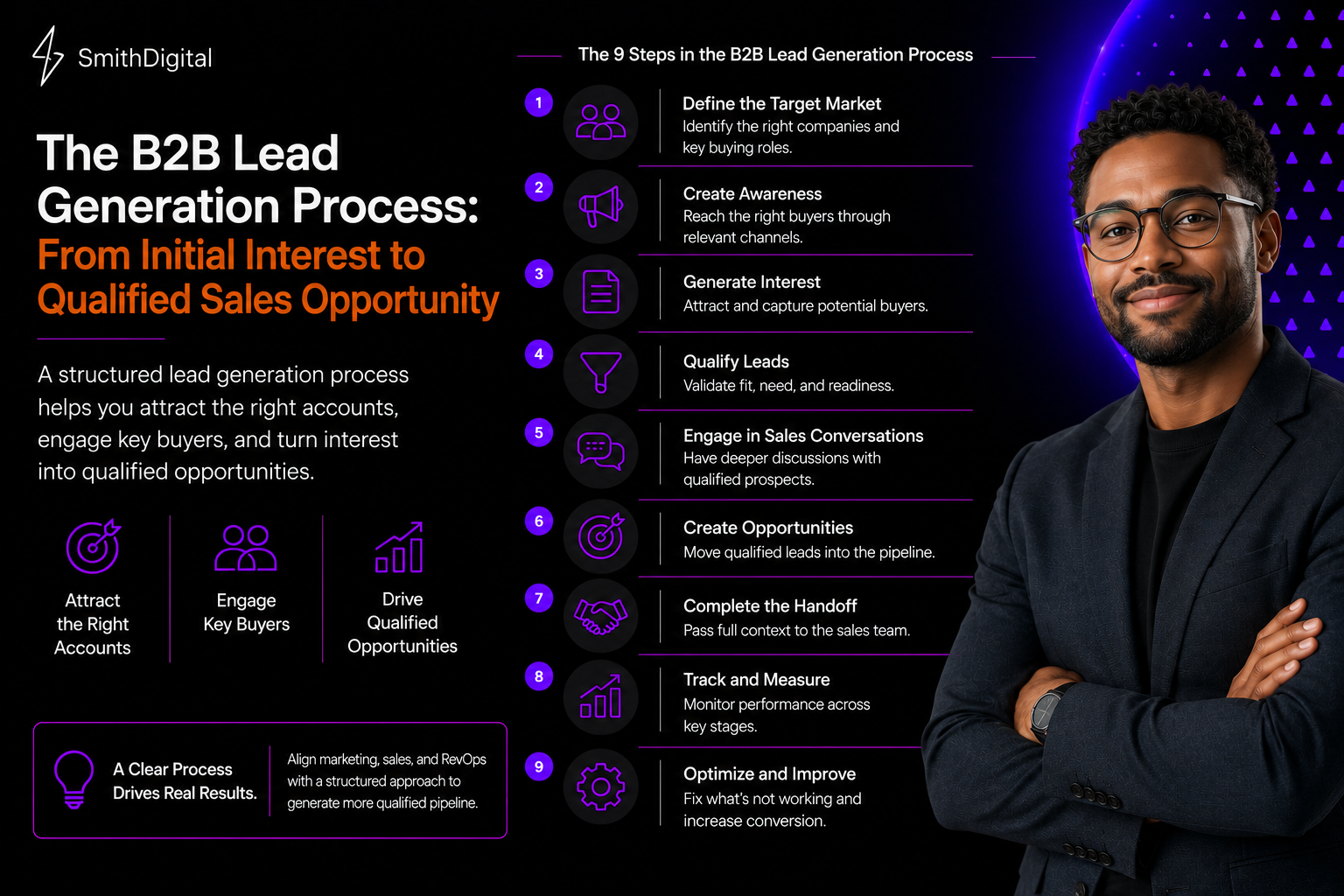
That is why B2B lead generation services for long sales cycles need to do more than produce names, appointments, or low-cost form fills. The goal is to identify the right target accounts, understand the buyer’s problem, shape outreach around that problem, and qualify interest before the lead reaches sales. Without that structure, sales teams end up chasing contacts instead of working real opportunities.

Strong lead generation for long sales cycles is built around fit, timing, context, and follow-through. It helps marketing and sales stay aligned from the first touch to the final handoff. When those pieces are in place, lead generation does not just create activity; it supports a healthier pipeline and gives sales a better chance of closing the right deals.

TL;DR: Long Sales Cycles Need Lead Generation That Builds Trust Over Time

  • Long sales cycles need lead generation built around fit, timing, context, and follow-up.

  • More B2B leads do not help if they rarely become qualified sales conversations.

  • Inbound and outbound both contribute, but neither works well without CRM discipline.

  • Prospecting should prioritize ICP fit and buying conditions instead of raw list volume.

  • Lead qualification should protect the sales team from low-intent and low-fit meetings.

  • Appointment setting helps only when the meeting context is captured before handoff.

  • Reporting should connect lead gen activity to pipeline movement and closed-won revenue.

Why Long Sales Cycles Change How B2B Lead Generation Works

A long sales cycle makes low-quality lead generation expensive. Problems that might stay hidden in a short sales process become obvious when buyers take months to evaluate options, compare vendors, and build internal agreement. Broad targeting creates low-fit leads. Generic outreach gets ignored. Loose lead qualification pushes weak meetings into the calendar. Delayed follow-up gives interested accounts time to cool off.

The damage usually appears downstream. Marketing reports lead volume, the sales team reports low acceptance, and leadership cannot tell whether the issue started with targeting, messaging, handoff, or CRM ownership. In complex B2B sales, those are not separate problems. They are one operating system.

Consider an ERP consulting firm selling into mid-market manufacturers. If the campaign targets every operations leader at every company above a revenue threshold, the list may look large enough to support outbound. But many of those companies are not reviewing ERP software, do not have executive support for a project, or are locked into other priorities. Sales then spends time chasing accounts that matched the category but not the buying conditions.

Long B2B sales cycles need a different standard. The goal is not to create activity across the funnel. The goal is to create qualified sales conversations with companies that can move through a realistic buying process.

Read Next: Demand Generation vs Lead Generation: What You Need to Know

Fix The Gaps Killing Your Pipeline.

Long sales cycles expose weak targeting, messaging, and follow-up. See how to connect everything into a system that creates qualified opportunities.


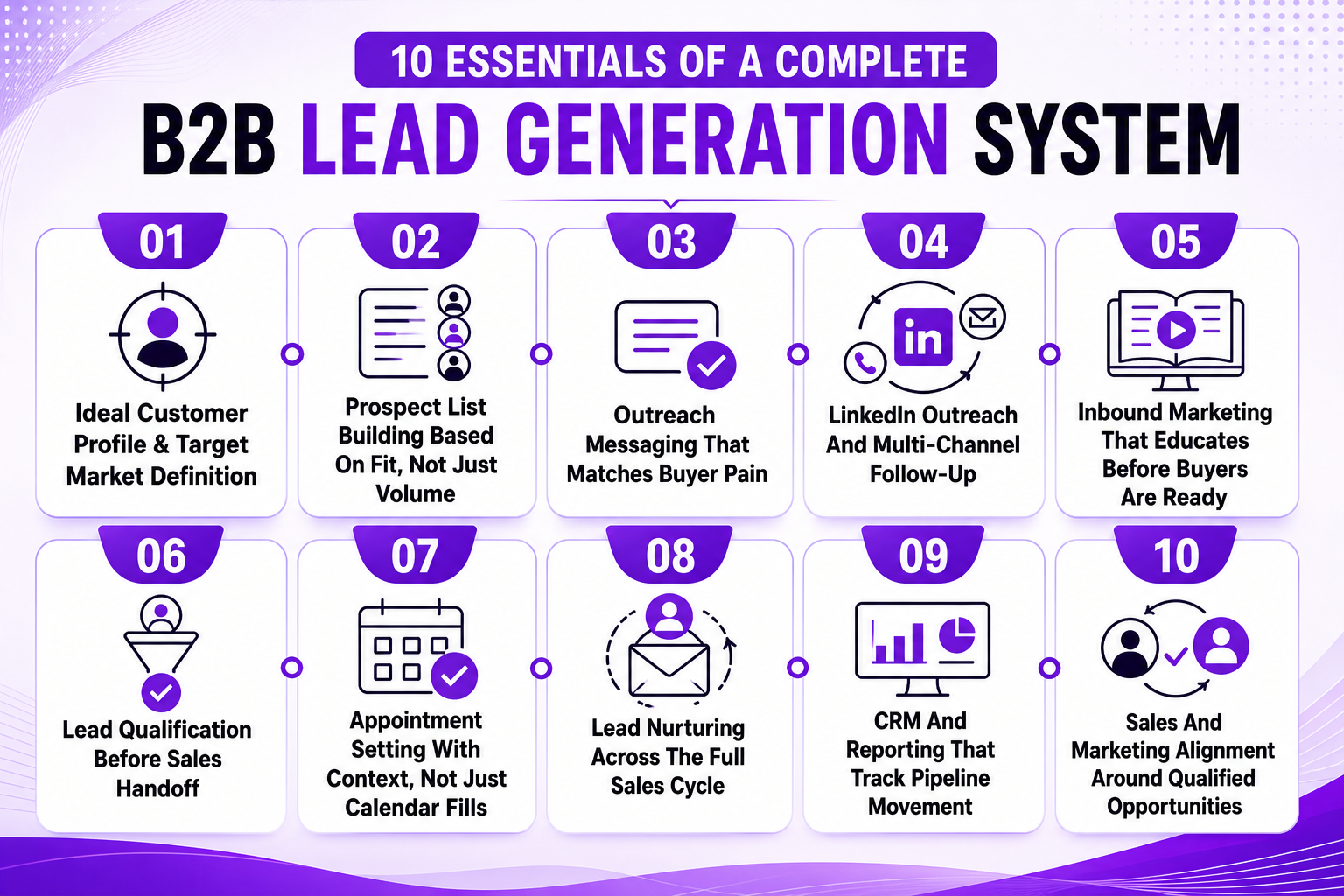
10 Best B2B Lead Generation Services That Support Long Sales Cycles

A lead generation service for complex sales should cover the points where the pipeline usually breaks: audience definition, prospecting, messaging, follow-up, qualification, handoff, and reporting. If one of those pieces is missing, the program can still produce activity, but that activity often stops before it becomes a qualified opportunity.

That is why long-cycle lead gen services should be judged as a system, not as a menu of disconnected tactics. A provider may be good at outbound outreach, LinkedIn prospecting, or appointment setting, but still underperform if the ICP is broad, qualification thresholds are loose, or CRM reporting cannot show which sources actually create pipeline.

10 Best B2B Lead Generation Services That Support Long Sales Cycles

#1) Ideal Customer Profile And Target Market Definition

A useful ideal customer profile does more than describe the type of company you want to reach. It should clarify which companies are commercially worth pursuing now, which accounts may need nurturing, and which should stay out of the funnel entirely. That means looking beyond industry and company size to factors such as buying triggers, operational pain, internal urgency, budget likelihood, stakeholder complexity, and implementation fit.

Without that level of definition, lead generation for B2B usually becomes too broad. A management consulting firm may target every CEO in its category, even though many of those companies do not have a defined transformation project, a budget owner, or enough pressure to hire outside help. A company in the USA selling cybersecurity services may target every IT leader, even though many accounts have no active compliance deadline, no recent security incident, and no near-term vendor review. The result is a list of companies that loosely match the market, but do not match the sales cycle.

The fix starts with segmentation. Separate the full target market from the near-term target market. Then define what makes an account more likely to move now. That could include a funding event, a hiring pattern, a platform change, a compliance deadline, a geography expansion, a merger, a leadership change, or visible research behavior tied to your product or service.

A strong B2B lead generation agency should be able to explain this logic clearly. If the agency cannot show why a company belongs on the target list, it will be difficult to protect lead quality later. The more specific the ICP, the easier it becomes to build better lead lists, prioritize high-fit accounts, and create outreach that speaks to a real business problem.

#2) Prospect List Building Based On Fit, Not Just Volume

List building looks simple until poor list quality starts distorting everything downstream. A bloated list can make outbound lead generation look active while reducing reply quality, increasing sales rejection, and slowing the sales development team. In a long sales cycle, every poor-fit record costs more because it takes time to research, contact, follow up, qualify, and document.

The first check is whether the list was built around commercial fit or convenience. A database can produce thousands of contacts quickly, but that does not mean those contacts belong in your generation programs. Long B2B sales cycles punish lazy list building because every bad record creates noise inside the sales funnel.

  • Account Fit: Start with companies that match the ideal customer profile on industry, company size, buying environment, delivery fit, and budget likelihood. A professional service firm selling enterprise advisory work should not prospect the same way as a company selling a lower-ticket service into small businesses.

  • Role Relevance: The right prospect is not always the highest-ranking title. Some B2B sales cycles begin with department leaders, technical evaluators, operations owners, finance stakeholders, or internal champions before a final decision-maker gets involved.

  • Buying Conditions: Prioritize companies that match the category and show signs of likely movement. These signs may include hiring, expansion, leadership change, technology migration, funding, compliance pressure, or active research behavior.

  • Exclusion Rules: Remove accounts with poor fit, low budget likelihood, incompatible geography, irrelevant company size, or buying conditions that make short-term movement unlikely. Exclusion rules are just as important as targeting rules because they protect the sales team from low-quality work.

  • List Review: Audit accepted meetings, rejected leads, and closed-lost reasons every month. If sales keep disqualifying the same account types, the list criteria are wrong.

For example, an MSP that targets every company with 50 to 500 employees may build a large list fast, but many of those businesses may already be tied to an existing provider and have no near-term reason to switch. A stronger list would narrow around companies with recent staffing changes, compliance pressure, office expansion, cloud migration, or signs that internal IT coverage is stretched. That creates fewer names, but better sales conversations.

Read Next:

#3) Outreach Messaging That Matches Buyer Pain

Outreach fails when it describes the seller before it describes the buyer’s problem. That is common in B2B lead gen. The message talks about expertise, end-to-end support, better results, or years of experience, but never names the operational issue that would make the prospect care now.

Long sales cycles make that mistake harder to hide. B2B buyers do not move forward because an email sounds polished. They move when the message reflects a problem they already recognize, frames that problem clearly, and gives them a practical reason to continue the conversation.

For an enterprise SaaS company, that may mean speaking to low product adoption after implementation instead of using a broad phrase like “digital transformation.” For a commercial real estate firm, it may mean addressing vacant space, owner-side lead flow, or investor outreach instead of promising “marketing growth.” For a business broker, it may mean seller readiness, valuation timing, buyer quality, or deal confidentiality instead of a vague promise to generate more leads.

A lead generation agency should be able to explain how it develops messages that resonate by segment, buyer role, and stage of the sales cycle. The first version of the message should be grounded in buyer pain, not in what the agency wants to promote. Then it should be tested against reply quality, meeting quality, lead qualification outcomes, and opportunity creation, not just open rates or response volume.

If replies are polite but vague, the message is probably not specific enough. If prospects engage but sales rejects them later, the message may be attracting the wrong type of interest. If the outreach gets attention but no one can explain the business problem behind the meeting, the message is creating activity without enough qualification depth.

Read Next: Why AI Alone Is Failing at Cold Outreach

#4) LinkedIn Outreach And Multi-Channel Follow-Up

LinkedIn works best as part of a coordinated follow-up process, not as a replacement for one. In long B2B sales cycles, buyers move between email, search, internal discussion, vendor comparison, peer recommendations, and social platforms over time. A single-channel strategy leaves too many chances for the conversation to stall.

The goal is not to contact the same prospect everywhere at once. The goal is to make each touchpoint consistent, timely, and useful. If email introduces a specific problem, LinkedIn should reinforce that same problem or share a related point of view. If a prospect visits a comparison page after outbound outreach, follow-up should reflect that signal instead of restarting the conversation with a generic ask.

  • LinkedIn Role: Use LinkedIn to reinforce relevance, credibility, and timing. It can be useful when an email response is delayed, but the account still fits the target market.

  • Email Role: Use email when the message needs enough detail to connect a buyer's pain point to your value proposition. Email is often better for explaining the problem, the context, and the reason for outreach.

  • Call Role: Use cold calling when there is a reason to call, such as prior engagement, a visible trigger event, a strong fit signal, or a clear account-based marketing priority.

  • Sequencing Logic: Build sequences so each step adds context instead of repeating the same CTA. Repetition without a new context often makes outreach feel automated and easy to ignore.

  • Ownership Rules: Make it clear whether marketing, SDRs, BDRs, sales development, or account executives own follow-up at each stage. Without ownership rules, warm accounts can sit untouched.

A practical test helps here. Pull ten opportunities that reached a qualified stage. If the CRM history shows disconnected outreach across email, LinkedIn, and calls, the multi-channel process is not coordinated well enough. If each touchpoint builds on the previous one, the team is more likely to shorten sales delays without increasing low-fit meetings.

#5) Inbound Marketing That Educates Before Buyers Are Ready

Inbound lead generation plays a different role in long B2B sales cycles than it does in short, transactional buying environments. It often reaches potential customers before they are ready to speak with a sales rep. They may be trying to understand the problem, compare approaches, estimate cost, build internal support, or decide whether change is worth the disruption.

If inbound marketing only pushes for a demo or consultation too early, many qualified buyers will leave without taking the next step. That does not always mean the content failed. It may mean the conversion path did not match the buyer’s stage.

For complex B2B sales, inbound should be built around education and progression. Content marketing, SEO, comparison pages, use-case pages, case studies, practical guides, and conversion paths should help the buyer move from early research to clearer commercial interest. An ERP partner, for example, may need content that explains migration risk, implementation cost drivers, platform fit, and change management before the buyer is ready to request a consultation. A professional service firm may need thought leadership and service pages that help the buyer define the business problem before asking for a meeting.

The fix is to align the CTA with the buyer stage. Early-stage search traffic may convert better on a benchmarking guide, checklist, assessment, calculator, or practical resource than on a direct appointment setting form. Then the CRM should track whether those inbound leads later become qualified sales conversations, not just downloads.

If traffic rises but buyer-to-opportunity conversion stays low, the issue may not be weak content. It may be poor alignment between source, search intent, CTA, nurture path, and sales follow-up.

Read Next: How Inbound Marketing Strategies Help ERP Resellers Grow ERP System Sales

#6) Lead Qualification Before Sales Handoff

Lead qualification is where many lead generation teams reveal whether they understand the sales cycle they are supporting. If handoff happens too early, sales inherits people who are curious but not commercially relevant. If the handoff happens too late, real interest can go cold while marketing or SDRs hold onto the account for too long.

The right threshold depends on the offer, deal size, target market, and sales process, but the logic should always be explicit. Sales should know why the lead was passed over, what was confirmed, what is still unknown, and what the next step the prospect agreed to.

  • Fit Confirmation: Verify industry, company size, role relevance, and whether the account belongs in the target market.

  • Problem Confirmation: Capture the issue the buyer is trying to solve so sales do not restart discovery from zero.

  • Timing Assessment: Distinguish between immediate evaluation, mid-term interest, and early research.

  • Handoff Criteria: Define what qualifies as ready for the sales team and what should stay in nurture.

  • Recycling Process: Create a clear path for leads that are real but early, instead of marking them as dead.

That is the point of sales development in complex B2B sales. The job is not just to find contacts. It is to separate surface interest from qualified intent. Teams that need a cleaner model here often benefit from clearer role ownership between inbound follow-up, SDR work, and BDR work.

Read Next:

#7) Appointment Setting With Context, Not Just Calendar Fills

Appointment setting creates value only when the meeting advances a real sales process. Long sales cycles expose low-quality appointment setting quickly because a sales rep can usually tell within minutes whether the prospect belongs in the funnel. If the booking came from loose qualification, incomplete notes, or a generic outreach sequence, the meeting may still happen, but it rarely becomes a qualified pipeline.

That problem usually starts before the meeting. The prospect may have replied positively to a broad message without confirming need, timing, or account fit. Or the SDR may have booked the call before clarifying why the account was interested, who would attend, and what problem they wanted to discuss. Sales then spends the first meeting rebuilding context that should already be in the CRM.

A usable appointment-setting process connects every meeting to account fit, role clarity, stated pain, timing, and an agreed reason for the call. That matters even more when a provider charges per lead or appointment, because volume-based pricing can create pressure to book meetings that are not actually useful.

Review the no-show rate, sales acceptance rate, meeting quality, and meeting-to-opportunity conversion together. If meetings are easy to book but rarely turn into qualified opportunities, the problem is not calendar volume. It is qualification depth.

#8) Lead Nurturing Across The Full Sales Cycle

Lead nurturing is not a backup plan for leads that failed to convert. In a long sales cycle, it is part of the core generation process. B2B buyers often pause because they need budget approval, internal alignment, technical review, legal review, executive buy-in, or a stronger trigger event. If the process treats that silence as disinterest, the company loses accounts that may still be commercially relevant.

Good lead nurturing keeps the conversation organized without restarting it. That can include role-specific emails, follow-up from SDRs, LinkedIn touches, case studies matched to the buyer’s situation, comparison resources, objection-handling content, and reminders tied to relevant timing windows. The content should answer the next question the buyer is likely to ask. It should not just keep sending promotional messages into the inbox.

A business brokerage firm, for example, may need different nurture paths for sellers exploring timing, buyers comparing acquisition targets, and referral partners watching the market. A software company may need one sequence for technical evaluators and another for budget owners. A professional service firm may need different follow-up for early education, active vendor comparison, and post-consultation decision support.

Review whether nurture paths are segmented by buyer role, buyer stage, account type, and sales cycle length. If every lead receives the same follow-up, the campaign is maintaining activity, not moving the sales pipeline.

#9) CRM And Reporting That Track Pipeline Movement

Long sales cycles create too many handoffs, delays, and stakeholder changes to manage without a clean CRM. If the record does not show what the buyer asked, what sales learned, who owns follow-up, and where the account sits in the lifecycle, the conversation resets every time it changes hands.

That is why CRM structure is part of lead generation quality, not a separate admin task. A clean setup lets marketing, sales development, and account executives see whether inbound lead generation, outbound lead generation, appointment setting, and lead nurturing are moving accounts toward qualified opportunities. A messy setup hides the source of failure. The team sees activity, but cannot tell whether the problem came from targeting, messaging, handoff, timing, or routing errors inside the CRM.

CRM Data Points That Track Pipeline Movement and Performance

What to Track Why It Matters in a Long Sales Cyce
Lead Source Shows which channels are creating qualified sales conversations, not just form fills or contact volume. This helps the team compare inbound lead generation, outbound lead generation, paid campaigns, referrals, events, and content-driven leads by actual pipeline impact.
Campaign or Touchpoint Source Identifies which campaign, content asset, email sequence, LinkedIn touch, webinar, ad, or referral first influenced the buyer. This matters because long B2B sales cycles often involve several interactions before a prospect becomes sales-ready.
Buyer Role Separates decision-makers, influencers, technical evaluators, finance stakeholders, end users, and low-fit contacts. Knowing the role helps sales tailor follow-up instead of treating every lead like the final buyer.
Company Fit Confirms whether the account matches the ideal customer profile based on industry, company size, location, budget range, use case, and delivery fit. This prevents sales from spending time on accounts that were never likely to convert.
Pain Point or Business Need Helps sales continue the conversation without restarting discovery. This field should capture the buyer’s stated challenge, such as poor lead quality, manual processes, slow growth, compliance pressure, low conversion rates, or lack of internal capacity.
Buying Intent Signals Shows whether the prospect is simply researching or actively comparing options. Useful signals may include repeat website visits, demo requests, pricing-page views, content downloads, webinar attendance, comparison-page visits, or direct questions about budget and timing.
Engagement History Gives sales a clear view of past interactions, including emails opened, replies, calls, meetings, content shared, objections raised, and pages viewed. This helps the next touchpoint feel relevant instead of generic.
Follow-Up Status Prevents warm prospects from going cold between touchpoints. The CRM should make it clear who owns the next step, when follow-up is due, and whether the lead is waiting on sales, marketing, sales development, or the buyer.
Lifecycle Stage Clarifies whether a prospect is early-stage, engaged, marketing-qualified, sales-qualified, opportunity-stage, paused, closed-lost, or closed-won. Consistent lifecycle stages help teams understand where leads slow down.
Sales Handoff Notes Ensures account executives receive enough context before taking over. Good handoff notes include the buyer’s need, urgency, objections, stakeholders involved, content consumed, and recommended next action.
Opportunity Movement Shows whether lead generation is creating a pipeline, not just activity. This helps teams measure movement from first touch to qualified conversation, from qualified conversation to opportunity, and from opportunity to closed deal.
Deal Velocity Tracks how long leads take to move from one stage to the next. In long sales cycles, this helps reveal whether delays are caused by weak nurturing, poor timing, unclear ownership, slow buyer-side decision-making, or a weak value proposition.
Lost Reason Helps identify patterns behind failed opportunities. If leads often close-lost because of budget, poor fit, no urgency, wrong stakeholder, or timing issues, the team can adjust targeting, messaging, qualification, or nurture strategy.
Closed-Won Source Connects lead generation work to revenue outcomes. This shows which channels, campaigns, buyer segments, and generation programs produce actual customers instead of leads that only look good in top-of-funnel reports.

Start with three checks. First, review whether lifecycle stages are being used consistently by marketing, sales development, and account executives. Second, check whether sales can see the original source, buyer role, stated pain, engagement history, and follow-up owner without digging through disconnected notes. Lastly, compare lead volume by source against qualified opportunity creation, deal velocity, and closed-won revenue by source. If those numbers tell different stories, your reporting is exposing a process problem that leads to counts alone that cannot be shown.

Read Next:

#10) Sales And Marketing Alignment Around Qualified Opportunities

Long-cycle lead generation breaks down when sales and marketing work from different definitions. Marketing may count an inbound lead as success because a form was completed. A lead gen agency may count an outbound reply as success because someone engaged. Sales may reject both because neither contact matched the ICP, buying stage, decision path, or urgency needed to start a real opportunity.

Alignment starts with shared thresholds. Define what qualifies as a lead worth follow-up, what qualifies as a sales-ready lead, what should stay in nurture, and what should be disqualified. Then connect those definitions to ownership. Someone should be responsible for response time, someone for qualification depth, someone for CRM updates, and someone for adjusting the campaign when lead quality drops.

This is also where sales and marketing feedback should change the lead generation process. If sales keep rejecting a certain persona, account segment, source, or message, that should change targeting. If prospects keep asking the same question before agreeing to a meeting, that should change the content or outreach. If qualified opportunities stall after handoff, that may point to weak context, slow follow-up, or missing decision-maker involvement.

Lead generation works more reliably when both teams measure qualified opportunities instead of defending their own activity metrics. The shared question should be simple: which efforts are helping businesses generate real pipeline, and which efforts are only creating movement at the top of the funnel?

Read Next: Why Aligning Sales & Marketing BDR Teams Boosts Pipeline Growth

Inbound Vs Outbound Lead Generation For Long Sales Cycles

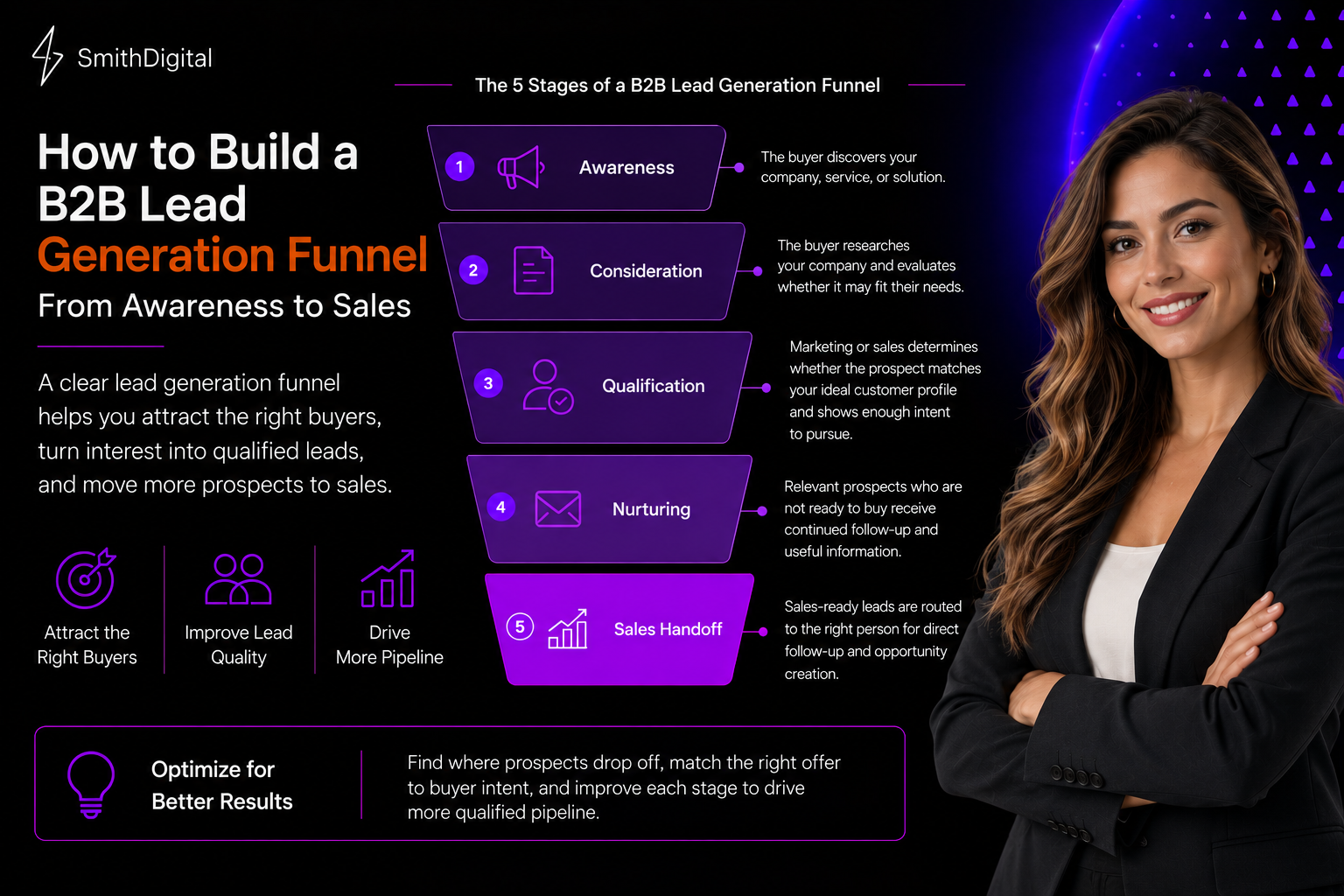
Inbound and outbound solve different problems in a long sales cycle. Inbound helps B2B buyers who are already researching, comparing vendors, and trying to understand their options. Outbound helps companies reach target accounts before those accounts raise a hand. Most complex B2B sales need both because buyers do not all enter the funnel the same way, and they do not all move at the same speed.

The mistake is using either one without enough operational support. Inbound can produce traffic and inbound leads that never become qualified sales if the CTA is mismatched or follow-up is delayed. Outbound can generate replies and appointments that never turn into pipeline if targeting is loose or the message attracts low-fit interest.

The right mix depends on how buyers research, how narrow the target market is, how expensive the product or service is, and whether the sales team can support ongoing follow-up. Many companies need a strategic approach that combines demand generation, outbound sales, content marketing, sales development, and lead nurturing across multiple channels.

Lead Generation Strategy: Strengths and Trade-Offs

Lead Generation Approach Where It Helps Risk If Used Alone
Inbound Lead Generation Educates buyers through search, content, comparison pages, use-case pages, and practical resources. May take time to convert if follow-up, lead scoring, and nurturing are weak.
Outbound Lead Generation Reaches target accounts directly through email, LinkedIn, calls, and prospecting. Can feel generic if targeting, timing, and messaging are not specific enough.
Appointment Setting Creates sales conversations with prospects that match the target market and show enough interest to justify a meeting. Can create low-quality meetings if the qualification is too loose or incentives focus only on booked calls.
Account-Based Marketing Focuses campaigns around high-value accounts, buying committees, and key decision-makers. Can stall if sales and marketing are not coordinated around account ownership and follow-up.
Content Marketing Builds trust during long research cycles and supports lead nurturing before buyers are ready to speak with sales. May drive traffic without a pipeline if conversion paths and CRM tracking are unclear.
Buyer Intent Campaigns Prioritize companies already showing research behavior or category interest. Can waste effort if intent signals are not matched with ICP fit, timing, and role relevance.
Sales Development Works the gap between early interest and qualified sales conversations. Can underperform if reps lack clear qualification rules, strong messaging, and CRM discipline.

The best lead generation model usually combines channels instead of treating inbound and outbound as competitors. Inbound can educate and capture demand. Outbound can create conversations with companies that match the ICP. Lead nurturing can keep relevant prospects engaged until timing improves. CRM reporting can show whether those efforts are actually helping the sales team create qualified opportunities and close deals.

Read Next:

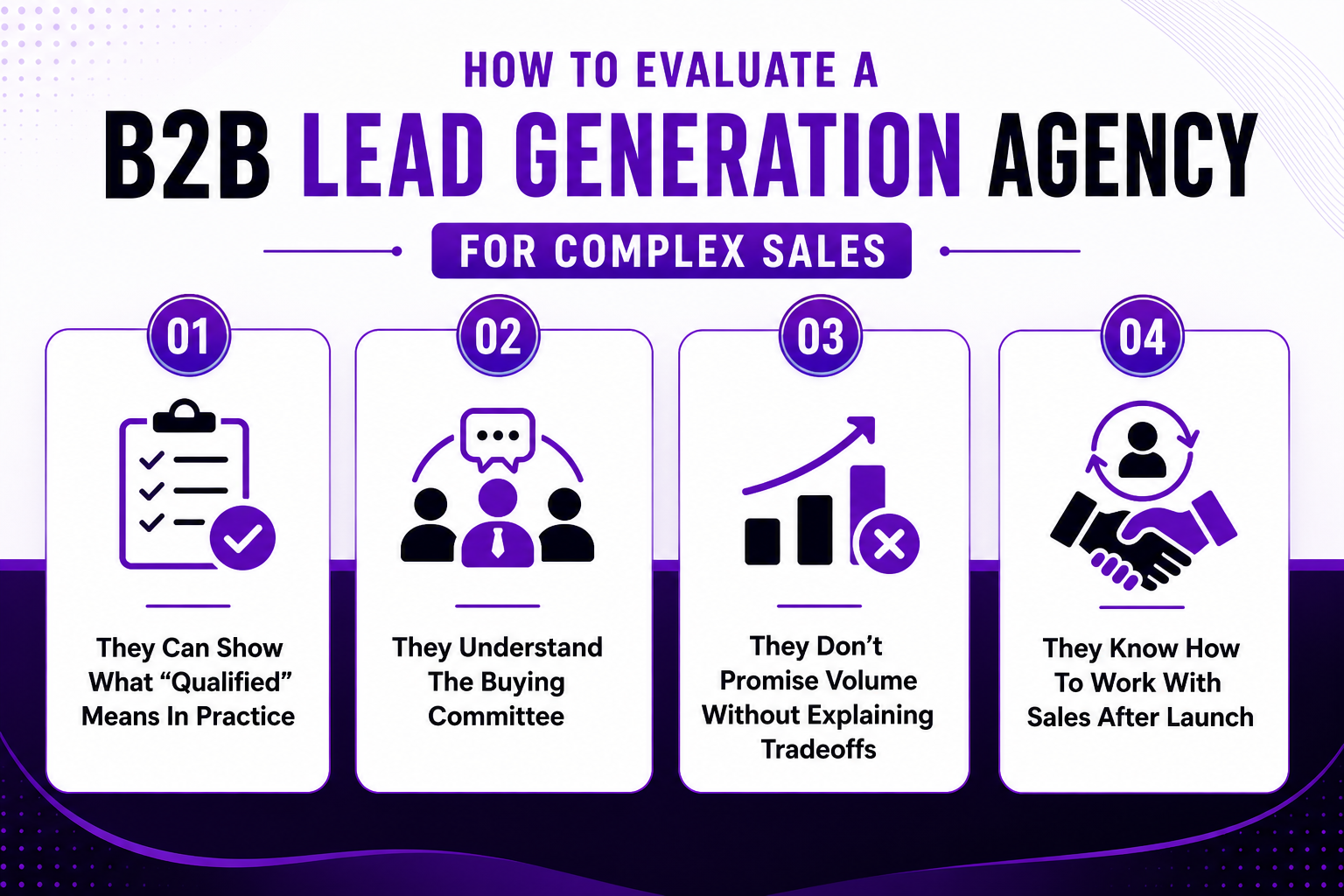
How To Evaluate A B2B Lead Generation Agency For Complex Sales

A B2B lead generation agency should be able to show how it creates qualified opportunities, not just how it creates activity. That sounds obvious, but many agencies still lead with dashboards built around lead counts, email volume, LinkedIn touches, appointments booked, or per-lead pricing. Those numbers matter only if they connect to accepted sales conversations, qualified pipeline, and closed deals.

For companies with a long sales cycle, the evaluation should go deeper than channel capability. A provider may know outbound, appointment setting, content marketing, or LinkedIn outreach, but still struggle if it does not understand your sales process, your buyer’s decision path, or the difference between a contact and a qualified lead.

Use the evaluation process to answer one larger question: Can this agency operate inside a complex B2B sales environment without creating more noise for the sales team? The best B2B lead generation companies can explain how they diagnose fit, protect lead quality, manage handoff, and improve the generation process once real data starts coming in.

How to Evaluate a B2B Lead Generation Strategy

They Can Show What “Qualified” Means In Practice

Many agencies say they deliver qualified leads, but the real test is whether they can define that term clearly. In B2B sales, a qualified lead should not mean someone replied to outreach, downloaded a guide, accepted a LinkedIn request, or agreed to a meeting without context. It should mean the prospect matches the target market, has a relevant business problem, fits the sales cycle, and has enough intent to justify the next step.

Ask the agency to show examples of what it would pass to sales. A useful handoff should include the company, buyer role, reason for outreach, stated pain point, engagement history, qualification notes, open questions, and recommended next action. That gives the sales rep enough context to continue the conversation instead of starting from zero.

For example, a weak handoff might say: “Prospect is interested in learning more.”
A stronger handoff would say: “Operations leader at a 300-person logistics company. They are reviewing vendors because internal reporting is slowing down customer onboarding. They asked about the implementation timeline and integration support. Follow up next week with a workflow-focused discovery call.”

That level of detail is what separates a real, qualified sales conversation from a basic appointment. If the agency cannot show how it documents qualification, the sales team may end up doing the agency’s discovery work after every handoff.

They Understand The Buying Committee, Not Just The Contact List

Complex B2B sales rarely depend on one person. Even when one prospect starts the conversation, the final decision may involve a decision-maker, finance stakeholder, technical evaluator, operations lead, legal reviewer, or executive sponsor. A lead gen agency that only targets one title may miss how the buying process actually works.

This is especially important for high-value products or services. A SaaS company may need to engage both the technical user and the budget owner. A cybersecurity firm may need IT, compliance, and finance involved. A professional service firm may begin with an operations leader, but later needs executive approval before the deal can move forward.

Ask how the agency maps buyer roles inside target accounts. It should be able to explain who usually enters the conversation first, who influences the decision, who approves the budget, and who may block the deal. That does not mean every campaign needs to contact every stakeholder at once. It means the outreach and follow-up should reflect how B2B buyers make decisions in the real world.

If the agency treats every prospect as if they are the final buyer, it may create early engagement that fails later in the sales pipeline.

They Do Not Promise Volume Without Explaining Tradeoffs

Be cautious with agencies that lead with guaranteed lead volume, guaranteed appointments, or very low cost per lead. Those offers can sound attractive, but they often hide tradeoffs around account fit, qualification depth, personalization, and sales acceptance.

In long B2B sales cycles, more leads are not always better. A large number of low-fit sales leads can create more work for sales reps, lower trust in the lead generation team, and make reporting harder to interpret. A smaller number of well-qualified opportunities may be more valuable than a high-volume campaign that never reaches pipeline.

A credible agency should be honest about the relationship between speed, volume, quality, and market size. If your target market is narrow, your offer is complex, or your decision-makers are hard to reach, the agency should not pretend the campaign will behave like a simple transactional funnel.

A better answer sounds like this: “We can increase outreach volume, but if we keep qualification standards high, the number of sales-ready meetings may be lower at first. We would rather build toward accepted opportunities than flood the CRM with contacts sales will reject.”

That kind of answer shows the agency understands lead quality, not just lead generation activity.

They Know How To Work With Sales After Launch

A B2B lead generation agency should not disappear after launching campaigns. Complex sales require ongoing coordination with the sales team because early results often reveal what needs to change. The first few weeks may show that one segment responds better than another, that a certain buyer role lacks urgency, or that sales keep rejecting leads from a specific source.

Ask how the agency will work closely with sales after launch. There should be a regular feedback loop around accepted leads, rejected leads, meeting quality, objections, sales notes, and opportunity movement. Without that feedback, the agency may keep optimizing for replies or appointments while sales struggle with lead quality.

The review should not be vague. It should answer questions such as:

Sales Feedback Signals and Next Actions

Sales Feedback Signal What The Agency Should Do With It
Sales rejects leads from one industry Tighten targeting or remove that segment from the target market.
Meetings happen, but do not become opportunities Review qualification rules, buyer pain, and appointment-setting criteria.
Prospects ask the same question repeatedly Improve outreach, content marketing, nurture assets, or sales enablement materials.
One source produces many leads, but a weak pipeline Compare source quality against qualified opportunity creation, not just volume.
Deals stall after discovery Check whether the right decision-maker and buying context were identified before handoff.

This is where many lead gen services succeed or fail. The agency does not need to own the entire sales process, but it does need to improve based on what the sales team is seeing.

They Can Explain What They Will Not Do

A reliable agency should be clear about what falls inside and outside its scope. This is especially important if you are comparing B2B lead generation companies with different service models. Some agencies focus on outbound sales. Others support inbound lead generation, demand generation, lead nurturing, fractional sales, CRM reporting, or appointment setting. Some provide strategy and execution, while others only build lead lists or run outreach.

The issue is not whether one model is better than another. The issue is whether the agency is transparent about what it can support. If you need help with inbound follow-up, CRM cleanup, sales development, or nurturing prospects, but the agency only handles outbound prospecting, that gap should be clear before launch.

Ask what additional services are included, what requires a separate scope, and what your internal team still needs to own. For example, the agency may generate meetings, but your sales team may still need to handle discovery, proposal follow-up, CRM updates, and long-term nurture. Or the agency may support outreach and lead qualification, but not content marketing or inbound marketing.

A clear scope protects both sides. It prevents you from expecting a full demand generation engine when you have only purchased outbound lead generation. It also prevents the agency from being judged on parts of the funnel it does not control.

They Make Reporting Useful For Decisions

Reporting should help you make better decisions, not just prove that the agency did work. For complex sales, that means the report should connect activity to movement through the funnel. You should be able to see which sources create sales conversations, which conversations become qualified opportunities, where prospects stall, and which campaigns influence the pipeline.

This does not mean every result will be immediate. A long sales cycle often requires patience. But even early reporting should show whether the campaign is moving in the right direction. If the agency only reports on email sends, LinkedIn touches, open rates, booked meetings, or cost per lead, leadership still cannot tell whether the work is creating a real sales pipeline.

The key is not to ignore activity. Activity still matters. But activity should be evaluated against lead quality, sales acceptance, opportunity creation, and eventual revenue contribution.

They Have A Realistic Ramp-Up Plan

The first month of a lead generation campaign should not be treated like the final version of the strategy. In complex B2B sales, the early stage is often about learning which segments respond, which messages resonate, which buyer roles engage, and which sources create qualified sales conversations.

A credible agency should explain what it expects to learn in the first 30, 60, and 90 days. The first phase may focus on ICP validation, list quality, early outreach performance, and reply patterns. The next phase may refine messaging, qualification rules, and follow-up sequences. Later phases should look more closely at sales acceptance, qualified opportunities, and pipeline contribution.

This matters because many companies judge lead generation too early, using the wrong metrics. If you expect closed deals before the sales cycle has had time to move, you may cut off a campaign before it has enough data. But if the agency uses “long sales cycle” as an excuse for weak early indicators, that is also a problem.

A good ramp-up plan balances both realities. It should show what can be learned early, what takes longer to measure, and which decisions will be made at each stage.

They Can Explain How Their Pricing Matches Your Goals

Pricing affects behavior. That is why you should understand whether an agency charges per lead, per appointment, a monthly retainer, a performance-based fee, or a hybrid model. None of these models is automatically wrong, but each one creates different incentives.

A per-lead or appointment model can work when qualification standards are strict and both sides agree on what counts. But if the definition is loose, the agency may be rewarded for volume while the sales team absorbs the quality problem. A retainer model may support deeper strategy, testing, CRM work, and lead nurturing, but it still needs clear performance expectations.

Ask what the pricing model encourages. Does it reward booked meetings or qualified opportunities? Does it account for complex sales cycles? Does it support list refinement, message testing, and sales feedback reviews? Does it include time for improving lead quality, or only for generating more names?

The best lead generation agency is not always the cheapest. It is the one whose service model, pricing, and reporting all support the same outcome: qualified opportunities that your sales team can realistically work and close.

Questions To Ask Before You Hire A B2B Lead Generation Agency

Use these questions to compare agencies more clearly:

Lead Generation Agency Evaluation Checklist

Evaluation Question Why It Matters
How do you define a qualified lead for our business? Reveals whether the agency understands fit, pain, timing, buyer role, and sales readiness.
What information will sales receive before a meeting? Shows whether handoff will include useful context or just a booked calendar slot.
How do you decide which companies belong in the target market? Tests whether list building is based on commercial fit, not database convenience.
What happens to prospects who are interested but not ready? Indicates whether the agency has a lead-nurturing or lead-recycling process.
How do you adjust campaigns based on rejected leads? Reveals whether sales feedback improves targeting and qualification.
Which parts of the funnel do you own, and which parts do we own? Prevents confusion around outreach, inbound follow-up, CRM updates, nurturing, and sales handoff.
How do you report on pipeline movement? Shows whether reporting goes beyond activity and connects to qualified opportunities.
What should we expect in the first 30, 60, and 90 days? Helps set realistic expectations for testing, learning, and sales pipeline movement.
How does your pricing model affect lead quality? Clarifies whether the agency is incentivized to generate volume or sales-ready opportunities.
What would make you recommend against working with us? A strong agency should be honest about a poor fit, unclear offers, weak sales follow-up, or limited market demand.

Read Next: B2B Marketing Automation Examples You Can Implement Today

Better Lead Generation For Long Sales Cycles Starts With Pipeline Discipline

Long sales cycles punish disconnected lead generation. Broad targeting brings in low-fit accounts. Generic outreach attracts vague interest. Loose qualification fills calendars but not the pipeline. Weak CRM discipline forces sales and marketing to guess where opportunities are slowing down. When those issues stack up, the campaign may still appear active, but it does not generate enough qualified opportunities to meet revenue goals.

The fix is operational, not cosmetic. Define the ideal customer profile tightly, build prospect lists around fit and timing, use messages that describe the buyer’s pain clearly, qualify before handoff, and report on opportunity creation instead of raw volume. That is how B2B companies shorten wasted cycles, improve lead quality, and protect sales capacity in complex environments.

  • Buyer Fit: Long sales cycles need prospects who match the target market, problem, and buying context.

  • Follow-Up Quality: Outreach, nurturing, and CRM discipline keep qualified prospects from going cold.

  • Pipeline Focus: Strong lead generation services measure qualified opportunities, not just leads or meetings.

When those pieces work together, lead generation becomes easier to manage and easier to trust. The sales team gets better context, marketing can see which efforts are creating real movement, and leadership can judge performance by pipeline quality instead of surface-level activity.

Turn Lead Generation Into Qualified Pipeline

We help B2B teams align targeting, outreach, qualification, and CRM into one system built for long sales cycles.


FAQs

What are B2B lead generation services for long sales cycles?

B2B lead generation services for long sales cycles help companies find the right prospects, start relevant conversations, qualify interest, nurture accounts over time, and move qualified leads toward the sales pipeline. These services are built for complex sales where buyers need more research, internal alignment, and follow-up before making a decision.

How does B2B lead generation work for long sales cycles?

B2B lead generation for long sales cycles works by combining ideal customer profile definition, prospect list building, outbound outreach, inbound marketing, lead qualification, lead nurturing, sales handoff, and CRM reporting. The goal is not just to generate B2B leads, but to create qualified sales conversations that can move through a longer sales process.

Why is B2B lead generation harder in a long sales cycle?

B2B lead generation is harder in a long sales cycle because buyers take more time to compare vendors, involve more stakeholders, and often delay decisions until there is a clear business case. A weak campaign may still create leads, but those leads may not become qualified opportunities if targeting, messaging, qualification, and follow-up are not strong enough.

What should B2B lead generation services include for complex sales?

B2B lead generation services for complex sales should include ideal customer profile development, target market definition, list building, outreach messaging, LinkedIn and email follow-up, inbound lead generation, appointment setting, lead qualification, lead nurturing, CRM tracking, and pipeline reporting. These pieces help sales teams focus on qualified leads instead of low-fit contacts.

What should a B2B lead generation agency do before launching outreach?

A B2B lead generation agency should first understand the company’s ideal customer profile, target market, sales cycle, buyer roles, offer, qualification rules, and CRM process. Without that foundation, outreach may generate activity but fail to produce qualified opportunities that the sales team can actually work.

Is inbound or outbound better for long B2B sales cycles?

Most B2B companies with long sales cycles need both inbound and outbound lead generation. Inbound helps educate buyers who are already researching, while outbound helps reach target accounts before they request a meeting. The strongest approach connects both channels through lead nurturing, CRM tracking, and clear sales handoff rules.

How do B2B lead generation services improve lead quality?

B2B lead generation services improve lead quality by narrowing the target market, building lead lists around account fit, matching outreach to buyer pain, qualifying interest before handoff, and tracking which sources create real pipeline. This helps the sales team spend less time on poor-fit leads and more time on qualified opportunities.

What is the difference between a lead and a qualified lead in B2B sales?

A lead is usually a contact or company that has shown some level of interest. A qualified lead is a prospect that matches the ideal customer profile, has a relevant business problem, fits the target market, and has enough timing or intent to justify sales follow-up. In long sales cycles, that distinction is important because not every interested contact is ready for sales.

When should a company outsource B2B lead generation?

A company should consider outsourcing B2B lead generation when it needs more prospecting capacity, stronger outbound execution, better list building, sales development support, or a faster way to test new markets. Outsourcing can help when the internal team lacks time, tools, or expertise, but the agency still needs to work closely with sales.

How do you measure success for B2B lead generation services?

Success should be measured by lead quality, sales acceptance, qualified opportunities, pipeline movement, deal velocity, and closed-won revenue, not just lead volume or cost per lead. For long sales cycles, the most useful reporting shows whether B2B lead generation is creating sales conversations that can realistically become revenue.

11 Silent Killers Behind Underperforming B2B Lead Gen Campaigns (+Fixes)

1 min read

11 Silent Killers Behind Underperforming B2B Lead Gen Campaigns (+Fixes)

B2B lead generation campaigns rarely fail because of one obvious mistake. More often, they underperform because of quiet problems that build up...

Read More
11 Best B2B Lead Generation Services Enterprise Software and Consulting Firms Should Know

1 min read

11 Best B2B Lead Generation Services Enterprise Software and Consulting Firms Should Know

Long sales cycles make weak lead generation look acceptable for far too long. Dashboards can show form fills, booked calls, and rising traffic while...

Read More
BDR Lead Qualification: How to Turn MQLs into Sales-Ready Opportunities

1 min read

BDR Lead Qualification: How to Turn MQLs into Sales-Ready Opportunities

If your BDRs treat every inbound lead the same, you're not just wasting time. You're wasting pipeline. The real question for Demand Gen Directors: ...

Read More