
1 min read
11 Silent Killers Behind Underperforming B2B Lead Gen Campaigns (+Fixes)
B2B lead generation campaigns rarely fail because of one obvious mistake. More often, they underperform because of quiet problems that build up...

Lead gen challenges for professional services firms usually come down to weak positioning, broad targeting, low-quality leads, slow follow-up, poor nurturing, and unclear pipeline visibility. These issues make it difficult for firms to turn marketing activity into qualified sales conversations, even when they are publishing content, posting on LinkedIn, sending emails, running ads, and getting traffic.
Many firms mistake visibility for pipeline. The problem is not always a lack of lead generation activity. More often, the firm is attracting the wrong prospects, sounding too similar to competitors, or failing to move interested buyers into timely, qualified conversations.
Professional services buyers are cautious because the wrong partner can cost them time, budget, and reputation. Before speaking with sales, they usually need proof of expertise, a clear reason to believe, and a follow-up process that helps them evaluate fit without feeling rushed.
This guide breaks down the biggest lead gen challenges for professional services firms, including weak positioning, broad targeting, unqualified leads, slow follow-up, low conversion rates, and poor pipeline visibility. It also explains how to fix those issues without wasting time, budget, or reputation.
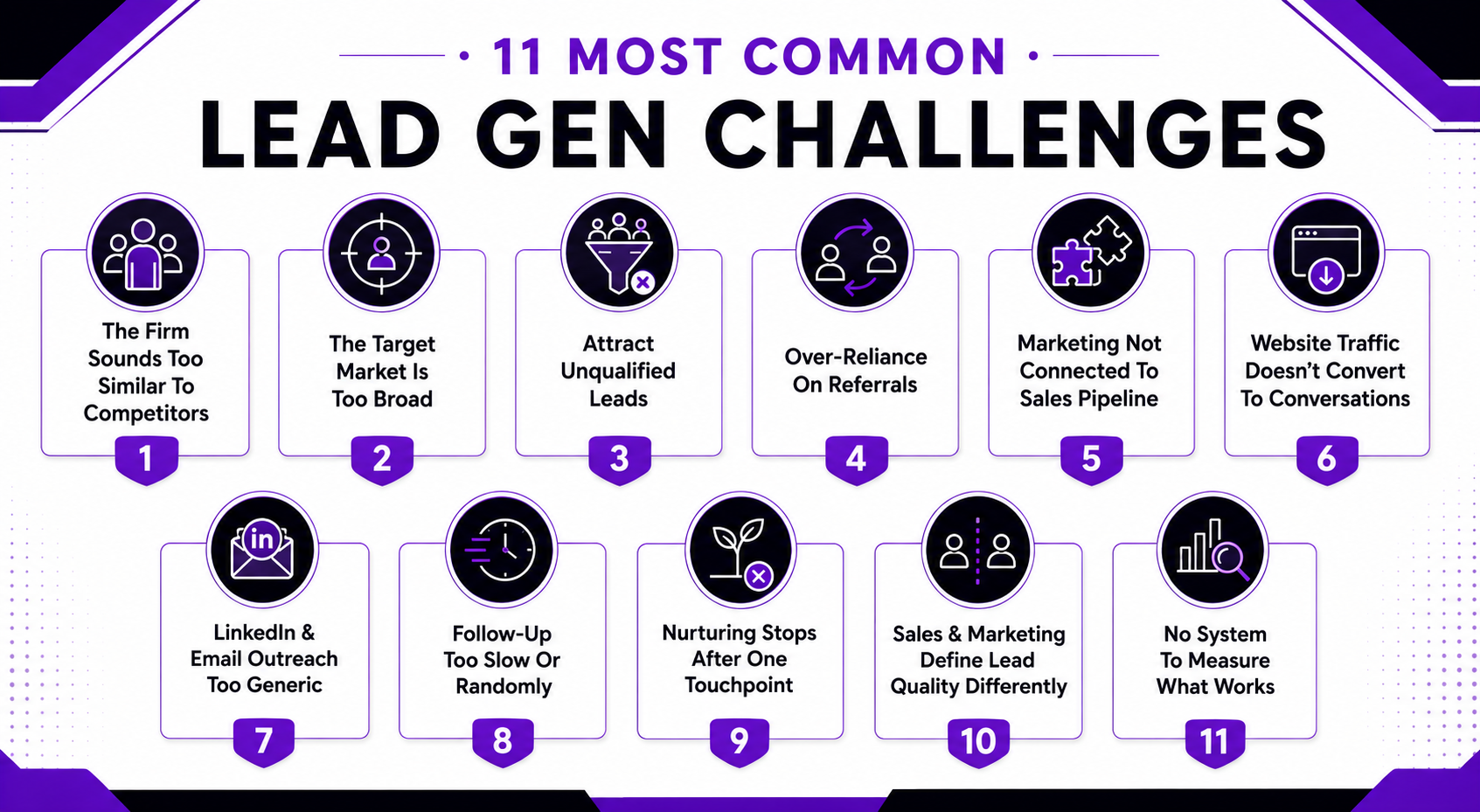
Trust breaks when firms ask for sales calls before proving expertise or relevance.
Broad targeting usually creates more unqualified leads, not a stronger pipeline for firm growth.
Referrals can mask weak acquisition systems until growth slows or partners need scale.
Disconnected marketing activities make it harder to qualify, nurture, and convert prospects consistently.
Slow follow-up causes quality leads to decay before sales reps create real momentum.
Reporting should show qualified opportunities and revenue impact, not just lead volume alone.
Professional services firms operate in a trust-heavy buying environment. A prospect is not just evaluating price or availability. They are judging expertise, reputation, credibility, relationship fit, and whether the firm understands their pain points.
That makes the lead generation process more fragile. A generic ad, vague website, or automated email sequence can damage trust faster than it creates demand. Professional buyers usually need proof, education, and repeated engagement before they are ready to convert.
The sales cycle is often long because the deal may involve partners, executives, department leaders, finance teams, or other decision makers. Even when the pain is real, urgency can move slowly. That means the firm needs a strategy for nurturing interest, not just capturing new leads.
The biggest obstacle is usually not one tactic. It is the lack of a connected system for positioning, targeting, content, outreach, conversion, follow-up, and pipeline measurement.
Most professional services firms do not have one obvious lead generation failure. The problem is usually a collection of smaller breaks: unclear positioning, a target market that is too wide, weak conversion paths, inconsistent follow-up, and poor alignment between marketing and sales.
Each issue can look manageable in isolation. Together, they lower lead quality, slow the sales process, weaken trust in the pipeline, and make it harder to know which lead generation efforts are actually creating revenue opportunities.

Professional buyers do not respond to claims they have seen a hundred times before: experienced team, strategic partner, tailored solutions, trusted advisor, client-first approach. Those phrases may be true, but they do not help a prospect understand why one firm is better suited for a specific business problem than another.
This usually shows up across websites, service pages, ads, proposals, and outreach messages. The firm explains what it does, but not the client situation it solves best. A management consulting practice, for example, should not stop at “we help organizations improve performance.” That leaves too much work for the buyer.
Does the firm help PE-backed companies integrate acquisitions? Does it help CFOs fix reporting gaps after ERP expansion? Does it help services companies improve utilization, margin discipline, or operating visibility? Specificity gives buyers a reason to self-qualify.
A stronger position connects three things: the buyer, the pain point, and the business outcome. That makes marketing sharper, improves conversion, and helps the sales team qualify prospects faster because the conversation starts with clearer expectations.
A broad target market feels safer because it creates the illusion of more opportunity. In reality, it often increases lead volume while lowering fit. The firm starts attracting prospects that technically sit in the category but lack urgency, budget, authority, or a strong use case.
That creates wasted effort for sales reps, weaker conversion rates, and a pipeline that looks active but does not move reliably. A sharper target does not limit growth. It gives the firm a better filter for deciding which prospects deserve time and resources.
Industry fit: The firm should know which industries produce the strongest client outcomes, not just which industries could theoretically buy.
Company profile: Company size, revenue band, operating complexity, and growth stage often determine whether a prospect is commercially viable.
Buying trigger: Accounts facing expansion, compliance pressure, system changes, leadership transitions, or stalled growth usually convert more reliably than passive browsers.
Decision-maker access: Targeting should reflect who can influence or approve the engagement, not only who consumes the content.
Commercial value: Some leads may eventually convert but still produce weak revenue, long sales cycles, or low-margin work.
Read Next: Signal-Based Prospecting Sounds New—It’s Actually Been Table Stakes for Years
Unqualified leads usually come from a mismatch between offer, channel, and buyer intent. The problem is not always that marketing is failing to generate interest. Often, it is generating the wrong kind of interest. A downloadable checklist, low-commitment ad, or broad educational article can bring in contacts who are researching casually, outside the target market, or too early to convert into a serious sales lead.
That creates downstream friction quickly. Sales reps review form fills that do not meet the firm’s qualification threshold, marketing celebrates volume that does not become pipeline, and leadership sees acquisition cost rising without enough revenue impact. Over time, confidence in lead generation drops because the firm associates marketing activity with wasted effort.
Fixing this starts with reviewing where poor-fit leads enter the system. Look at the source, the CTA, the landing page promise, the form fields, and what happens after submission. If a page attracts early-stage traffic, the conversion path should help qualify readiness rather than push every visitor toward a sales conversation. Better-fit conversion paths improve both lead quality and conversion rate because they ask for the right action at the right stage.
Referrals can produce quality leads, but they are not a complete lead generation strategy. They are difficult to forecast, hard to scale, and vulnerable to timing shifts outside the firm’s control. A strong quarter of referrals can make the sales pipeline look healthier than the underlying system really is, while a weak referral period can expose how little repeatable acquisition infrastructure exists.
This dependency becomes more dangerous as a firm grows. Practice leaders may want to enter a new market, increase revenue from a specific service line, or reduce concentration risk across a small set of relationships. Referrals alone rarely support that level of strategic control. They tend to reward existing reputation rather than deliberate positioning, nurture, and channel discipline.
A better model keeps referrals as one acquisition source while building additional channels that create predictable demand. SEO, content marketing, LinkedIn, email, and targeted outreach should help the firm generate new leads from buyers who have not yet entered the referral network but match the ideal client profile.
Plenty of firms stay busy without becoming effective. Marketing runs campaigns, publishes content, launches an ad, or sends an email, but none of that activity connects cleanly to qualification, follow-up, opportunity creation, or sales pipeline reporting. The firm can see effort, yet cannot see which effort improves revenue.
Disconnected source tracking: Leads enter the CRM without reliable source data, so channel performance becomes guesswork.
Weak handoff logic: Marketing may pass names to sales without clear qualification rules, context, or next-step expectations.
No lifecycle discipline: Contacts move through the funnel inconsistently because stages, ownership, and definitions are unclear.
Poor feedback loops: Sales knows which prospects are low-fit, but that information does not reshape targeting or campaigns.
Activity-based reporting: Dashboards emphasize traffic, clicks, and form fills instead of qualified opportunities and deal progression.
A firm does not need perfect attribution to improve this. It does need a usable lead generation process that connects channels to conversion, qualification, nurture, and pipeline outcomes. That is why CRM structure matters. Clean lifecycle stages, ownership rules, routing logic, and reporting fields make it possible to see what is actually working.
Read Next:
It is a common misconception that investing in SEO, thought leadership, or paid acquisition will help naturally convert visitors on the website into meetings. That assumption breaks when the page experience does not align with helping a buyer move from interest to action.
Several issues usually sit behind this obstacle. The page may speak too broadly, the CTA may ask for a consultation too early, the copy may not align with what the lead saw on the previous funnel stage, or the form may capture contacts without helping qualify them. In other cases, the traffic itself is not commercially useful. A page might rank well for educational keywords that generate attention but not buying intent.
A better website treats conversion as part of the full sales funnel, not an isolated web metric. Each page should align with the visitor’s stage, clarify who the offer is for, show proof, reduce uncertainty, and give an appropriate next step.
For related guidance, see Conversion Rate Optimization Tips: Best Practices to Improve Website Conversion and CRO Performance.
Professional services outreach fails when it sounds mass-produced, under-researched, or disconnected from the prospect’s business situation. Buyers can recognize templated messages quickly.
For example, an ERP advisory practice will struggle if it sends every CFO the same pitch about improving operational efficiency. A more effective approach would reference a relevant trigger, such as post-acquisition integration, reporting delays, system expansion, or platform dissatisfaction. That gives the prospect a reason to believe the outreach is informed, not generic.
Weak prospect research: Messages reference job title or industry but miss the specific pain points shaping the buyer’s priorities.
No timing signal: Outreach happens without any evidence of urgency, change, or in-market behavior.
Generic value proposition: The message describes the sender’s firm instead of naming a credible business problem.
Thin sequencing: One email and one LinkedIn message rarely create enough engagement in a long B2B sales cycle.
Over-automation risk: Automation can support scaling, but it damages reputation when personalization is superficial or false.
Read Next:
Lead follow-up breaks more deals than many firms realize. A qualified prospect may submit a form, reply to an email, or engage with content, but if no one owns the next step clearly, momentum fades. In professional services, delay is especially costly because the buyer is often evaluating several options while trying to define the problem internally.
Random follow-up creates a second problem: inconsistent client experience. One sales lead receives a fast, relevant response, while another waits two days and gets a generic note. That inconsistency damages conversion and also affects brand perception. Buyers often interpret slow or vague follow-up as a signal that delivery may be equally disorganized.
Firms need ownership rules, timing expectations, CRM notifications, and a process for deciding what happens after each meaningful engagement.
Read Next: What Is a BDR? How Business Development Representatives Accelerate Sales & ROI.
Most professional services buyers are not ready to buy on the first conversion. They may understand the problem but still need internal buy-in, budget approval, technical evaluation, or confidence in the firm’s expertise. When lead nurturing stops after one form fill or one outreach attempt, the firm loses prospects who were interested but not yet ready.
This happens because the team treats every lead as either an immediate sales opportunity or a dead end. Neither approach fits a long consideration cycle. Buyers need a nurture path that helps them keep learning, compare options, and return when urgency increases. That path might include case studies, benchmarking content, targeted email sequences, webinar invitations, or practical diagnostic resources.
Effective lead nurturing does not mean sending generic newsletters. It means matching content and follow-up to the buyer’s stage, pain points, and likely objections. That improves engagement while helping the firm convert more of the right prospects over time.
Misalignment between marketing and sales creates one of the most expensive lead generation challenges in professional services. Marketing may count a lead as a success when a prospect fills out a form. The sales team may not consider that same contact viable unless the company fits the target market, the buyer has authority, the timing is active, and the need matches the firm’s practice area. When those definitions diverge, reporting looks acceptable while pipeline quality declines.
Different qualification thresholds: Marketing optimizes for contact volume while sales prioritizes commercial fit and readiness.
Unclear MQL logic: A score or lifecycle stage may promote leads that lack budget, urgency, or buyer authority.
No shared review process: Teams do not regularly examine which leads were converted, stalled, or disqualified.
Weak closed-loop feedback: Marketing does not receive enough detail on why sales rejected specific leads.
Confused ownership: No one decides when a prospect should stay in nurture versus move to direct selling.
A practical fix starts with a shared definition of what qualifies as a sales-ready lead. That definition should include fit, interest, urgency, and expected revenue value. Supporting systems matter too. Teams working through CRM structure and reporting issues should review B2B Marketing Automation Examples You Can Implement Today and 4 Ways Outsourced BDRs Improve Your Database Hygiene.
Without usable measurement, firms cannot tell whether a lead gen challenge sits in targeting, conversion, follow-up, nurture, or channel performance. They only see symptoms: cost per lead rises, new leads increase without better revenue, or the pipeline swings unpredictably month to month. That is not enough to guide a strategic response.
A workable measurement system should show more than marketing activity. It should track where leads came from, whether they qualified, how they moved through the sales pipeline, how long conversion took, and which channels influenced revenue. If reporting stops at website sessions or form submissions, the firm will keep optimizing the wrong things.
Measurement also protects time and resources. It shows which tactic is producing low-fit leads, which offer attracts the wrong buyer, where follow-up is delayed, and which channel deserves more investment. Firms that want a cleaner reporting foundation should build around CRM discipline first, then improve attribution and automation from there.
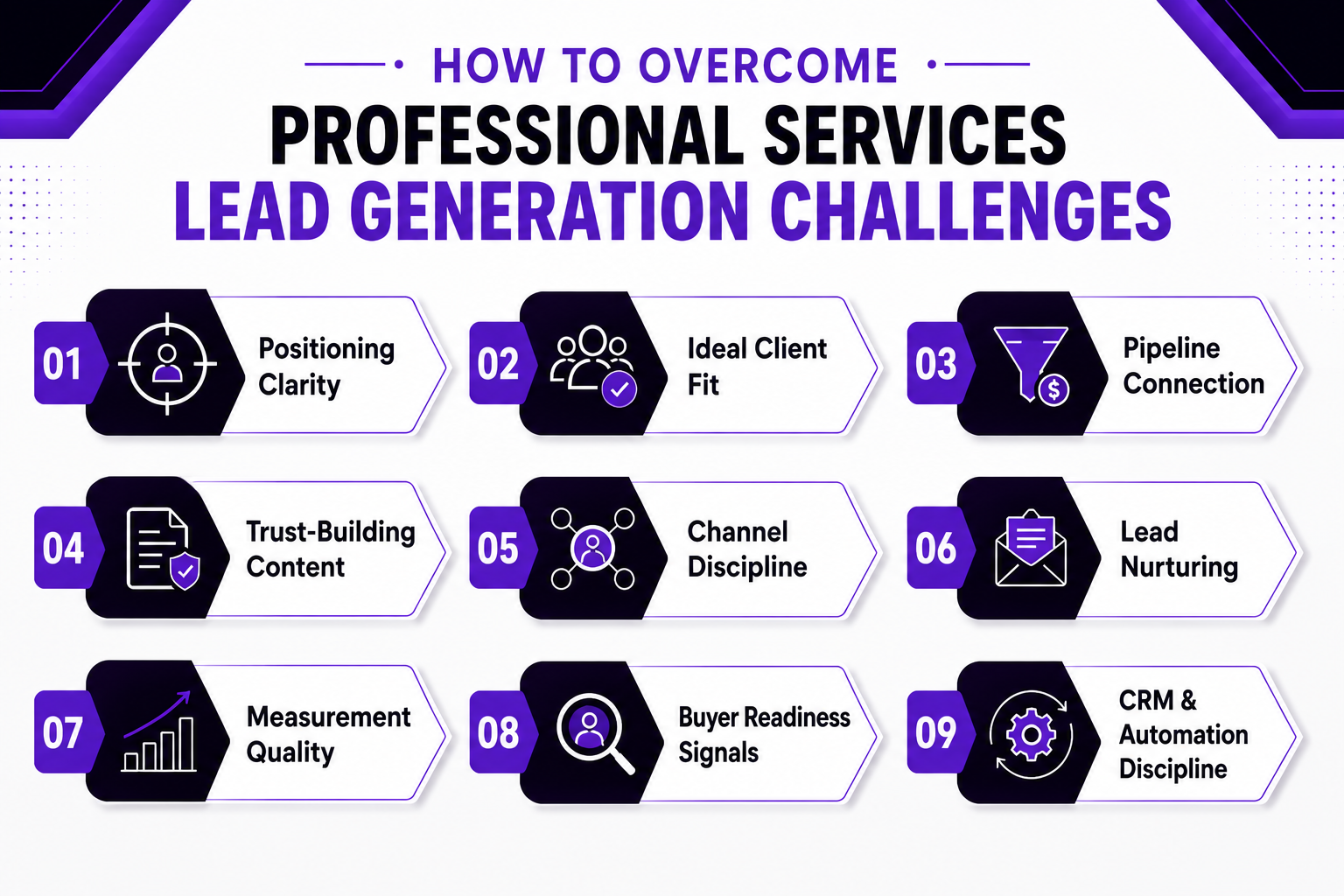
Professional services firms rarely fix lead generation by adding one new platform or one more campaign. Improvement comes from tightening the full system: who the firm wants to reach, what message it leads with, how it converts interest, how it qualifies leads, and how it measures progress through the sales pipeline. That structure helps marketing and sales work from the same logic instead of reacting to scattered signals.

Positioning Clarity: Explain who the firm helps, which pain points it solves, and why its expertise is relevant before increasing lead generation activities. More traffic will not solve a message that sounds interchangeable with every competitor.
Ideal Client Fit: Define the target by industry, company size, business model, urgency, decision makers, and revenue potential. A stronger fit improves quality leads, lowers wasted outreach, and makes the lead generation strategy easier to scale.
Pipeline Connection: Map every lead source to a clear sales process so contacts are captured, qualified, assigned, and tracked consistently. A good campaign cannot overcome a broken handoff or a missing follow-up workflow.
Trust-Building Content: Create content that helps buyers evaluate risk, understand options, and see proof of expertise. Professional services buyers often need evidence and education before they are ready to convert into a real sales conversation.
Channel Discipline: Use LinkedIn, email, SEO, content marketing, and paid acquisition as connected parts of one process. Each channel should support the same buyer journey instead of competing for attention with separate tactics.
Lead Nurturing: Build nurture sequences for prospects who are interested but not ready today. Relevant follow-up, useful content, and clear next steps help the firm generate better opportunities from leads that would otherwise stall.
Measurement Quality: Track lead quality, conversion rate, cost per lead, qualified opportunities, sales pipeline movement, and revenue impact. Those metrics reveal whether lead generation efforts are improving commercial performance or just increasing activity.
Buyer Readiness Signals: Use prospect research and buyer intent signals to prioritize outreach where interest is more likely to be real. That helps the firm qualify faster and avoid spending energy on poorly timed outreach.
CRM and Automation Discipline: Support the process with clean lifecycle stages, routing rules, notifications, and automation that improve consistency rather than create noise.
Most lead generation problems look simpler than they are. Teams often describe the symptom first: poor conversion, rising cost per lead, weak LinkedIn engagement, or sales complaints about lead quality. The more useful question is what that symptom reveals about the system behind it.
This table helps connect common professional services lead gen problems to the underlying cause and the first correction worth making. That matters because firms often spend budget fixing the visible issue while leaving the actual obstacle untouched.
| Lead Gen Challenge | What It Usually Means | What To Fix First |
|---|---|---|
| Leads are coming in, but not converting |
The offer, message, or follow-up does not match the buyer's intent |
Review conversion paths, forms, calls, and lead quality criteria |
| Most leads are unqualified | Targeting is too broad, or channels are attracting poor-fit prospects | Tighten the ideal customer profile and channel strategy |
| Website traffic is growing, but the pipeline is flat | Content may be attracting readers who are not ready or not relevant | Review keyword intent, page structure, and conversion opportunities |
| LinkedIn outreach gets low engagement | Messages may sound generic or disconnected from real client pain points | Improve prospect research, personalization, and outreach sequencing |
| Sales complains about lead quality | Marketing and sales may not agree on what a qualified lead means | Define lead qualification rules and feedback loops |
| Follow-up is inconsistent | There may be no clear ownership, CRM workflow, or follow-up process | Assign ownership, timing, notifications, and next-step rules |
| Cost per lead is rising | Paid channels may be targeting weak-fit audiences or unclear offers | Review ad targeting, landing pages, and conversion rate |
| The pipeline is unpredictable | Lead generation activities are not connected into one repeatable process | Build a system for targeting, nurturing, follow-up, and reporting |
Professional services lead generation improves when the firm stops treating marketing as isolated tactics and starts managing it as a connected revenue process. Buyers need to trust the firm, recognize their own problem in the message, and move through a clear path from first engagement to qualified conversation. When that structure is missing, lead generation activities create motion without a dependable pipeline.
Trust First: Professional services buyers need confidence, proof, and expertise before becoming sales-ready leads.
Fit Matters: Strong lead generation starts with a clear target market and ideal client profile.
Pipeline Discipline: Every channel should support qualification, follow-up, nurturing, and measurable revenue impact.
SmithDigital works with B2B companies and professional services firms that need data-driven strategies built around turning traffic into pipeline. That includes improving online visibility, strengthening the sales funnel, diagnosing growth blockers, and building a more reliable revenue engine around qualified leads and measurable outcomes.
Talk to a growth strategist to identify the growth blockers keeping your traffic, leads, and sales funnel from turning into a qualified pipeline.
The biggest challenges usually include vague positioning, broad targeting, unqualified leads, slow follow-up, low conversion, weak lead nurturing, and poor visibility into which marketing activities actually create pipeline.
Lead generation is harder because professional services buyers need trust, proof, and relevance before engaging, and the sales process often involves long cycles, multiple decision makers, and more careful evaluation than product-led purchases.
They generate higher-quality leads by tightening target criteria, improving messaging around specific pain points, aligning offers to buyer intent, strengthening qualification rules, and connecting marketing to a clear sales pipeline process.
They often attract unqualified leads when targeting is too broad, content appeals to low-intent readers, forms create low-friction conversions without enough qualification, or marketing and sales disagree on what a viable prospect looks like.
LinkedIn can support lead generation when firms use it for focused prospecting, informed outreach, credibility building, and relationship development tied to specific buyer problems rather than generic connection requests and templated sales messages.
Lead nurturing helps firms stay relevant with prospects who are interested but not ready yet by delivering useful follow-up, educational content, and timely next steps that increase trust and improve later conversion.
They should measure lead generation through lead quality, conversion rate, cost per lead, qualified opportunities, sales pipeline movement, and revenue impact rather than relying only on traffic, clicks, or raw lead volume.
They improve lead quality by agreeing on qualification criteria, sharing feedback on accepted and rejected leads, building cleaner CRM workflows, and reviewing which channels and offers actually produce sales-ready opportunities.
1 min read
B2B lead generation campaigns rarely fail because of one obvious mistake. More often, they underperform because of quiet problems that build up...

1 min read
Long sales cycles make weak lead generation look acceptable for far too long. Dashboards can show form fills, booked calls, and rising traffic while...
1 min read
Some B2B lead generation campaigns look successful on the surface, but fall apart once sales tries to turn the leads into revenue. The CRM may fill...