11 min read

Benefits of Outsourcing BDR Services: How to Cut Costs and 10x Your Pipeline

Written by Updated August 7, 2026
Picture of Eric Smith
Eric Smith

Eric Smith is the founder of SmithDigital, a revenue-focused growth partner that helps B2B companies generate qualified pipeline through a combination of SEO, AI discoverability, HubSpot optimization, outbound prospecting, and conversion-focused marketing. Over the past two decades, Eric has worked with software companies, ERP consulting firms, managed service providers, business brokers, technology consultants, and other B2B organizations looking to accelerate growth without building large inte...

Benefits of Outsourcing BDR Services: How to Cut Costs and 10x Your Pipeline

What if you could cut outbound sales costs by up to 70% while accelerating pipeline generation without adding headcount? As of 2026, that’s exactly what a growing number of B2B companies are achieving by outsourcing their BDR function, shifting a traditionally heavy operational burden into a more scalable, performance-driven model.

For sales and marketing leaders, the pressure is no longer just about generating more leads. It is about building a more predictable, repeatable revenue engine. Organizations are being pushed to create greater consistency across the sales funnel, reducing the lumpiness that often impacts pipeline, deal flow, customer acquisition, and revenue performance.

At the same time, teams are expected to deliver results faster, more efficiently, and with fewer resources. Long hiring cycles, inconsistent ramp times, rising overhead, and underperforming outbound efforts make it increasingly difficult to scale growth in a controlled and cost-effective way.

In-house BDR teams are costly, slow to ramp, and vulnerable to churn that quietly undermines pipeline momentum. Outsourced BDR programs, by contrast, provide near-immediate execution, compressing time to value and giving sales and revenue leaders a faster, more scalable way to generate qualified conversations.

The primary trade-off is control. External teams can dilute brand voice, misalign with internal sales processes, or prioritize volume over quality if not tightly managed.

The decision, then, is not simply whether to outsource. It is how to design and govern an outsourced BDR program, so it reinforces your go-to-market strategy rather than weakening it.

Leaders who treat outsourced BDRs as a true extension of their sales and marketing teams with clear KPIs, shared dashboards, and tight feedback loops are seeing faster pipeline velocity without sacrificing lead quality or brand integrity.

What Exactly Is a BDR?

A BDR (Business Development Representative) is primarily responsible for outbound lead generation. Their job is to identify potential prospects, run multichannel outreach, and ideally book qualified meetings for sales teams.

They generally don’t close deals, but without them it's difficult to build a consistent sales pipeline. Whether you staff internally or work with an outsourced BDR team, this role is critical to building predictability in your sales funnel.

Solid BDRs can increase pipeline volume quickly, prevent qualified leads from slipping through the cracks, and enable your sales team to focus on high-probability opportunities that are more likely to close in a shorter sales cycle. This is why more companies are turning to outsourced business development to grow faster without the weight of hiring, onboarding, and managing an internal team.

Why Outsource Your BDR Function?

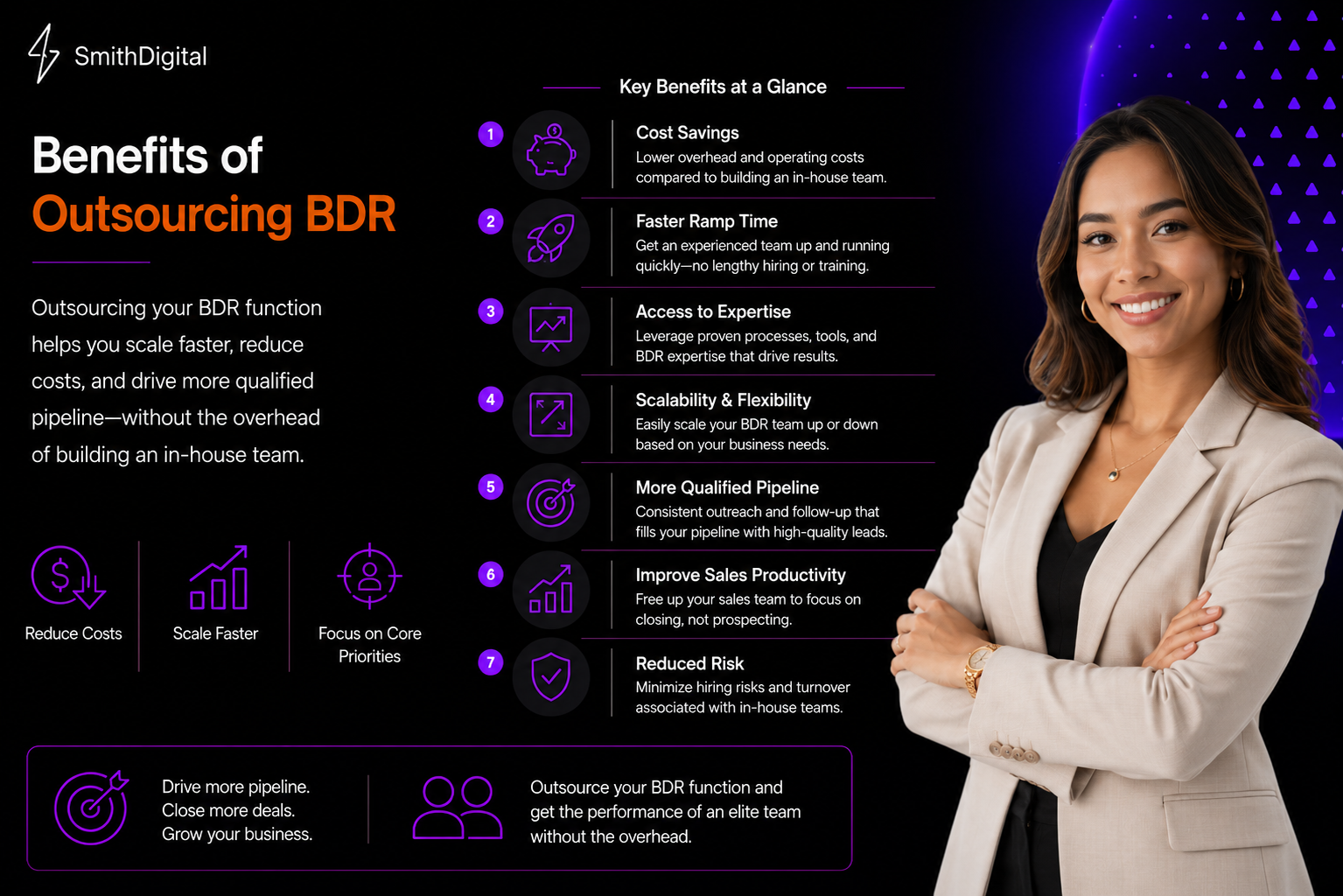
The benefits of outsourcing BDR go well beyond reducing payroll. A strong outsourced partner can provide the people, technology, expertise, processes, and management infrastructure needed to run an effective outbound program without requiring a company to build the entire function internally.

1. Lower and More Predictable Costs

An internal BDR program includes more than salary. Companies also absorb benefits, recruiting, commissions, technology, management, training, and turnover costs.

An outsourced model consolidates many of those expenses into a more predictable monthly investment, making it easier to track BDR success metrics such as cost per lead, cost per opportunity, cost per deal, and customer acquisition cost.

For companies looking to scale outbound without adding fixed overhead, outsourced BDR services can provide a more flexible alternative.

2. Access to Better Sales Technology

Modern outbound programs rely on sales intelligence, buyer intent data, CRM systems, dialing platforms, sequencing tools, data enrichment, and AI.

Leading BDR providers often already have enterprise-grade tools and established workflows in place. This can give clients access to capabilities such as ZoomInfo, third-party intent data, advanced dialing systems, and AI-powered prospecting without purchasing and managing the entire stack internally.

3. Industry and Domain Expertise

Outbound strategies vary significantly by industry.

Experienced BDR agencies understand the buyers, pain points, objections, sales cycles, and terminology within the markets they serve. That knowledge can reduce the learning curve and help companies avoid generic messaging or poorly targeted outreach.

4. Proven Playbooks and Experience

Experienced providers have seen what works—and what does not—across many campaigns.

They bring established playbooks for targeting, messaging, call strategy, qualification, follow-up, and sales handoff while helping clients avoid common mistakes that can sink an outbound program before it gains traction.

That institutional knowledge can take years to develop internally.

5. Faster Ramp and Easier Scalability

Building an internal BDR team requires recruiting, onboarding, training, and time to reach full productivity.

An outsourced provider already has much of that infrastructure in place, allowing companies to launch faster and add capacity without repeating the hiring process each time they need another representative.

6. Less Burden on HR and Sales Leadership

Internal teams create significant administrative overhead.

HR must recruit, interview, onboard, and replace employees, while sales leaders are responsible for training, coaching, performance monitoring, and managing turnover.

With outsourcing, much of that responsibility shifts to the provider, freeing internal teams to focus on strategy, customer relationships, and closing revenue.

7. Vendor Co-Op and MDF Funds May Offset Costs

For technology resellers, software partners, and other companies participating in vendor programs, outsourced BDR services may offer an additional financial advantage.

Some vendors allow co-op marketing dollars or market development funds (MDF) to be used for approved third-party lead generation or outsourced marketing services, even when those funds cannot be applied toward internal salaries or certain software expenses.

When available, this can materially reduce the net cost of the program. Eligibility varies by vendor, so companies should confirm the specific program rules before assuming reimbursement is available.

8. More Focus on Closing Revenue

Outsourcing allows internal salespeople to spend less time building lists, prospecting, managing sequences, and chasing early-stage leads.

Instead, BDRs can focus on generating qualified conversations while account executives and sales leaders concentrate on discovery, proposals, negotiations, and closing business.

Ultimately, the value of outsourcing is not simply lower-cost labor. It is the ability to access specialized people, technology, expertise, and proven processes without having to build and manage the entire outbound function internally.

Potential Reasons to Avoid BDR Outsourcing

While outsourcing BDRs can support growth, it’s not foolproof. If you pick the wrong outsourcing partner or treat it like a turnkey solution, you risk damaging your pipeline instead of building it. Here are the biggest pitfalls:

Brand Voice Dilution

In complex industries, an outsourced team may not immediately capture your exact tone, positioning, or messaging. Without close alignment, outreach can sometimes come across as generic or slightly off-brand, especially in high-stakes sales development efforts.

Inconsistent Quality

Some providers staff junior reps with little training or industry context. Poor list building, overreliance on AI-generated cold outreach, and sloppy execution can undermine trust and derail your pipeline generation efforts.

Communication Gaps

When outsourced BDRs operate in a silo, it creates friction with your internal sales team. Missed handoffs, redundant outreach, or a lack of feedback loops kill momentum and lead quality.

Loss of Control

You don’t manage their hiring, training, or workflows. That means less visibility into performance and fewer levers to pull when things break. For some orgs, the reduced level of control outweighs the upside.

Misaligned Goals

Without shared KPIs, even a good BDR partner can drift off course. Make sure your business goals and success metrics are baked into the program from day one.

What Do Outsourced BDR and SDR Services Include?

Outsourced BDR and SDR services can cover much more than cold calling or appointment setting. The strongest programs combine prospect research, sales intelligence, buyer intent data, multichannel outreach, and account-based marketing tactics to identify the right prospects and engage them across multiple touchpoints.

While the terms BDR and SDR are often used interchangeably, there can be differences in how the roles are structured.

BDR Services vs. SDR Services

Sales Development Representatives, or SDRs, typically focus on qualifying leads and creating sales opportunities. Depending on the company, this can include responding to inbound inquiries, following up with marketing-generated leads, or conducting outbound prospecting.

Business Development Representatives, or BDRs, are more commonly associated with proactive outbound prospecting. Their role is to identify target accounts, find the right decision-makers, initiate conversations, qualify interest, and create opportunities for account executives or sales leaders.

In practice, many outsourced sales development programs combine both functions. The objective is less about the job title and more about building a repeatable process for identifying, engaging, qualifying, and converting prospects into sales conversations.

Cold Calling and Phone Prospecting

Phone outreach remains an important component of B2B prospecting, particularly when targeting specific accounts or decision-makers.

Outsourced calling services can include list development, direct-dial research, cold calling, objection handling, qualification, follow-up, and appointment setting.

Technology can also improve calling efficiency. Modern dialing platforms, sales intelligence databases, call analytics, and AI-assisted coaching allow BDR teams to reach more prospects while continuously improving messaging and call performance.

Outbound Email Services

Email allows BDR teams to reach a larger number of prospects while maintaining structured follow-up over time.

Effective programs go beyond sending generic mass emails. They combine segmentation, persona-specific messaging, personalization, sequencing, deliverability management, and performance testing to improve response rates.

Email also works particularly well when coordinated with phone and social outreach rather than operating as an isolated channel.

LinkedIn and Social Prospecting

LinkedIn prospecting gives BDR teams another way to research accounts, identify decision-makers, build familiarity, and engage prospects outside the inbox.

Social prospecting can include account research, profile engagement, connection strategies, direct outreach, content interaction, and coordinated follow-up.

When combined with calls and email, LinkedIn creates additional touchpoints and can make future outreach more recognizable and relevant.

Sales Intelligence and Buyer Intent Data

One of the biggest advantages of a modern outsourced BDR program is the ability to use data to prioritize outreach.

Sales intelligence tools can help identify target companies, organizational structure, job titles, direct contact information, technology usage, company growth, and other characteristics that indicate potential fit.

Third-party buyer intent data adds another layer by identifying companies that may be actively researching topics, products, or solutions related to what you sell.

Instead of treating every prospect equally, BDR teams can prioritize accounts showing stronger fit or buying signals and focus resources where the probability of engagement may be higher.

Multi-Channel Prospecting

The most effective outbound programs rarely rely on a single channel.

A prospect may ignore an email but answer a phone call. Another may recognize the company after seeing a LinkedIn interaction or display advertisement. Multiple coordinated touchpoints can create familiarity and reinforce the message over time.

A multichannel BDR program can combine:

  • Phone outreach
  • Personalized email sequences
  • LinkedIn prospecting
  • Buyer intent monitoring
  • Programmatic display advertising
  • Retargeting
  • Newsletter marketing
  • Content and thought leadership

The objective is to surround high-value accounts with relevant messaging rather than relying on one cold email or phone call to generate a response.

Account-Based Marketing and BDR Outreach

For companies pursuing high-value accounts, outbound BDR services can also be integrated into a broader account-based marketing strategy.

Rather than targeting thousands of companies equally, ABM focuses sales and marketing resources on a defined group of accounts that closely match the ideal customer profile.

Sales intelligence and intent signals can identify which accounts deserve attention. BDRs can then coordinate calls, emails, and LinkedIn outreach while marketing supports those efforts through programmatic advertising, retargeting, newsletters, and relevant content.

This creates a more coordinated approach in which prospects encounter the company through multiple channels before and during direct sales outreach.

At SmithDigital, our outsourced BDR programs are designed around this broader model. We combine sales intelligence, buyer intent data, multichannel prospecting, and account-based marketing tactics to help B2B companies identify the right accounts, reach the right people, and create more qualified sales opportunities.

The goal isn't simply to generate more activity. It's to use better data, better targeting, and coordinated outreach to improve the probability that sales teams are spending their time with companies that have a genuine reason to buy.

Key Considerations Before Outsourcing Your BDR Function

Outsourcing business development can accelerate pipeline generation, but choosing the right provider matters. Before engaging an outsourced BDR agency, make sure the program aligns with your market, sales process, technology, and expectations.

1. Define What a Qualified Opportunity Looks Like

Don't measure success solely by calls made, emails sent, or meetings booked.

Define the ICP, target personas, qualification criteria, and what must happen for a lead to become a sales-qualified opportunity. Then establish KPIs around meetings, qualified opportunities, conversion rates, pipeline generated, and ultimately revenue.

Activity metrics still matter, but they should explain performance—not become the definition of success.

2. Understand the Full Program Cost

Compare outsourcing against the fully loaded cost of building the same capability internally, not simply the salary of one BDR.

Consider recruiting, benefits, management, sales intelligence, CRM and prospecting technology, data, training, turnover, and ramp time. Also determine exactly what the provider's fee includes. Some outsourced programs include technology, databases, management, and campaign strategy, while others charge separately.

For companies participating in vendor programs, also determine whether co-op or MDF dollars can offset part of the outsourced program cost.

3. Evaluate the Technology and Data Stack

Ask what tools and data the provider brings to the engagement.

A sophisticated program may use sales intelligence platforms, third-party buyer intent signals, verified contact data, CRM integrations, dialing technology, email sequencing, AI, and other tools to identify, prioritize, and reach the right prospects.

Just as important, establish where the data lives, how activity is recorded in your CRM, and what information you retain if the engagement ends.

4. Look for Industry and Market Expertise

The provider should understand more than outbound sales and prospecting; they should understand your ICP, buyer personas, and the nuances of your particular industry.

Ask about experience in your industry, typical buying committees, sales cycles, objections, terminology, and the types of companies they have successfully targeted.

Industry knowledge can dramatically shorten the learning curve and reduce the amount of trial and error required to develop effective messaging and targeting.

5. Evaluate the Outreach Strategy

Avoid providers that depend entirely on one channel.

The strongest outsourced BDR programs coordinate phone, email, LinkedIn, sales intelligence, buyer intent data, and, where appropriate, broader account-based marketing tactics such as display advertising, retargeting, newsletters, and content.

The goal should be to create multiple relevant touchpoints around priority accounts rather than simply maximizing outbound activity.

6. Assess Communication and Market Alignment

Your BDRs represent your company directly to prospective customers.

Evaluate communication skills, professionalism, working-hour coverage, familiarity with your target market, and the provider's ability to represent your brand accurately.

Where the representatives are located matters less than whether they can communicate effectively with the people you sell to.

7. Set Realistic Expectations for Ramp and Results

Outbound is rarely an overnight lead-generation tactic.

Providers need time to refine targeting, test messaging, gather response data, learn objections, and optimize campaigns. Initial activity can begin relatively quickly, but building a predictable pipeline engine generally requires ongoing testing and iteration.

Be cautious of providers promising an unrealistic number of meetings or immediate ROI without first understanding your market, average deal size, sales cycle, and offer.

8. Demand Visibility and Accountability

You should know what is happening inside your program.

Look for clear reporting around outreach activity, conversations, meetings, qualification, opportunity creation, pipeline, and conversion rates. Ideally, those activities should also be visible within your CRM rather than existing only inside the agency's systems.

The best outsourced BDR relationships operate as an extension of your sales organization, with shared data, regular communication, transparent performance reporting, and clear accountability for results.

Selecting and Vetting Your BDR Outsourcing Partner

Choosing a BDR outsourcing partner is a high-impact decision. The right agency can accelerate pipeline generation and strengthen your sales process. The wrong one can create poor-quality meetings, inconsistent messaging, and wasted budget.

Proven Track Record

Look beyond testimonials and ask for evidence of performance.

A credible provider should be able to discuss metrics such as meetings generated, SQLs created, conversion rates, pipeline influenced, and campaign performance. Relevant case studies and client references are especially valuable because they show whether the agency has delivered results in situations similar to yours.

Third-party reviews on platforms such as G2, Clutch, and Trustpilot can provide additional context, but they should complement—not replace—real performance data and client conversations.

Industry Fit

Industry experience can significantly shorten the learning curve.

A provider that understands your market is more likely to recognize the right buyers, common pain points, buying triggers, objections, terminology, and sales dynamics. That can lead to stronger targeting and more relevant conversations from the start.

Ask specifically about experience with companies like yours, not simply whether the agency has worked somewhere within your broader industry.

Transparent Reporting

You should have clear visibility into how the program is performing.

Look for reporting that connects outreach activity to meaningful outcomes such as conversations, meetings, qualified opportunities, pipeline, and conversion rates. Ideally, activity should also be captured in or integrated with your CRM so your internal team has a complete view of each prospect and account.

Transparency makes it easier to identify what is working, where prospects are dropping off, and what needs to change.

References You Can Call

References remain one of the best ways to understand what it is actually like to work with an outsourced BDR provider.

Speak with current clients when possible and ask about onboarding, communication, lead quality, responsiveness, reporting, campaign adjustments, and how the agency handles challenges when performance falls short of expectations.

A strong provider should be comfortable letting satisfied clients speak for the quality of the relationship.

Best Practices for Getting More from an Outsourced BDR Program

Outsourcing BDR is not a set-it-and-forget-it strategy. The strongest programs operate as an extension of the internal sales organization and improve through ongoing communication, data, and feedback.

1. Align with Sales Weekly

Hold regular meetings between internal sales leadership and the outsourced team to align sales, marketing, and BDR efforts and review pipeline, meeting quality, conversion rates, objections, and campaign performance.

These conversations help identify problems early and keep targeting, messaging, and qualification criteria aligned with revenue goals.

2. Equip the Team with the Right Information

Give your outsourced BDR team the same context you would provide an internal employee.

Share ICP definitions, buyer personas, product information, competitive positioning, case studies, objection handling, messaging guidelines, and examples of successful customer conversations.

The better they understand your business and buyers, the more effectively they can represent your company.

3. Create a Continuous Feedback Loop

Your account executives should regularly provide feedback on the opportunities being generated.

Which meetings were strong? Which prospects were poorly qualified? Which objections keep appearing? Which industries, job titles, or messages are producing the best opportunities?

Feeding that information back into the BDR program allows targeting, messaging, qualification, and outreach strategy to improve over time.

Should You Outsource Your BDR Function?

If your company needs more pipeline but does not want to build and manage an entire sales development operation internally, outsourcing can provide a faster and more flexible path to market.

The key is choosing the right partner and evaluating the program based on business outcomes—not simply calls made or emails sent.

A strong outsourced BDR partner should bring more than people. They should contribute sales intelligence, technology, industry expertise, proven playbooks, multichannel execution, transparent reporting, and a process for continuously improving results.

Start with clearly defined objectives, establish what constitutes a qualified opportunity, and measure the program against pipeline and revenue impact.

If you are evaluating whether outsourcing fits your sales strategy, SmithDigital’s outsourced BDR services combine sales intelligence, buyer intent data, multichannel prospecting, and account-based tactics to help B2B companies build pipeline without adding the operational burden of an internal BDR team.

Ready to Build a More Predictable Sales Pipeline?
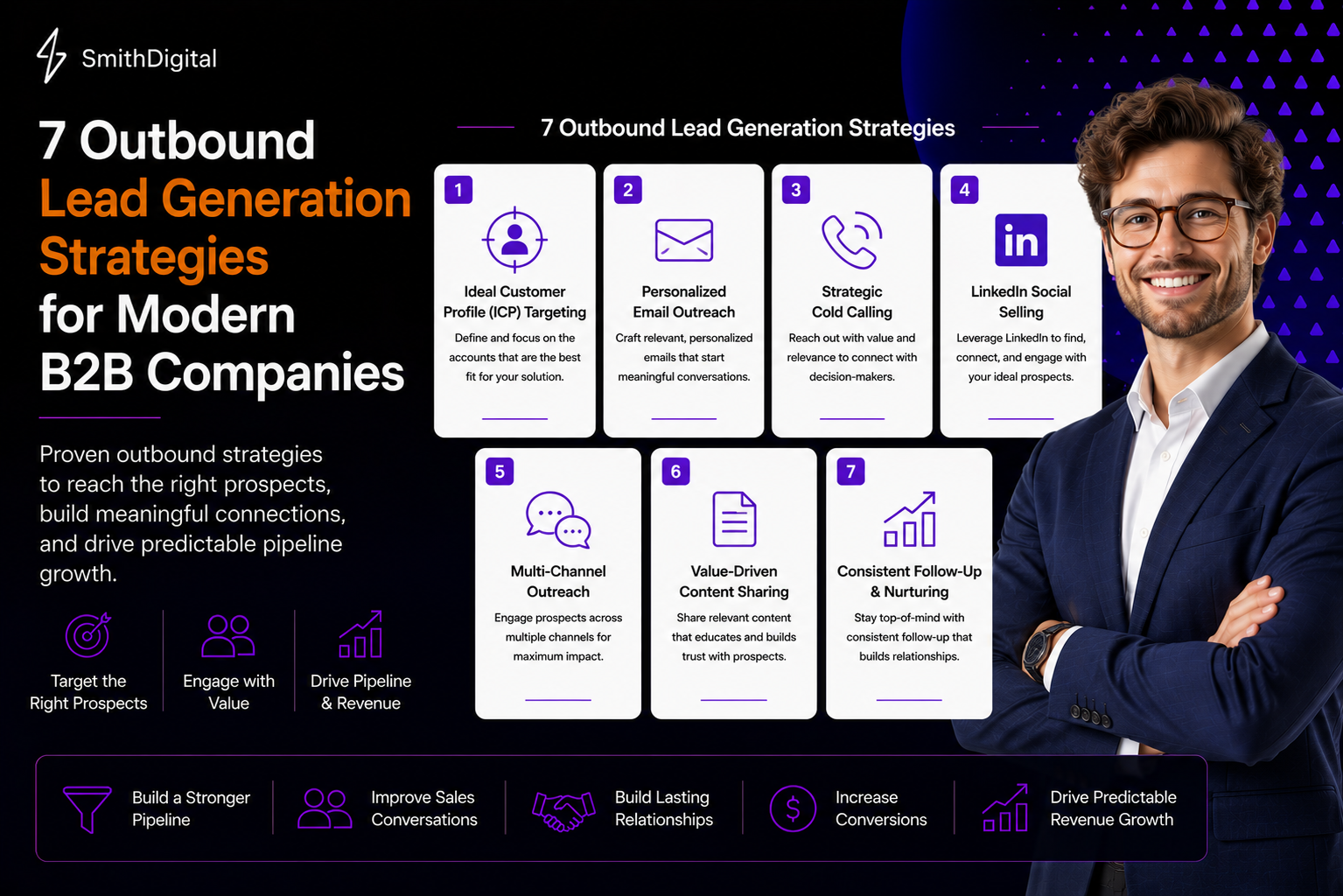
7 Outbound Lead Generation Strategies for Modern B2B Companies

1 min read

7 Outbound Lead Generation Strategies for Modern B2B Companies

The most effective outbound lead generation strategies help B2B companies identify the right prospects, start relevant sales conversations, and...

Read More
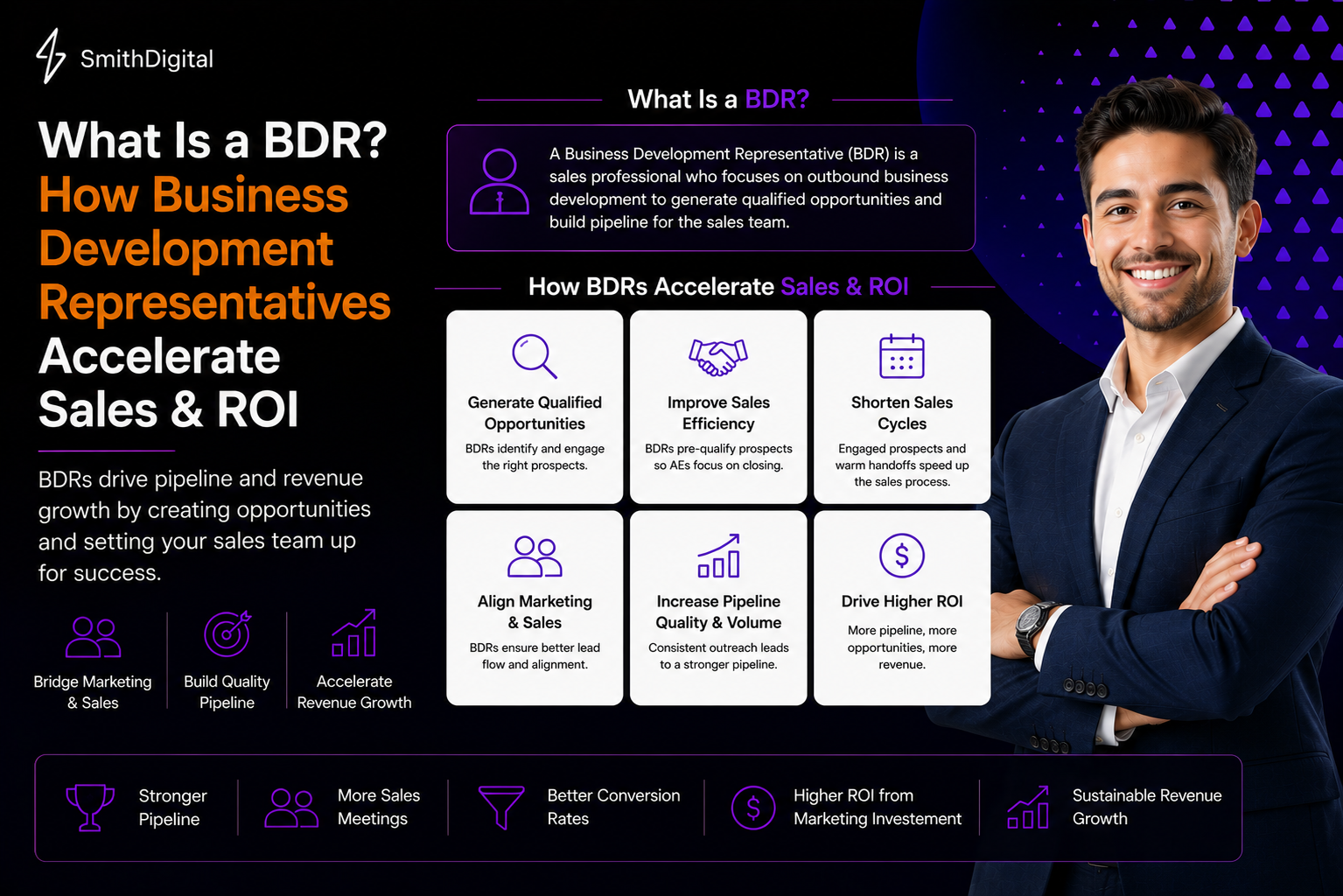
What Is a BDR? How Business Development Representatives Accelerate Sales & ROI

1 min read

What Is a BDR? How Business Development Representatives Accelerate Sales & ROI

“Why does the pipeline break down even when marketing is generating leads and sales is actively working them?” In many B2B organizations, the issue...

Read More
Outsourcing BDR Checklist: How to Choose the Right Partner

1 min read

Outsourcing BDR Checklist: How to Choose the Right Partner

Outsourcing your BDR team can unlock serious growth—but only if you choose the right partner. Are your reps stuck chasing cold leads while qualified...

Read More