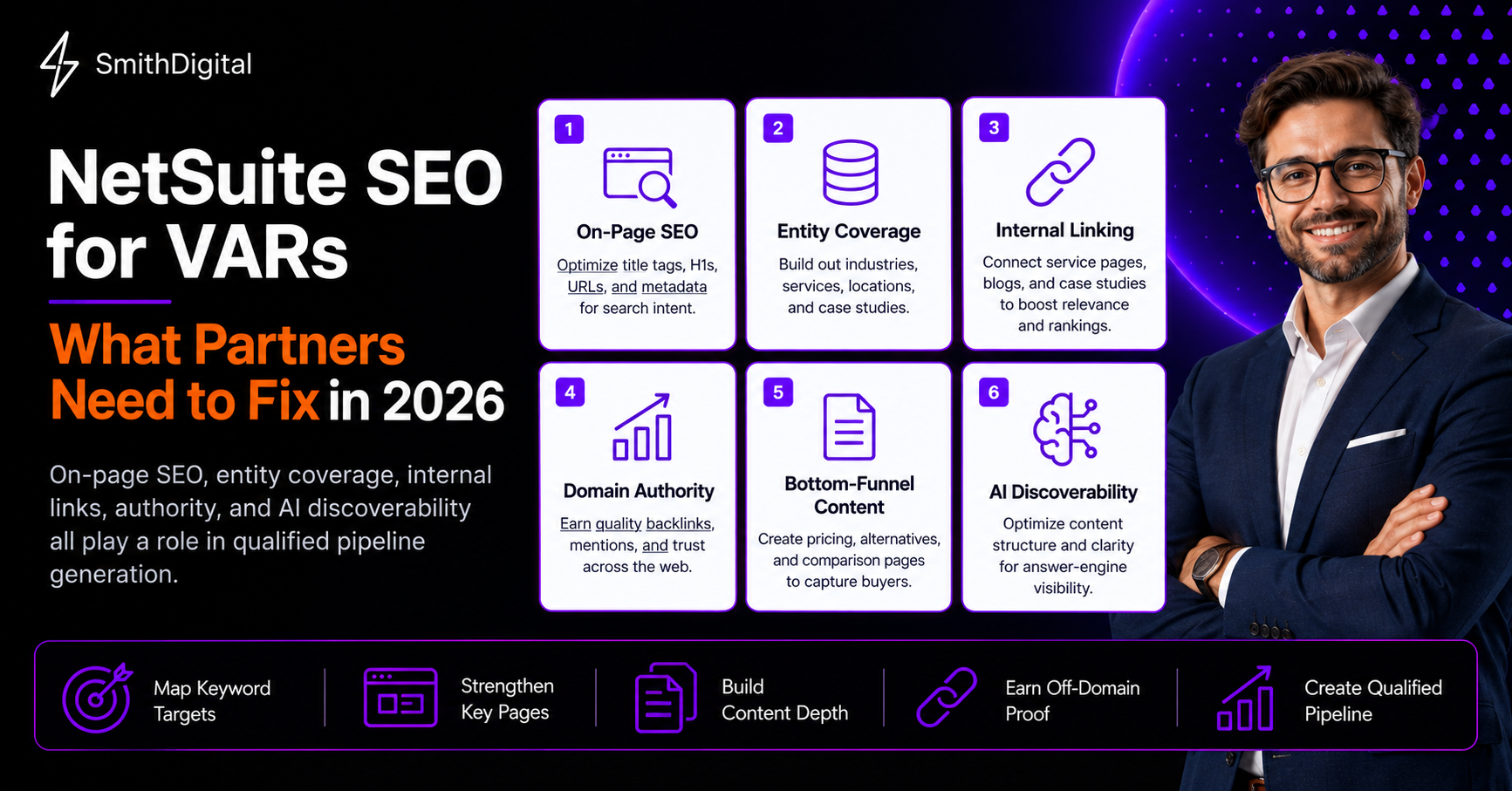
Why NetSuite Partners Struggle with SEO—and How to Fix It
Digital marketing has become the primary growth engine for ERP resellers, yet many NetSuite VARs still struggle to generate quality leads online. In...
%20(23).png?width=302&height=302&name=_SD%20web%20assets%202025%20(500%20x%20500%20px)%20(23).png)
ERP lead generation has changed more in the last two years than it did in the previous decade. For VARs and ERP consultancies, the challenge is no longer just standing out—it’s being discovered at all.
AI-driven research has replaced traditional search behavior. Prospective buyers now ask tools like ChatGPT, Google’s AI Overviews, and Perplexity direct questions about ERP pricing, implementation risks, and platform comparisons. Many of those questions are answered without a single website visit. If your content isn’t structured, specific, and credible enough to be surfaced by AI systems, you’re invisible during early-stage research—where most ERP shortlists are formed.
Vendor-generated leads are no longer reliable. Most ERP publishers have doubled down on direct sales. Partner ecosystems still exist, but lead distribution has thinned, become inconsistent, or disappeared entirely for smaller VARs. Relying on vendors to fill your pipeline in 2026 is no longer a strategy—it’s a risk. VARs that haven’t built independent demand generation capabilities are often one policy change away from stalled growth.
ERP buying cycles have become longer and more cautious. ERP decisions now involve larger buying committees, heavier financial scrutiny, and higher expectations around implementation success. Economic uncertainty hasn’t eliminated demand, but it has raised the bar. Buyers spend more time researching before engaging vendors, and they expect proof—case studies, comparisons, and clear implementation experience—long before a sales conversation begins.
Competition has intensified at the attention level, not just the product level. ERP buyers are flooded with content, ads, webinars, and comparison tools. Technical expertise alone is no longer enough to generate interest. Firms that win in 2026 are those that consistently show up during research with clear answers, differentiated positioning, and content aligned to real buyer questions—not generic marketing messages.
The opportunity hasn’t disappeared—but the rules have changed. ERP demand continues to grow, but the firms capturing it are the ones that understand modern discovery. VARs that invest in SEO fundamentals, AI-friendly content, and consistent education gain a compounding advantage, while those relying on referrals and outdated tactics fall further behind each quarter.
Bottom line: In 2026, ERP lead generation is defined by discoverability, credibility, and patience. VARs that adapt to AI-driven research, build independence from vendors, and align content with how buyers actually evaluate ERP systems can still build predictable pipelines—but only if they treat lead generation as a core capability, not a side project.
Even VARs with deep technical expertise and successful implementations often struggle to generate consistent ERP leads. The issue isn’t demand—it’s execution. In 2026, most ERP lead generation failures fall into a small number of predictable categories.
Many VARs still rely heavily on ERP publishers for referrals, despite years of evidence that vendor-led demand is unreliable. Lead volume fluctuates, quality varies, and priority almost always goes to direct sales teams or top-tier partners.
When vendor leads slow down—or disappear entirely—firms without independent lead generation systems are left scrambling. By the time most VARs decide to invest in marketing, they’re already behind and under pressure to produce immediate results, which rarely happens in ERP.
The risk: No control over pipeline, no predictability, and no leverage.
ERP buyers begin their journey with research—pricing, comparisons, risks, and implementation concerns. If your firm doesn’t appear during those searches, you’re not being considered.
Many VAR websites rely on shallow service pages, fail to target evaluation-stage keywords, and aren’t structured in a way AI systems or buyers can easily extract answers from—allowing prospects to form shortlists before these firms ever appear.
The reality: If you’re not visible during research, you’re invisible during selection.
ERP sales cycles routinely stretch 6–18 months and involve finance, operations, IT, and executive leadership. That complexity punishes inconsistent marketing.
VARs that publish sporadically, follow up irregularly, or disappear after initial contact lose deals—not because they’re unqualified, but because they’re forgotten. ERP buyers tend to move forward with firms that stay present and helpful throughout the evaluation process.
The challenge: Lead generation isn’t about speed—it’s about endurance.
Most VARs understand that content matters. Far fewer execute consistently.
Most VARs don’t fail at content because they lack ideas—they fail because content is reactive instead of intentional. Publishing only when sales slows down and chasing topics without buyer-intent alignment prevents content from ever compounding.
Without a clear content strategy, blogs become noise instead of assets. Google doesn’t reward randomness, and neither do ERP buyers.
The consequence: Missed rankings, wasted effort, and no compounding effect.
Even when VARs manage to attract the right traffic, many fail to convert it.
ERP buyers don’t want to talk to sales immediately—but they do want tools, clarity, and evidence. When websites rely on intrusive forms, bury value propositions below the fold, or fail to show real ERP experience through case studies and results, traffic leaks without a trace.
The outcome: Traffic without leads, and leads without context.
Bottom line: ERP lead generation breaks down when VARs rely on vendors, fail to show up during research, publish inconsistently, and neglect conversion fundamentals. These issues compound over time—making growth feel unpredictable even in a growing market. The firms that solve these challenges don’t chase tactics. They build systems.
Effective ERP lead generation is not about chasing every new tactic. In 2026, VARs that generate predictable pipelines follow a repeatable system built around how ERP buyers actually research, evaluate, and shortlist vendors.
ERP lead generation breaks down immediately without focus. The VARs that generate qualified leads consistently don’t target “any company that needs ERP.”
High-performing VARs narrow their scope by industry, company size, ERP platforms they implement best, and the types of projects they can deliver profitably. This focus determines everything downstream—from keywords to messaging to conversion paths. Without it, traffic may increase, but lead quality won’t.
Rule: If you can’t clearly describe your best-fit ERP client in one sentence, your lead generation will stay unfocused.
ERP buyers search very differently than casual SaaS buyers. High-quality ERP leads come from high-intent queries, not broad informational terms.
The keywords that drive real opportunities consistently fall into five categories: pricing and cost, comparisons, reviews and real-world experiences, best-for queries by industry or size, and problem-based searches tied to implementation or scaling challenges. These categories matter because they signal evaluation—not curiosity. Ranking for them means entering deals already in motion, not educating buyers who may never purchase.
Outcome: Fewer leads—but dramatically better ones.
By 2026, a significant portion of ERP research happens without clicks. Buyers ask AI tools direct questions and build shortlists before contacting vendors.
Content that performs in AI-driven research is specific and grounded in real ERP experience, written in natural language, and structured so answers can be extracted without interpretation. Pages that explain tradeoffs, risks, timelines, and real-world constraints outperform generic solution overviews.
If your content avoids specifics, AI systems will avoid it too.
ERP lead generation compounds over time—but only with consistency.
Winning VARs don’t publish randomly. They build content around buyer objections, implementation concerns, platform comparisons, and cost or ROI questions—the same issues that slow or accelerate ERP decisions internally. Consistency matters more than frequency. Monthly, bi-weekly, or weekly all work; sporadic publishing does not.
Each piece of content should serve a clear purpose: ranking for a defined keyword, answering a real buyer question, and supporting a specific stage of the buying journey. Without this discipline, content becomes busywork instead of an asset.
Most ERP buyers are not ready to talk to sales on their first visit. High-performing ERP websites reflect that reality.
Effective conversion paths include short forms, educational offers such as readiness assessments or implementation guides, visible ERP case studies, and clear next steps that don’t force an immediate sales call. The goal isn’t to close—it’s to capture intent and stay present throughout a long evaluation cycle.
ERP lead generation fails most often at this step, not at traffic.
Tactics like ABM, paid search, and outbound can accelerate results—but only after the fundamentals are in place.
VARs that skip directly to ads or outreach without a clear ICP, keyword coverage, credible content, and conversion-ready pages end up paying more for lower-quality conversations. Acceleration works best when it amplifies something solid—not when it compensates for gaps.
Bottom line: ERP lead generation in 2026 is not about volume—it’s about relevance, visibility, and trust. VARs that define their audience, show up during research, publish with intent, and remove friction from conversion build pipelines that compound over time. Those that chase tactics without a system stay stuck reacting.
ERP lead generation is the process of attracting and identifying companies actively researching, evaluating, or planning an ERP implementation. For VARs and ERP consultancies, this includes capturing interest through search visibility, educational content, and conversion paths that align with long, multi-stakeholder buying cycles.
Unlike transactional software sales, ERP lead generation focuses on early discovery and sustained evaluation—not immediate conversion.
ERP lead generation is more challenging in 2026 due to three major shifts: AI-driven research has reduced traditional website traffic, ERP vendors generate fewer partner leads, and buyers require more proof before engaging vendors.
Most ERP buyers now complete significant research—pricing, comparisons, and risk assessment—before ever speaking with a provider. VARs that are not visible during this research phase struggle to enter shortlists.
ERP lead generation is a long-cycle process. Most VARs should expect three to six months to see early inbound traction from SEO and content, and six to eighteen months to consistently convert leads into qualified opportunities.
The timeline depends on competition, keyword difficulty, content quality, and how well leads are nurtured during evaluation. Firms that publish consistently and focus on buyer-intent keywords see results faster than those chasing volume.
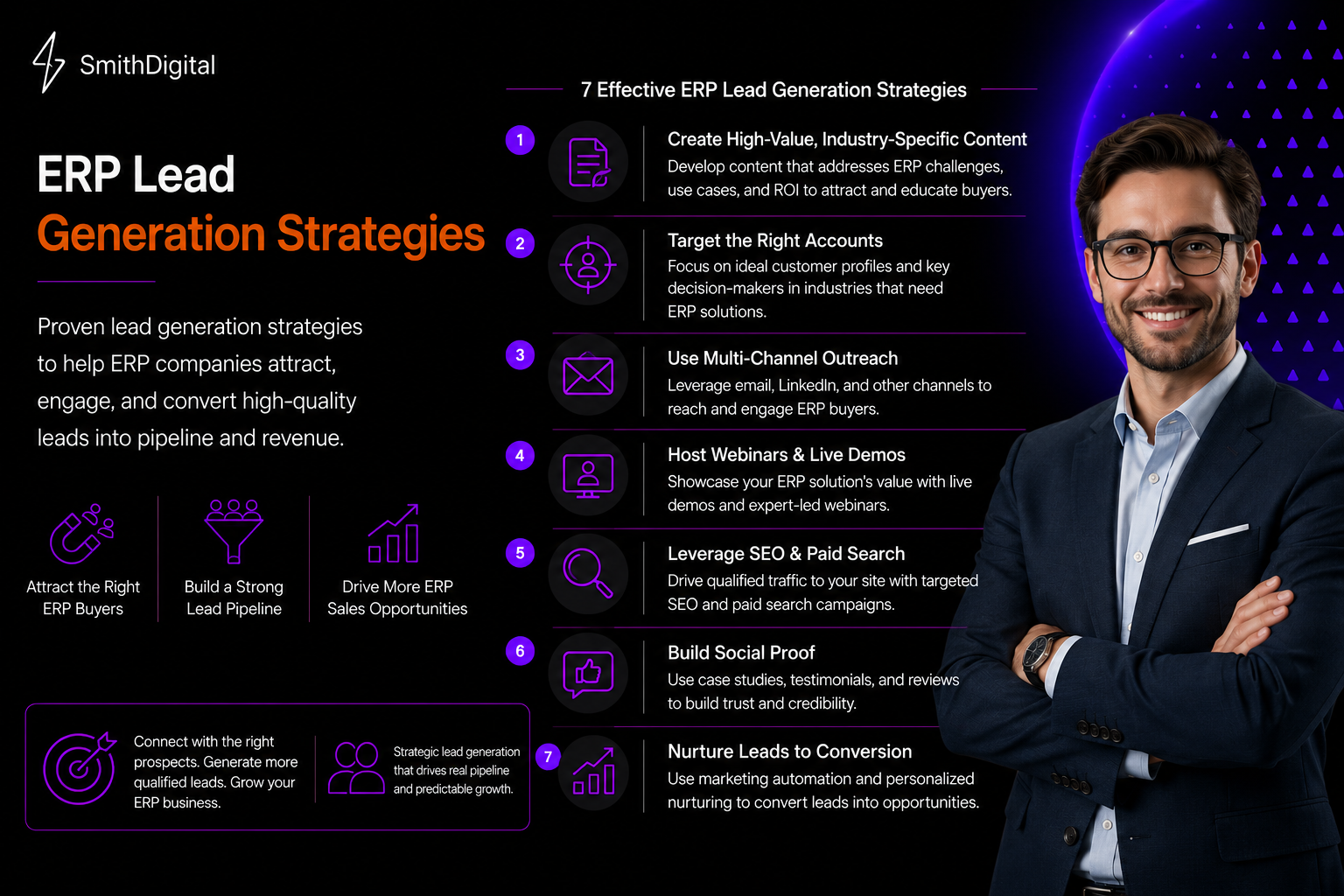
The most effective ERP lead generation strategies in 2026 include targeting high-intent keywords, creating structured and AI-friendly educational content, publishing consistently around buyer questions, optimizing websites for low-friction conversion, and building visibility independently of ERP vendors. Tactics like ABM and paid search can accelerate results, but only after these fundamentals are in place.
No. Vendor-generated leads can supplement pipeline, but they are unpredictable and increasingly prioritized for direct sales teams.
ERP VARs that rely exclusively on vendor referrals lack control over growth. Sustainable ERP lead generation requires independent visibility and demand creation, especially during early buyer research.
Content that generates the best ERP leads addresses pricing and implementation costs, platform comparisons and alternatives, common implementation risks and failures, industry-specific ERP use cases, and real implementation timelines and outcomes. This content attracts buyers who are actively evaluating options—not just learning what ERP is.
ERP lead generation in 2026 rewards firms that treat it as a core business system—not a collection of disconnected marketing tactics. Buyers research longer, trust fewer claims, and expect evidence before engaging. VARs that rely on vendor referrals, sporadic content, or short-term campaigns struggle to maintain momentum.
The firms that win build visibility early in the buying journey. They define a clear ideal customer profile, publish content aligned with real buyer questions, structure that content for both search engines and AI-driven research, and remove friction from conversion. Over time, this approach compounds—producing better conversations, shorter sales cycles, and more predictable pipeline.
There is no shortcut. But there is a repeatable path.
Digital marketing has become the primary growth engine for ERP resellers, yet many NetSuite VARs still struggle to generate quality leads online. In...
Is your BDR team generating qualified sales leads, or just logging activity? For RevOps leaders, that distinction is everything. When metrics focus...
The ERP market is evolving quickly, shaped by a more informed, digital-first buyer. Traditional outbound tactics like cold calls and trade shows no...