1 min read
13 min read
Should You Outsource Sales Development? A Buyer's Guide for B2B Companies
Eric Smith is the founder of SmithDigital, a revenue-focused growth partner that helps B2B companies generate qualified pipeline through a combination of SEO, AI discoverability, HubSpot optimization, outbound prospecting, and conversion-focused marketing. Over the past two decades, Eric has worked with software companies, ERP consulting firms, managed service providers, business brokers, technology consultants, and other B2B organizations looking to accelerate growth without building large inte...
Building a predictable pipeline has become one of the most difficult challenges for B2B sales and marketing teams. The cost of hiring and training experienced outbound reps continues to rise, turnover remains high across the industry, and scaling an internal team takes time most revenue leaders do not have. Outsourced sales development has emerged as a practical option for companies that need qualified meetings without the overhead of building everything from scratch. SmithDigital helps B2B companies navigate these decisions by aligning lead generation strategy with CRM infrastructure, buyer intent data, and sales enablement workflows.
This guide covers everything you need to know about outsourced BDR and SDR programs in 2026. You will learn how these services work, what pricing models exist, how to evaluate potential partners, and when outsourcing makes sense versus building in-house. The focus is on enterprise software companies, ERP consultants, MSPs, and B2B professional services firms with longer sales cycles and higher average contract values.
The goal is not to convince you that outsourcing is always the right answer. It is to give you the framework and specific criteria you need to make a decision that fits your business.
💡 TL;DR
- Outsourced SDR and BDR programs can reduce total sales development costs by 30 to 50 percent compared to building an internal team from scratch.
- Ramp time for outsourced programs typically runs 60 to 90 days faster than hiring internally because recruiting and training are already in place.
- Pricing models vary from monthly retainers to pay-per-meeting structures, with costs ranging based on ICP difficulty and qualification rigor.
- SmithDigital integrates outsourced prospecting with HubSpot CRM and buyer intent data to connect outbound activity with inbound engagement signals.
- The right fit depends on your average deal size, sales cycle length, internal sales capacity, and marketing maturity rather than universal rules.
What Is Outsourced Sales Development?
Outsourced sales development refers to hiring an external partner to handle top-of-funnel prospecting activities. Instead of recruiting, training, and managing SDRs or BDRs internally, you work with a specialized firm that runs outbound outreach on your behalf. These partners identify potential buyers, initiate contact through phone, email, and LinkedIn, qualify prospects, and book meetings for your internal sales team.
The service typically covers the entire front end of your sales process. Reps research target accounts, build contact lists, run multi-touch outreach sequences, handle objections, and pass qualified opportunities to your account executives. Some providers focus exclusively on appointment setting, while others operate as full sales and marketing partners that integrate with your CRM, marketing automation, and reporting infrastructure.
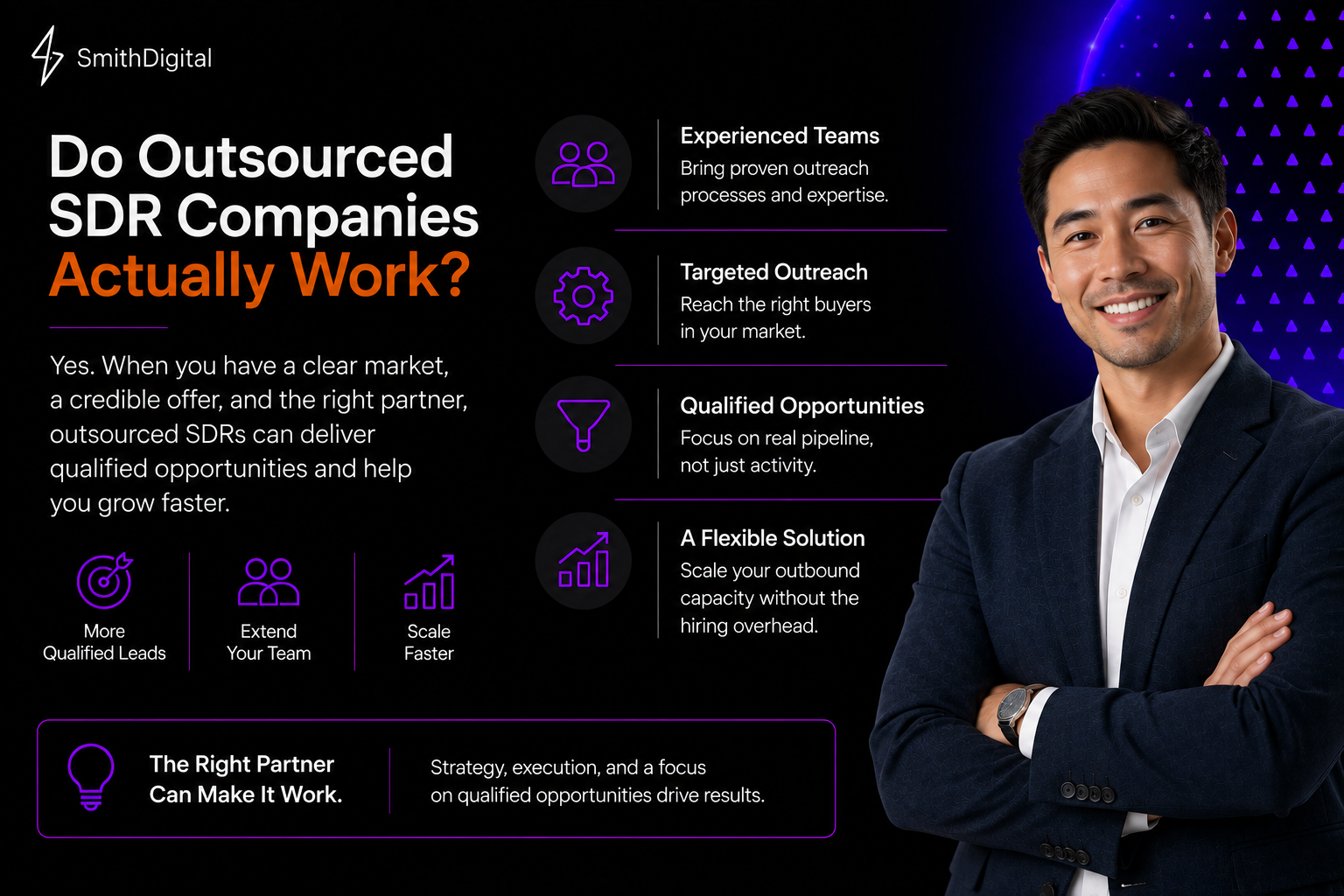
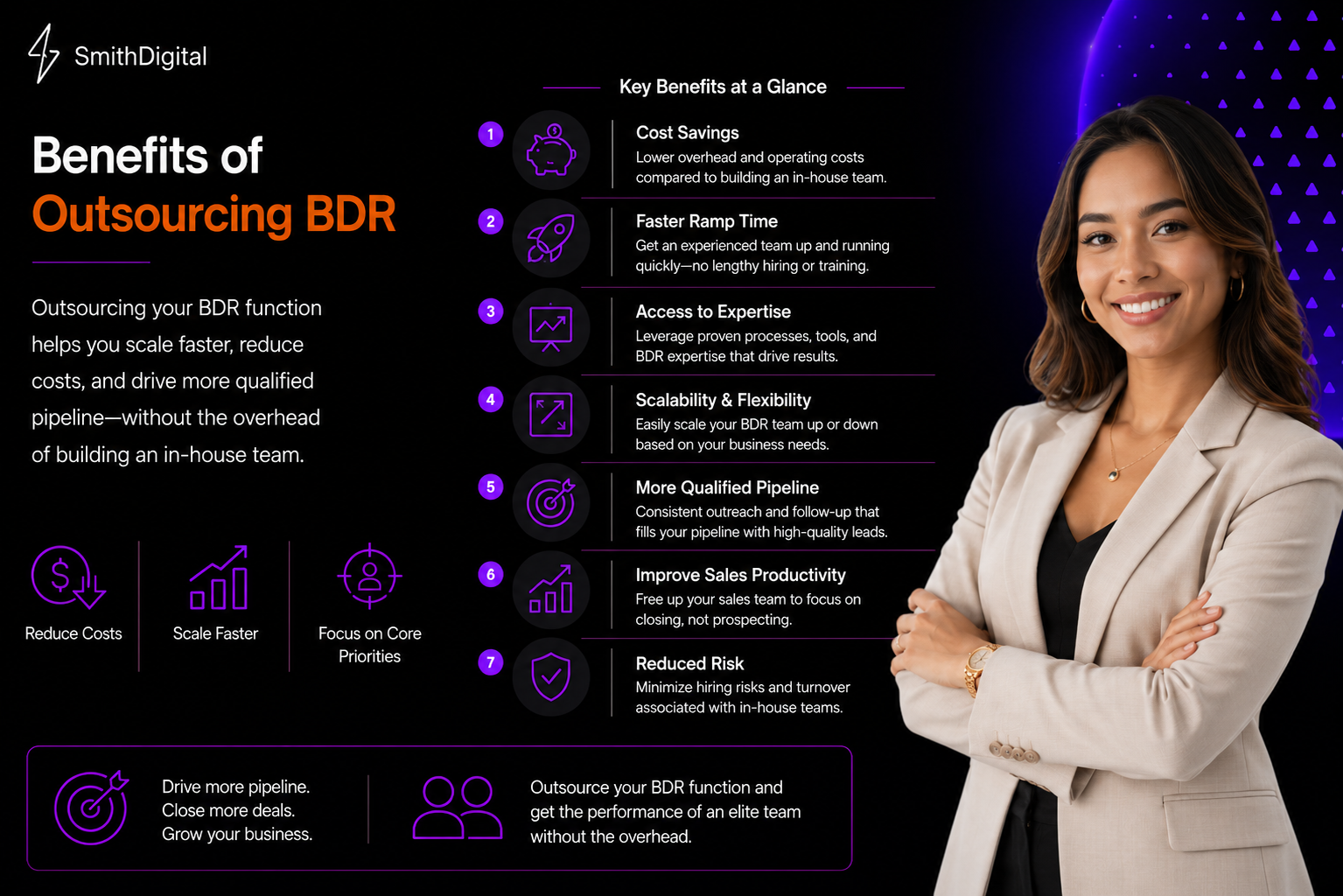
For enterprise software companies and B2B professional services firms, outsourced sales development fills a specific gap. Your account executives need qualified conversations, but sourcing those conversations requires dedicated prospecting resources. Outsourcing lets you access that capacity without the hiring delays, management overhead, and turnover risk that come with building an internal SDR function.
Why Do B2B Companies Outsource Sales Development?
The decision to outsource typically comes down to speed, cost, expertise, or some combination of the three. Each factor carries different weight depending on your current situation and growth objectives.
Speed to Pipeline
Hiring an internal SDR can take three to four months when you factor in recruiting, onboarding, and ramp time. Outsourced programs often go live within weeks because the partner already has trained reps, established processes, and the infrastructure to start outreach quickly. For companies facing near-term revenue targets or investor expectations, that time difference can determine whether you hit your numbers.
That pressure is showing up across sales organizations. Salesforce’s sixth State of Sales report found that 67% of sales reps did not expect to meet quota, based on a survey of 5,500 sales professionals worldwide. For revenue leaders, that makes pipeline generation more than an operational priority. It becomes a near-term performance issue.
Cost Efficiency
The fully loaded cost of an in-house SDR runs higher than most companies initially estimate. Base salary is only part of the equation. Add benefits, payroll taxes, recruiting costs, management overhead, training time, and software subscriptions, and the annual cost often exceeds what a single rep's output justifies. Outsourcing converts much of that fixed cost into variable spend that scales with your actual needs.
Access to Expertise and Tools
Outsourced providers bring playbooks, technology stacks, and operational knowledge that take years to develop internally. Many have experience across multiple industries and ICPs, which means they can ramp faster and avoid common mistakes. They also maintain subscriptions to data platforms, dialers, email automation tools, and third-party buyer intent data providers that would require significant investment to replicate in-house.
The technology gap is becoming harder to ignore. HubSpot’s 2025 sales research found that 84% of sales professionals use AI to optimize the sales process, while only 8% report not using AI at all. For companies building SDR programs from scratch, that means the real investment is not just headcount. It also includes the systems, data, automation, and enablement needed to make reps productive.
Reduced Management Burden
Managing an SDR team requires daily coaching, call reviews, performance tracking, and ongoing training. That management responsibility falls on your sales leadership, pulling time away from higher-leverage activities like deal strategy and AE development. Outsourcing shifts that burden to the partner, freeing your team to focus on closing.
How Outsourced SDR and BDR Programs Work
Most outsourced sales development engagements follow a similar structure. Understanding the workflow helps you evaluate providers and set realistic expectations for results.
Discovery and Onboarding
The engagement starts with a deep dive into your business. The provider learns your product, value proposition, ideal customer profile, target personas, and competitive positioning. They review your existing sales collateral, past outreach attempts, and CRM data. This phase typically takes one to three weeks depending on complexity.
List Building and Research
The partner identifies target accounts and contacts that match your ICP. Some providers expect you to supply lists, while others build them using data platforms like ZoomInfo, Apollo, or LinkedIn Sales Navigator. Quality matters here. Poor data leads to bounced emails, wrong numbers, and wasted rep time.
Outreach Execution
SDRs run multi-channel sequences that combine phone calls, personalized emails, LinkedIn messages, and sometimes video or direct mail. The cadence varies by provider and ICP. A typical sequence might include eight to twelve touches over three to four weeks. Reps track responses, handle objections, and advance interested prospects toward meetings.
Qualification and Handoff
Before booking a meeting, the SDR confirms that the prospect meets your qualification criteria. This might involve budget, authority, need, and timeline questions (BANT) or more detailed frameworks like MEDDIC. Qualified meetings get scheduled on your AE's calendar with detailed notes on the prospect's situation and interests.
Reporting and Optimization
Providers deliver regular reports on activity volume, response rates, meetings booked, show rates, and pipeline generated. Strong partners use this data to refine targeting, messaging, and channel mix over time. The goal is continuous improvement based on what resonates in your specific market.
Outsourced Sales Development Pricing Models in 2026
Pricing structures vary across the industry. Understanding the options helps you compare proposals and choose a model that aligns with your goals and risk tolerance.
Monthly Retainer Model
The most common structure is a fixed monthly fee for dedicated SDR capacity. You pay for a certain number of reps working on your account, and the provider handles recruiting, training, management, and tooling within that retainer. Monthly costs typically range from a few thousand dollars for nearshore or offshore options to significantly more for onshore US-based reps.
The retainer model aligns incentives around quality rather than pure volume. Since the provider gets paid the same regardless of how many meetings they book, there is less pressure to push loosely qualified opportunities. The trade-off is that you carry more risk if results fall short of expectations.
Pay-Per-Meeting Model
Some providers charge per qualified meeting delivered. Costs vary based on ICP difficulty, with simpler SMB targets at the lower end and C-suite enterprise personas at the higher end. This model shifts risk to the provider and makes budgeting more predictable.
The potential downside is incentive misalignment. Pay-per-meeting providers may prioritize booking volume over meeting quality, which can result in lower show rates and AE acceptance rates. If your sales team ends up on calls with prospects who do not fit your ICP, the apparent cost savings disappear.
Hybrid Pricing
Some engagements combine a smaller base retainer with performance bonuses tied to meeting volume or pipeline generated. This structure balances predictability with accountability. You cover the provider's baseline costs while creating upside for strong results.
Factors That Influence Cost
Several variables drive pricing beyond the basic model. ICP difficulty matters because reaching director-level and above requires more skilled reps and longer cadences. Total addressable market size affects efficiency since niche markets need more research per contact. Channel mix plays a role because phone-heavy programs typically cost more than email-first approaches. Compliance requirements add operational complexity in regulated industries.
How to Evaluate Outsourced SDR Companies
Not all providers deliver the same results. These criteria will help you distinguish partners who can actually move your pipeline from those who will waste your budget.
Industry Experience and Track Record
Ask whether the provider has worked with companies in your industry or with similar products. Experience with your buyer personas means faster ramp and more relevant conversations. Request case studies or examples of results they have delivered for comparable clients. Look for specifics on meeting volume, pipeline generated, and downstream conversion rather than vague claims.
SDR Quality and Training
The people making calls and sending emails on your behalf determine your results. Ask about rep experience levels, training programs, and ongoing coaching. Find out whether you will get dedicated reps or share capacity with other clients. Request to meet the team lead or account manager who will run your program.
Outreach Channels and Technology
Understand how the provider runs campaigns. Do they rely primarily on one channel, or do they execute coordinated multi-channel sequences? What sales engagement platforms, dialers, and data tools do they use? Can they integrate with your existing CRM and marketing automation stack? SmithDigital architects outbound programs around the HubSpot ecosystem, covering CRM structure, sequencing, pipeline tracking, automation, reporting, and sales handoff workflows.
Lead Sourcing and Data Quality
Data quality directly affects outreach effectiveness. Ask how the provider builds and verifies contact lists. Do they use multiple data sources? What is their process for keeping records accurate? Poor data leads to bounced emails, wrong contacts, and wasted effort.
Qualification Framework
Clarify how the provider qualifies prospects before booking meetings. What criteria must a contact meet? How do they handle objections and disqualify poor fits? Make sure their definition of a qualified meeting matches yours. Misalignment here leads to frustration and finger-pointing later.
Reporting and Transparency
Strong partners share detailed metrics on activity, responses, meetings, and outcomes. Ask what reports you will receive and how often. Look for providers who connect their effort to downstream results like pipeline value and closed revenue, not just vanity metrics like emails sent.
References and Reviews
Always talk to current or former clients. Ask about onboarding experience, communication quality, meeting volume, and whether they would hire the provider again. Independent reviews on platforms like G2 or Clutch can supplement reference calls.
When Should You Outsource Sales Development?
Outsourcing makes sense in specific situations. The decision depends on your current resources, growth stage, and operational priorities.
You Need Pipeline Quickly
If you have a near-term revenue target and cannot wait months to hire and ramp internal reps, outsourcing offers a faster path to qualified meetings. The provider absorbs the recruiting and training timeline that would otherwise delay your pipeline.
Your Deal Sizes Justify the Investment
Outsourced sales development works best when your average contract value supports the customer acquisition cost. Companies selling solutions with annual values of fifteen thousand dollars or more typically see positive ROI. Lower-value transactions may not generate enough margin to cover outsourced program costs.
You Have Internal Sales Capacity to Close
Outsourcing fills the top of your funnel. You still need account executives to run discovery, manage opportunities, and close deals. If your AE team is already overloaded or undersized, adding more meetings may not help. Make sure you have the downstream capacity to convert the pipeline you generate.
Your ICP Is Well Defined
Outsourced partners work from the ideal customer profile you give them. If you cannot clearly articulate who you are targeting, what problems you solve for them, and why they should care, outbound outreach will underperform. Invest time in defining your ICP before engaging a provider.
When Should You Build Sales Development In-House?
Outsourcing is not always the right answer. Several scenarios favor keeping SDRs on your payroll.
Deep Technical Pre-Qualification
Some products require extensive product knowledge to have credible conversations with prospects. Security tools sold to CISOs, complex data infrastructure, or custom enterprise integrations may need reps who have spent months learning your platform inside out. Outsourced providers can ramp on most products, but the most technical ICPs sometimes benefit from in-house expertise.
SDRs Performing Junior AE Work
If your SDR role involves running discovery, scoping solutions, or even quoting, you are describing junior AE responsibilities rather than pure prospecting. Outsourced providers handle top-of-funnel outreach and qualification. They typically do not run a full sales cycle.
You Need an AE Pipeline
Many companies use the SDR role as a training ground for future account executives. Internal SDRs learn your product, sales motion, and company culture before promoting into closing roles. Outsourcing removes this development path.
You Already Have a Working SDR Function
If you have an established SDR team with a strong manager, proven hiring process, and consistent results, the marginal cost of adding another internal rep may be lower than starting an outsourced program. Outsourcing offers the most value when you are building from scratch or need rapid scale.
How Buyer Intent Data Changes Outsourced Sales Development
One of the most significant shifts in B2B prospecting is the growing overlap between inbound intent and outbound execution. Companies that integrate these motions outperform those that treat them as separate functions.
Buyer intent data identifies accounts showing signals that they may be in-market for your solution. These signals include website visits, content downloads, webinar attendance, pricing page views, competitor research, and third-party intent data from platforms that track buying behavior across the web.
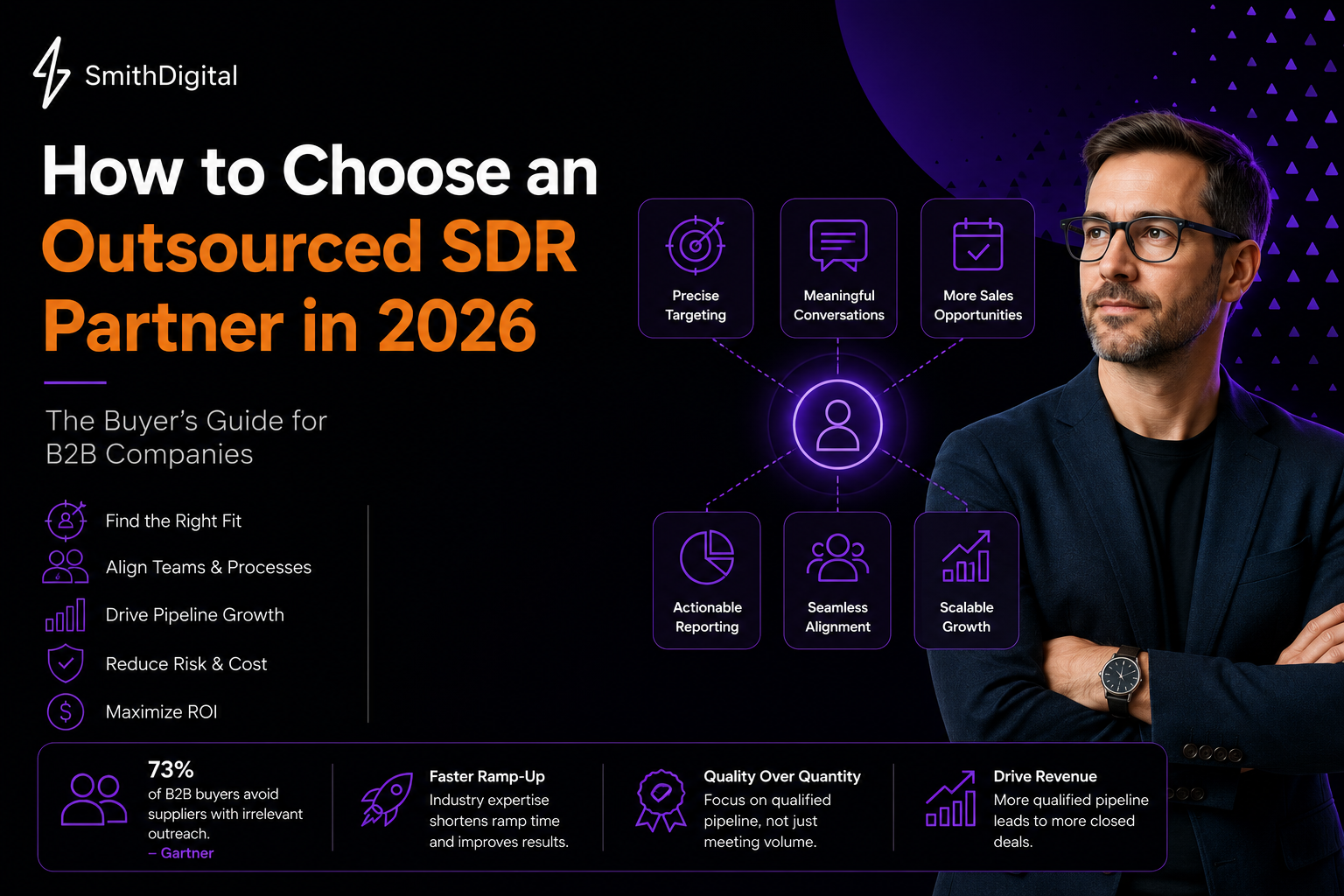
The practical impact is straightforward. Outreach conversations tend to be more productive when the prospect already recognizes the company or has demonstrated interest in related topics. Cold outreach still works, but targeting and timing matter far more than they did several years ago. Gartner’s 2025 sales research found that 73% of B2B buyers actively avoid suppliers that send irrelevant outreach, which means poor targeting does more than waste SDR time. It can remove your company from consideration before a real sales conversation ever happens.
SmithDigital places significant emphasis on identifying these signals through platforms like HubSpot, RB2B, Leadfeeder, ZoomInfo WebSights, and third-party buyer intent data tools. Many companies already have buying signals inside their business but fail to operationalize them effectively. Marketing drives traffic that sales never follows up on. High-intent companies visit the website and disappear. The goal is not simply generating more outreach activity. The focus is helping sales teams spend more time on accounts that are more likely to convert.
When evaluating outsourced providers, ask how they incorporate intent signals into targeting and prioritization. A partner that simply dials through a static list operates differently from one that dynamically adjusts outreach based on real-time engagement data.
How to Measure Outsourced Sales Development Performance
Tracking the right metrics helps you evaluate whether your investment is paying off and identify areas for optimization.
Activity Metrics
Volume indicators like calls made, emails sent, and LinkedIn messages delivered show whether the program is running at expected capacity. These are input metrics rather than outcomes, but they establish a baseline for understanding results.
Response and Connection Rates
Response rate measures how many prospects engage with outreach. Connection rate tracks successful phone conversations. These metrics indicate whether messaging resonates and whether data quality supports effective outreach.
Meetings Booked
The number of meetings scheduled gives you a top-line view of output. Break this down by ICP fit and persona to understand where the program performs best.
Show Rate
Show rate measures how many booked meetings actually happen. Low show rates often indicate qualification problems or weak confirmation processes. This metric directly affects your cost per meaningful conversation.
Sales Acceptance Rate
Sales acceptance measures how often your account executives consider the meeting legitimate and worth pursuing. High rejection rates signal misalignment between the provider's qualification criteria and your internal standards.
Pipeline Generated
Pipeline value tracks the potential revenue created from outsourced meetings that convert to opportunities. This connects outbound activity to business outcomes and enables ROI calculation.
Closed Revenue
Ultimately, the program should contribute to closed deals. Tracking revenue back to outsourced sourcing shows the true value of your investment, though attribution can be complex in longer sales cycles.
Common Mistakes When Outsourcing Sales Development
Avoid these pitfalls to increase your chances of success with an outsourced program.
Choosing Based on Cost Alone
The lowest-priced provider rarely delivers the most value. Cheap programs often mean inexperienced reps, poor data, and minimal management oversight. Calculate the cost per qualified opportunity and downstream conversion rather than just monthly spend.
Unclear ICP Definition
If you cannot articulate who the partner should target, they cannot build effective lists or craft relevant messaging. Invest time in defining your ideal customer profile, including industry, company size, roles, pain points, and buying triggers.
Treating the Provider as a Vendor Rather Than a Partner
Outsourced SDR programs perform better with collaboration. Share feedback on meeting quality, give insights on what resonates in conversations, and participate in regular strategy reviews. The more context you give, the better results you get.
Expecting Immediate Results
Outbound takes time to produce meaningful pipeline. Most programs need 60 to 90 days to ramp fully and another quarter to optimize based on market feedback. Set realistic expectations and give the program time to find its footing before judging performance.
Ignoring Downstream Conversion
Meeting volume means nothing if those meetings do not convert to opportunities and revenue. Track the full funnel from booked meeting through closed deal. A program that books fewer meetings but delivers higher-quality conversations often outperforms a high-volume approach.
How SmithDigital Approaches Outsourced Sales Development
SmithDigital approaches pipeline generation differently than traditional appointment-setting firms. Most B2B companies do not simply have a lead generation problem. They usually have gaps across the entire sales and marketing process. Marketing and sales often operate in silos. CRM data quality issues prevent effective follow-up. Buyer intent signals go unnoticed. SDR teams work cold lists while warm opportunities sit untouched.
SmithDigital takes a broader view of the sales and marketing process. The focus extends beyond booking meetings to include demand generation, CRM infrastructure, buyer intent integration, and sales enablement. Programs typically start with understanding where pipeline gaps exist and how to close them through a combination of strategy, tools, and execution.
The practical difference is that outreach connects to the rest of your revenue operations rather than running as an isolated activity. SDR efforts integrate with HubSpot CRM for tracking, reporting, and workflow automation. Buyer intent data informs prioritization so reps focus on accounts showing engagement signals. Content and messaging align with your broader marketing strategy.
This approach tends to work particularly well for B2B companies with longer sales cycles where buyers spend time researching vendors before engaging with sales. ERP consulting firms, MSPs, cybersecurity providers, and SaaS companies often fall into this category. The economics work best when your average deal sizes support meaningful customer lifetime value.
In Conclusion: Making the Right Decision for Your Business
Outsourced sales development offers a practical path to building pipeline without the time, cost, and management burden of hiring internally. The right fit depends heavily on your specific situation. Average deal size, sales cycle length, internal capacity, and marketing maturity all factor into whether outsourcing makes sense and which partner model works best.
Companies should also evaluate whether they need a standalone appointment-setting vendor or a partner that delivers outsourced BDR services as part of a broader revenue growth strategy that includes HubSpot, buyer intent data, and demand generation. The provider should function as an extension of your team, aligned with your goals and invested in your outcomes.
Neither outsourcing nor building in-house is inherently the right answer. Some organizations primarily need outbound scale and operational structure. Others need a partner that helps design, test, and refine an integrated motion that connects outbound prospecting with inbound demand and CRM infrastructure. Those are fundamentally different growth problems, even if both companies ultimately help generate sales conversations.
FAQs About Outsourced Sales Development
What is the typical cost of outsourced SDR services in 2026?
Pricing varies based on model and provider location. Monthly retainers for nearshore options typically range lower than onshore US-based programs. Pay-per-meeting structures charge based on ICP difficulty, with SMB targets at lower rates than enterprise C-suite personas. The fully loaded cost usually runs 30 to 50 percent less than building an equivalent internal team.
How long does it take for an outsourced BDR program to produce results?
Most programs need 30 to 60 days to complete onboarding and ramp. By 90 days, you should see consistent meeting volume and early pipeline contribution. Full optimization typically takes another quarter as the provider refines targeting and messaging based on market feedback. SmithDigital integrates programs with HubSpot CRM to accelerate reporting and optimization cycles.
Can outsourced SDRs represent my brand effectively?
Yes, when the program is structured correctly. Dedicated reps working exclusively on your account, trained on your product and messaging, operating in your CRM, and reviewed against your quality standards represent your brand the same way internal reps do. The risk comes from shared-rep models with generic scripts and minimal product knowledge.
What types of companies benefit most from outsourced sales development?
Companies with annual contract values of fifteen thousand dollars or more, sales cycles of three months or longer, and sufficient total addressable market size tend to see the most value. Enterprise software firms, B2B professional services companies, ERP consultants, and MSPs fit this profile well. SmithDigital specializes in these sectors with deep domain expertise in HubSpot implementation and sales enablement.
Should I outsource SDR or build an internal team?
The decision depends on your timeline, budget, and operational priorities. Outsourcing wins on speed and cost efficiency. Internal teams offer deeper product knowledge and an AE development pipeline. Many mid-stage B2B companies run hybrid models with a small internal team for strategic accounts and an outsourced pod for coverage and scale.
How do I measure the ROI of outsourced sales development?
Track meetings booked, show rates, sales acceptance rates, pipeline generated, and closed revenue attributed to the program. Calculate cost per qualified opportunity and compare to your customer lifetime value. A well-run program should pay for itself within a few closed deals. SmithDigital builds reporting dashboards in HubSpot and Databox to give full visibility into program performance and ROI.
1 min read
Outsourcing BDR Checklist: How to Choose the Right Partner
Outsourcing your BDR team can unlock serious growth—but only if you choose the right partner. Are your reps stuck chasing cold leads while qualified...
1 min read
5 Best Outsourced SDR Providers for ERP Partners in 2026
Choosing the best outsourced SDR provider starts with finding a partner that can generate a qualified pipeline for complex B2B sales. For ERP...