8 min read
How to Increase Your Domain Authority in 2026: Proven Strategies That Work
Your ERP platform might outperform the competition in terms of functionality and innovation, but if your website continues to rank below those...

13 min read
Eric Smith is the founder of SmithDigital, a revenue-focused growth partner that helps B2B companies generate qualified pipeline through a combination of SEO, AI discoverability, HubSpot optimization, outbound prospecting, and conversion-focused marketing. Over the past two decades, Eric has worked with software companies, ERP consulting firms, managed service providers, business brokers, technology consultants, and other B2B organizations looking to accelerate growth without building large inte...
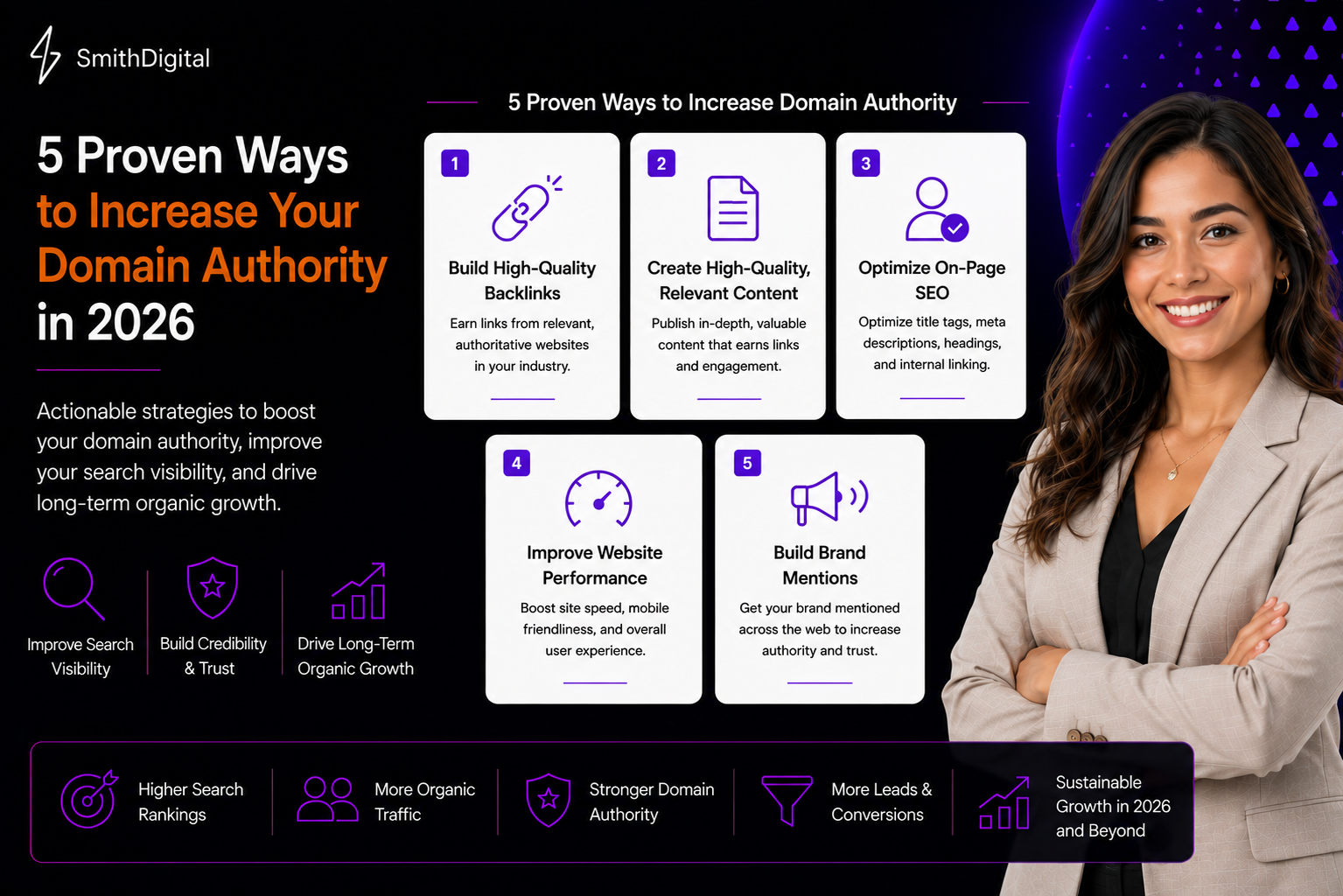
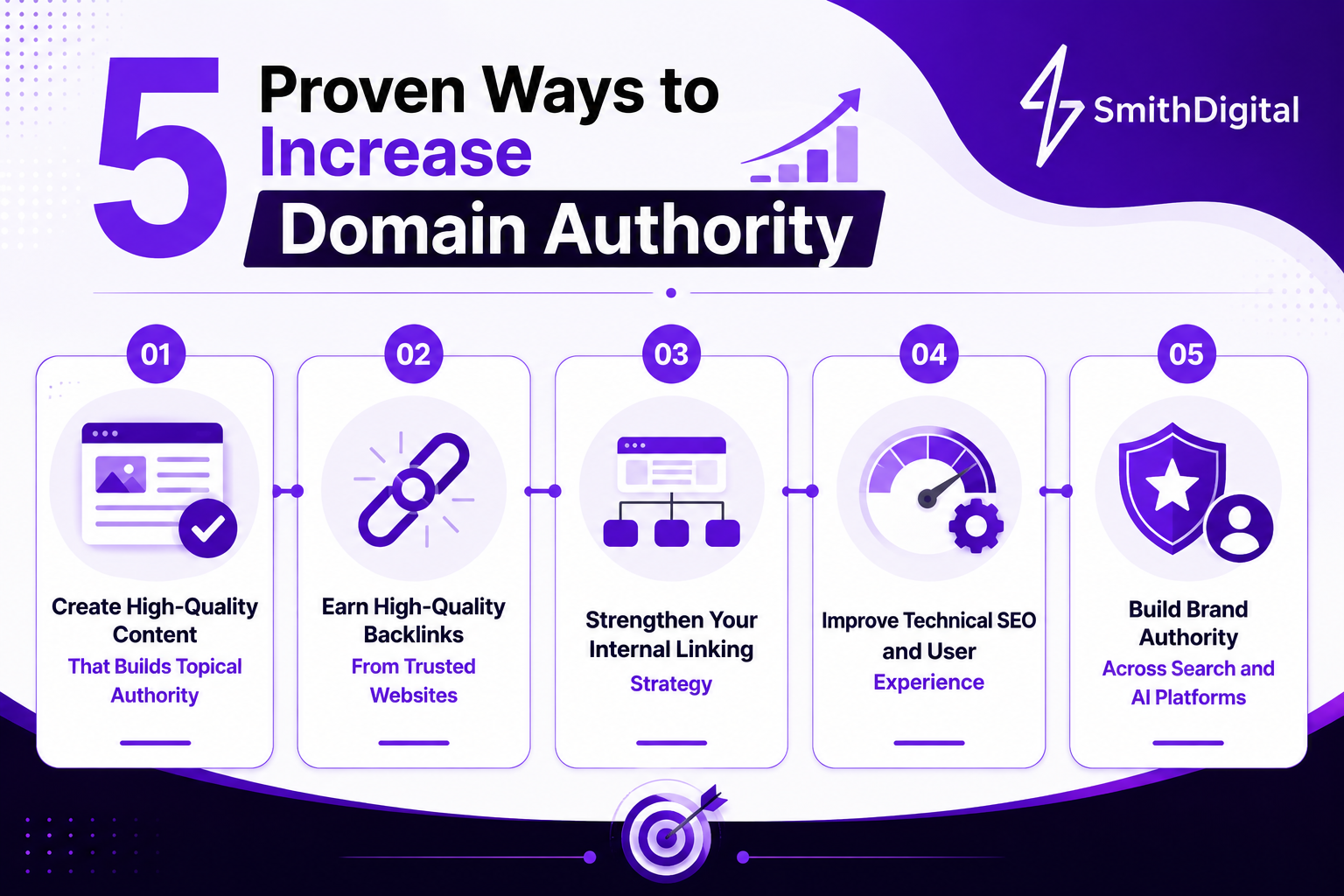
Increasing your Domain Authority starts with improving the overall quality and credibility of your website. The most effective ways to raise your score include earning high-quality backlinks, publishing authoritative content, strengthening your internal linking strategy, and maintaining a technically sound website. As these areas improve, your Domain Authority typically increases.
Although Domain Authority is not a Google ranking factor, it remains one of the most widely used SEO metrics for comparing the relative strength of one website against another. Developed by Moz, the metric predicts how likely a domain is to rank in search results by evaluating factors such as linking root domains, backlink quality, and the overall strength of a website's link profile. Other SEO platforms use similar metrics, including Ahrefs' Domain Rating (DR) and Semrush's Authority Score.
The metric has also become more relevant in the context of AI-powered search. In a 2025 study of 1,000 domains, Semrush found that websites with stronger backlink authority were cited more frequently in AI-generated answers, suggesting that authority signals continue to influence online visibility beyond traditional search results.
This guide explains what Domain Authority is, how Moz calculates the score, what a good Domain Authority score looks like, and five proven ways to increase your Domain Authority in 2026. You'll also learn which SEO practices have the greatest impact, which common mistakes hold websites back, and how to build authority to support long-term organic growth.
Create authoritative content that people and AI systems trust. Publish original, experience-based content that answers real buyer questions, earns backlinks, and is easy for search engines and AI assistants to understand and cite.
Earn high-quality backlinks from relevant, authoritative websites. Quality backlinks remain one of the strongest authority signals used by SEO tools and help reinforce your website's credibility across both traditional search and AI-powered search experiences.
Strengthen your internal linking and content structure. Connect related pages to help search engines and AI models understand the relationships between topics, distribute authority across your website, and improve navigation for visitors.
Optimize your website for technical SEO and user experience. Fast page speeds, mobile usability, clean site architecture, and structured content make it easier for both search engines and AI systems to crawl, interpret, and surface your content.
Build topical authority consistently. Cover your core subjects in depth instead of publishing isolated articles. A well-connected content ecosystem helps improve your Domain Authority, increases visibility in search results, and makes your expertise easier for AI platforms to recognize and reference.
Domain Authority (DA) is an SEO metric developed by Moz that estimates how likely a website is to rank in search results compared to other websites. It uses a 1–100 scale and is calculated using factors such as the quality of backlinks, the number of linking root domains, and the overall strength of a website's link profile.
Domain Authority isn't a Google ranking factor, but it remains one of the most widely used metrics for comparing website authority and measuring SEO progress over time. As your website earns stronger backlinks, publishes more authoritative content, and builds credibility within its niche, your Domain Authority typically improves as well.
Its value becomes clearer when viewed alongside broader SEO research. In Backlinko's 2025 study of 11.8 million Google search results, pages ranking #1 had an average of 3.8× more backlinks than positions #2 through #10, and websites with stronger overall link authority consistently performed better in search results.
For that reason, Domain Authority works best as a benchmark rather than a target. The score reflects the authority your website has built through consistent SEO efforts. Improving content quality, earning relevant backlinks, strengthening internal links, and developing topical authority all contribute to long-term growth in both search visibility and AI discoverability.
Read Next: SEO in the Age of AI (2026): What’s Changed, What Hasn’t, and What Still Works
Moz uses a machine learning model to estimate how likely a website is to rank compared to other domains. While the exact algorithm isn't public, several factors consistently have the greatest influence on your Domain Authority score.

Backlinks remain one of the strongest indicators of website authority because they act as endorsements from other websites. When reputable publications, industry websites, or trusted organizations link to your content, they signal that your website provides information worth referencing.
Focus on earning links through original research, in-depth guides, case studies, and other resources that people naturally want to cite. A handful of relevant, editorial backlinks will usually contribute more to your Domain Authority than hundreds of low-quality links.
The number of websites linking to you often matters more than the total number of backlinks. If one website links to your content 50 times, it doesn't carry the same weight as earning links from 50 different reputable websites.
Expanding the number of unique domains that reference your content demonstrates broader authority across your industry. This is one reason digital PR, strategic partnerships, and guest contributions can be valuable when they're relevant and editorially earned.
Moz evaluates your backlink profile as a whole rather than looking at individual links in isolation. The quality, diversity, relevance, and natural growth of your backlinks all contribute to your Domain Authority score.
A healthy link profile grows steadily over time and reflects genuine recognition from authoritative websites. Large spikes in low-quality backlinks or manipulative link-building tactics can reduce trust and limit long-term SEO performance.
Not every backlink improves your website's authority. Links from spam networks, private blog networks (PBNs), or unrelated websites can weaken the overall quality of your backlink profile.
Regularly reviewing your backlinks helps you identify suspicious links before they become a larger issue. Building links organically through useful content and legitimate industry relationships is a far more sustainable strategy than relying on shortcuts.
While Domain Authority is primarily influenced by backlinks, the websites that consistently earn authoritative links usually publish high-quality content around a clearly defined area of expertise. Covering related topics in depth makes it easier for other websites to reference your content and helps search engines understand what your business is known for.
This approach has become even more valuable as AI-powered search tools evaluate content based on expertise, context, and credibility. Building topical authority won't directly increase your Domain Authority overnight, but it creates the conditions that naturally attract stronger backlinks, improve your website's authority, and increase your visibility across both traditional search engines and AI-powered search experiences.
SmithDigital’s SEO & AEO Search Visibility Services help B2B companies develop the content, technical foundation, internal linking, and authority signals needed to improve visibility across traditional and AI-powered search.
Read More: SEO and AI Discoverability: Why the Fundamentals Still Matter
Domain Authority is a comparative metric rather than a fixed score. As other websites continue publishing content and earning backlinks, your score may change even if your own website remains the same.
Instead of chasing an arbitrary number, compare your Domain Authority with businesses competing for the same keywords and audience. That provides a more meaningful benchmark and helps you measure progress within your market.
There isn't a single Domain Authority score that's considered "good" for every website. A score that performs well in one industry may be below average in another because Domain Authority is a relative metric.
Instead of comparing your score with the entire web, compare it with businesses targeting the same audience, keywords, and markets. That provides a more meaningful benchmark and helps you understand how competitive your website is within your niche.
| Domain Authority Score | General Interpretation |
|---|---|
| 1-20 | New websites or domains with limited authority and relatively few high-quality backlinks. |
| 21-40 | Growing websites that have established some authority and are steadily expanding their content and backlink profile. |
| 41-60 | Established websites with a solid SEO foundation, consistent content production, and a healthy backlink profile. |
| 61-80 | Highly authoritative websites with strong brand recognition, extensive topical coverage, and backlinks from reputable sources. |
| 81-100 | Exceptionally authoritative domains, including major publishers, global brands, universities, and government organizations. |
These ranges provide useful context, but they shouldn't be treated as fixed goals. For example, a Domain Authority score of 35 may be enough to outperform competitors in a specialized B2B niche, while a score of 60 may still fall behind established brands in highly competitive industries.
As search continues to evolve, website authority is measured by more than a single metric. Search engines and AI-powered search platforms evaluate the overall quality of your content, your expertise within a topic, your backlink profile, and the credibility of your brand. A higher Domain Authority often reflects those strengths, but improving your website should always take priority over chasing a specific score.
Now that you understand what influences your Domain Authority score and how to evaluate it, the next step is improving the factors that contribute to it. The following strategies focus on practical, sustainable ways to build website authority, strengthen your backlink profile, and improve your visibility across both traditional search engines and AI-powered search experiences.
Improving your Domain Authority isn't about chasing a higher score. It's about building a website that consistently earns trust, attracts authoritative backlinks, and demonstrates expertise within your industry. As those signals strengthen, your Domain Authority naturally improves alongside your visibility in both traditional search engines and AI-powered search experiences.
The five strategies below focus on the factors you can directly influence. Rather than looking for quick wins, they emphasize sustainable SEO practices that continue delivering value over time. Whether you're trying to improve organic rankings, generate more qualified traffic, or increase your website's authority, these are the areas that deserve the most attention.

The most effective way to increase your Domain Authority is to create content that other people genuinely find valuable. High-quality content attracts backlinks, keeps visitors engaged, encourages sharing, and gives search engines more signals that your website is a credible source of information.
The strongest content doesn't try to rank for as many keywords as possible. Instead, it solves specific problems, answers important questions, or provides original insights that readers can't easily find elsewhere. Comprehensive guides, industry research, case studies, comparison articles, and practical resources are all examples of content that naturally earns attention and backlinks over time.
Just as important is topical authority. Rather than publishing articles across dozens of unrelated subjects, focus on becoming the go-to resource within your area of expertise. For example, if your business specializes in B2B lead generation, create a connected library of content covering outbound sales, inbound marketing, buyer intent, sales development, CRM strategy, and related topics. This helps search engines understand your expertise while making it easier for readers to continue exploring your content.
This approach also aligns with how AI-powered search platforms evaluate information. AI assistants increasingly favor content that demonstrates depth, accuracy, and context instead of isolated articles targeting individual keywords. Building interconnected topic clusters gives both search engines and AI systems a clearer understanding of your expertise, making your content more likely to be surfaced, referenced, and cited.
A coordinated Inbound Marketing Strategy can connect this content to keyword research, conversion paths, lead nurturing, and the broader buyer journey. When planning new content, prioritize quality over quantity by focusing on:
Answering specific search intent with clear, complete, and practical information.
Publishing original insights, research, examples, or case studies whenever possible.
Organizing related content into topic clusters connected through strategic internal links.
Refreshing existing articles to keep statistics, examples, and recommendations current.
Writing for real decision-makers instead of trying to satisfy search algorithms alone.
Over time, this approach helps you build topical authority, earn stronger backlinks, increase your website's credibility, and improve your Domain Authority as a natural result of creating genuinely useful content. For companies that need a coordinated content and authority-building program, SmithDigital’s SEO & AEO Search Visibility Services combine search strategy, content development, on-page optimization, internal linking, and AI visibility improvements.
Read Next: Deep Pages and Google AI Overviews: What the Data Tells Us
High-quality backlinks remain one of the strongest factors influencing your Domain Authority because they signal that other websites trust your content enough to reference it. However, relevance and authority matter far more than the total number of backlinks you earn.
Instead of focusing on link quantity, concentrate on earning backlinks from reputable websites within your industry. Editorial links from trusted publications, business partners, industry associations, and well-established blogs typically provide far more value than links from low-quality directories or unrelated websites.
The most effective way to earn these backlinks is by publishing content that others naturally want to cite. Original research, in-depth guides, case studies, comparison articles, and practical resources are more likely to attract editorial links because they provide unique value.
Avoid shortcuts such as buying backlinks or participating in link schemes. These tactics may temporarily increase your backlink count, but they rarely contribute to long-term authority and can weaken the overall quality of your backlink profile.
As AI-powered search continues to evolve, earning backlinks from trusted sources does more than improve your Domain Authority. It strengthens your website's credibility, making your content more likely to be recognized as a reliable source by both search engines and AI-powered search platforms.
Read More: Authority Guest Post: SERP Insights on the Best Guest Posting Strategies & Services
Imagine you've published an excellent guide that earns backlinks from several reputable websites. If that page isn't connected to other relevant pages on your site, much of that authority stays concentrated on a single URL. Strategic internal linking helps distribute that authority across your website, making it easier for both users and search engines to discover your most important content.
A strong internal linking strategy also reinforces topical authority. Linking related articles together helps search engines understand how your content is organized and how different topics relate to one another. The same structure benefits AI-powered search platforms by providing additional context that makes your content easier to interpret and reference.
Review your existing content regularly and look for opportunities to add relevant internal links between related pages. Use descriptive anchor text, prioritize links that genuinely help readers, and connect supporting articles to cornerstone or pillar pages whenever possible.
Unlike backlinks, internal links are completely within your control. Improving them is one of the fastest and most cost-effective ways to strengthen your website's authority, improve content discovery, and support long-term SEO performance.
Read More: Understanding Anchor Text in SEO: Best Practices for 2025
High-quality content and strong backlinks can only deliver their full value if search engines can efficiently crawl, understand, and index your website. Technical SEO provides that foundation by ensuring your content is accessible, well-organized, and easy to navigate.
A technically sound website also creates a better experience for visitors. Fast-loading pages, mobile-friendly design, intuitive navigation, and a clear site structure encourage users to explore more of your content and reduce unnecessary friction during their journey.
Focus on the technical elements that have the greatest impact on both visibility and usability:
| Technical SEO Factor | Why It Matters |
|---|---|
| Site Speed | Faster pages improve user experience and make it easier for search engines to crawl your website efficiently. |
| Mobile Optimization | Ensures your website performs well across all devices and meets modern search expectations. |
| Site Architecture | A logical structure helps visitors, search engines, and AI systems discover related content more easily. |
| Crawlability & Indexing | Allows important pages to be found, crawled, and included in search results. |
| Structured Data | Provides additional context that helps search engines better understand your content and can support enhanced search results. |
While technical SEO doesn't directly increase your Domain Authority score, it strengthens the foundation that supports every other SEO effort. When your website is easier to crawl, navigate, and understand, the authority you build through content and backlinks has a greater opportunity to translate into stronger search visibility.
Read Next: Improve SEO Ranking: Rank Higher on Google Search Fast
Strong brands naturally earn more attention, mentions, and backlinks. When people recognize your business as a trusted source, they're more likely to reference your content, recommend your expertise, and link to your website. Over time, those signals contribute to a stronger backlink profile and increased Domain Authority.
Building brand authority requires consistent visibility beyond your own website. Publishing original research, contributing expert insights, speaking on podcasts or webinars, participating in industry events, and earning media coverage all help establish your business as a credible voice within your industry. These activities also create more opportunities for authoritative websites to reference your content.
Brand authority has become increasingly important as AI-powered search continues to evolve. Platforms such as ChatGPT, Google AI Overviews, Gemini, and Perplexity look beyond individual web pages when generating responses. Businesses with a consistent reputation, recognized expertise, and authoritative content are more likely to be surfaced and cited over time.
While brand authority won't increase your Domain Authority overnight, it strengthens many of the signals that influence long-term SEO success. Combined with high-quality content, trusted backlinks, strategic internal linking, and a technically sound website, it helps create lasting authority that benefits both traditional search engines and AI-powered search experiences.
Read Next: Does Social Media Actually Help SEO in 2026?
Monitoring your Domain Authority helps you track your website's authority over time and compare your progress against competitors. While Domain Authority shouldn't be your only SEO metric, checking it regularly can help you understand whether your content, backlink profile, and overall SEO strategy are moving in the right direction.
To assess how well the same website is prepared for AI-driven discovery, use SmithDigital's AI Search Grader Tool alongside your backlink and search-performance reports. Several trusted SEO tools can also help you evaluate your website's authority and performance:
Moz Link Explorer (Domain Authority): Moz is the creator of Domain Authority, making it the primary source for checking your DA score. It also provides insights into backlinks, linking root domains, and Page Authority.
Ahrefs (Domain Rating): Ahrefs measures website authority using Domain Rating (DR). While DR is calculated differently from Domain Authority, it's one of the most widely used metrics for evaluating backlink strength and referring domains.
Semrush (Authority Score): Semrush uses Authority Score to estimate a website's overall authority based on backlinks, organic search performance, and other trust signals. It's particularly useful for competitive analysis and monitoring SEO growth.
Google Search Console: GSC doesn't provide a Domain Authority score, but it offers valuable data on search impressions, clicks, indexing status, Core Web Vitals, and keyword performance. Reviewing these metrics alongside your Domain Authority gives you a more complete picture of your website's SEO health.
Keep in mind that Domain Authority, Domain Rating, and Authority Score are different metrics developed by different companies, so their scores shouldn't be compared directly. Instead, use the same tool consistently to monitor trends over time, and evaluate your authority alongside other key SEO metrics such as organic traffic, keyword rankings, referring domains, and conversions. Together, these metrics provide a more accurate picture of your website's long-term growth.
Improving your Domain Authority requires consistent effort over time. Avoiding these common mistakes can help you build authority more effectively and prevent setbacks in your SEO strategy.
| Common Mistake | Why It Hurts Your Domain Authority |
|---|---|
| Prioritizing Backlink Quantity Over Quality | Low-quality or irrelevant backlinks provide little value and can weaken the overall quality of your backlink profile. |
| Publishing Content Without Topical Focus | Covering too many unrelated topics makes it harder to establish expertise and earn authoritative backlinks. |
| Ignoring Internal Linking | Poor internal linking limits content discovery and prevents authority from flowing naturally across your website. |
| Neglecting Technical SEO | Crawl errors, broken links, and slow-loading pages can reduce your website's visibility and user experience. |
| Expecting Overnight Results | Domain Authority grows gradually as your website earns trust, publishes quality content, and attracts authoritative backlinks over time. |
Avoiding these mistakes won't increase your Domain Authority overnight, but it helps ensure your SEO efforts produce steady, sustainable growth.
Increasing your Domain Authority starts with building a website people trust. Publishing high-quality content, earning authoritative backlinks, strengthening your technical SEO, and building topical expertise all contribute to greater visibility across both traditional search engines and AI-powered search experiences.
If you're looking to accelerate that growth, SmithDigital's SEO & AEO Search Visibility Services help B2B companies improve website authority through technical SEO, content strategy, authority building, internal linking, and answer engine optimization (AEO). The result is a stronger online presence that attracts more qualified organic traffic and increases your visibility across search engines and AI-powered answer engines.
Talk to a Growth Strategist to learn how SmithDigital can help you increase your website's authority, improve your SEO & AEO search visibility, and build a sustainable growth strategy for 2026 and beyond.
No. Domain Authority is a metric created by Moz to estimate how likely a website is to rank compared to other websites. Google has confirmed that it doesn't use Moz Domain Authority (Moz DA) as a direct ranking factor. However, the same factors that help improve your website's Domain Authority—such as high-quality content, authoritative backlinks, and technical SEO—also help improve visibility in search engines like Google.
Because Domain Authority is calculated using a proprietary machine learning model, Moz doesn't publish the exact formula behind its website authority score. Instead, the model evaluates signals such as backlink quality, linking root domains, and the overall strength of your website's backlink profile to estimate your domain's authority relative to other websites.
Domain Authority measures the overall authority of an entire website, while Page Authority estimates the ranking potential of an individual page. Domain Rating (DR) is Ahrefs' authority metric for measuring backlink strength. Although these metrics serve a similar purpose, each platform calculates its domain score differently, so their scores shouldn't be compared directly.
If you're looking to improve your Domain Authority score or increase your website's Domain Authority, focus on the fundamentals. Publish high-quality content, earn backlinks from trusted websites, strengthen your internal linking strategy, and improve your technical SEO. These strategies build long-term website authority and are far more effective than looking for shortcuts or quick fixes.
If you want a free Domain Authority checker, Moz Link Explorer is the official tool for checking your Moz Domain Authority. Ahrefs and Semrush also provide valuable authority metrics through Domain Rating and Authority Score, along with backlink analysis and Domain Overview reports. Regardless of which authority checker you use, monitor your progress consistently over time instead of comparing scores across different platforms.
8 min read
Your ERP platform might outperform the competition in terms of functionality and innovation, but if your website continues to rank below those...

1 min read
Most content never gets seen. In fact, 96.55% of pages get zero organic traffic from Google. Not low traffic—none. It’s not because all of that...
5 min read
Key Takeaways Social media is not a direct Google ranking factor, but it increasingly influences SEO through AI discoverability, branded search...