What is Lead Generation? The Ultimate Guide to B2B Best Practices
Lead generation is the process of attracting buyers to your product or service. Learn B2B best practices to generate qualified leads & grow your...
14 min read
Written By
Published November 12, 2026
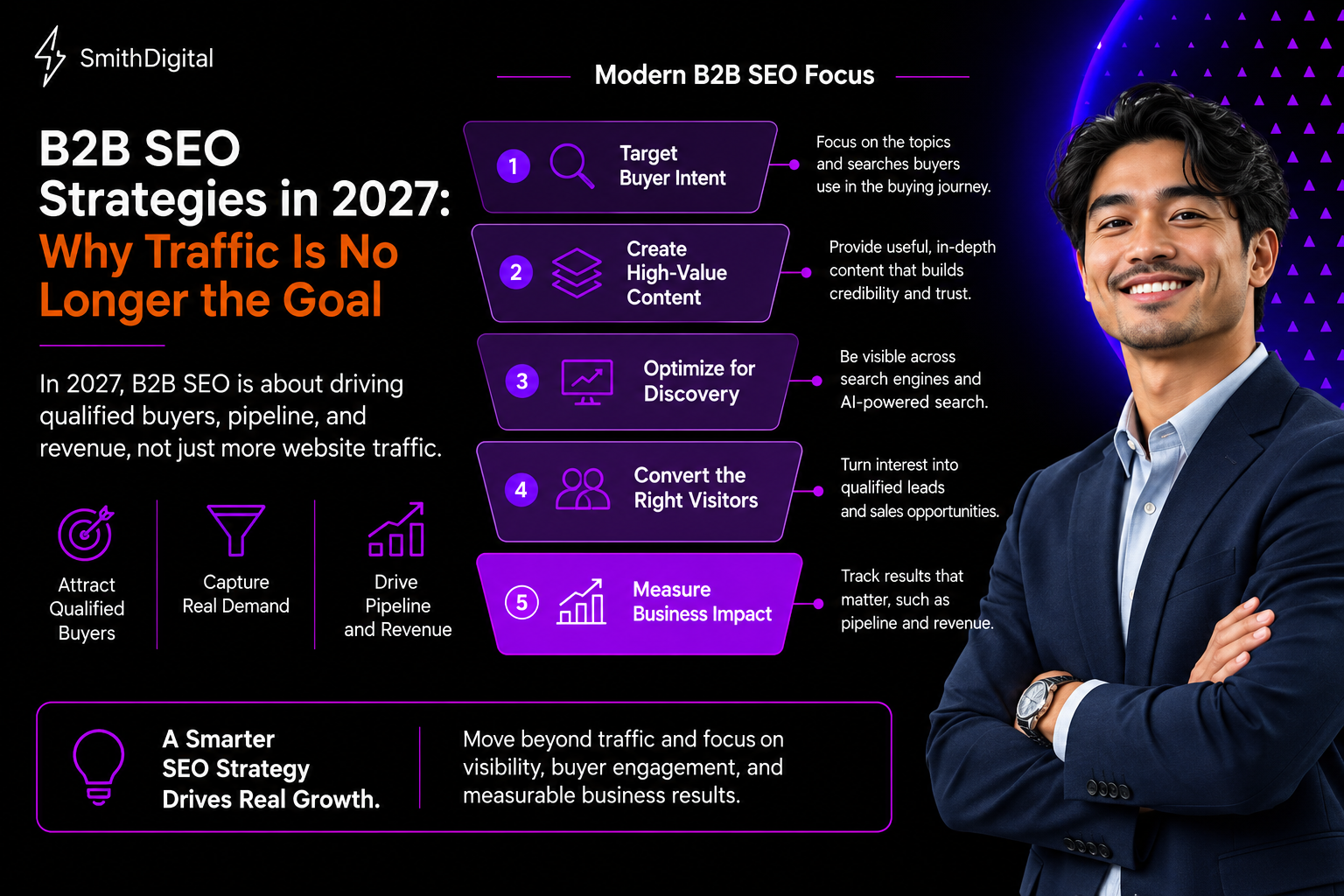
An effective B2B SEO strategy in 2027 prioritizes high-intent keywords, search visibility, useful content, and a measurable sales pipeline. For B2B companies, success depends on reaching buyers during their research process and helping them move toward a purchasing decision.
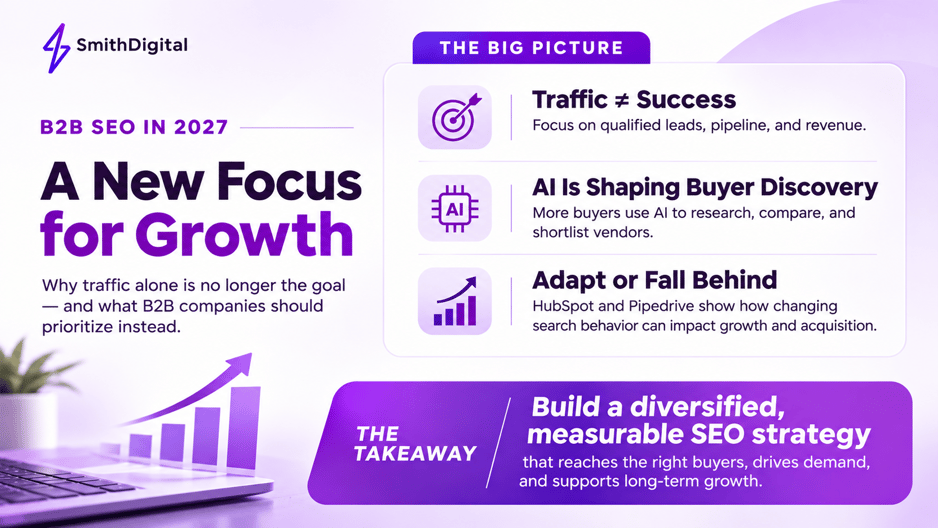
According to Wynter's November 2026 Research, 67% of 200 surveyed B2B professionals who had recently used AI for vendor research said an AI assistant introduced a previously unconsidered vendor that made their shortlist. The study also found that 72% visited vendor websites after their AI research. These findings highlight why search visibility, credible website content, and conversion performance need to work together.
Recent developments at HubSpot and Pipedrive further illustrate how changing search behavior is affecting established customer acquisition models. Their experiences raise important questions about how B2B companies should evaluate organic traffic, lead quality, and marketing efficiency. This guide covers the B2B SEO strategies, AI search optimization practices, and revenue-focused metrics worth prioritizing in 2027.
B2B SEO strategies in 2027 should prioritize qualified leads, sales opportunities, and revenue alongside traditional search performance. As buyers increasingly use AI tools to research and compare vendors, organic traffic alone provides an incomplete picture of SEO effectiveness.
Prioritize commercial search intent. Target keywords tied to buyer problems, solution comparisons, pricing, and vendor evaluation.
Optimize for traditional and AI search. Combine technical SEO, relevant content, and credible third-party authority to improve visibility across Google and AI-powered platforms.
Create content that supports buying decisions. Focus on service pages, comparison guides, case studies, and practical answers to buyer questions during evaluation.
Measure pipeline contribution. Track qualified leads, sales opportunities, conversion rates, and revenue alongside rankings and website traffic.
Diversify customer acquisition. Connect SEO and AEO with paid media, buyer intent data, and outbound prospecting to reduce dependence on a single channel.
The priority for 2027 is a B2B SEO strategy that consistently reaches the right buyers and contributes to measurable business growth.
HubSpot, one of the companies that helped popularize inbound marketing, has experienced a substantial decline in organic search traffic.
In an October 2026 Interview with Search Engine Journal, HubSpot Chief Marketing Officer Kipp Bodnar revealed that the company's blog had lost approximately 80% of its organic traffic from a peak of more than 20 million monthly visits. Yet the company's financial performance tells a more complicated story.
According to HubSpot's Q3 2026 Earnings Release, quarterly revenue reached approximately $947.6 million, representing 17% year-over-year growth. The figures raise an important question about B2B SEO strategies: How much business value was that lost traffic actually generating?
Much of HubSpot's lost traffic came from broad informational content that attracted large audiences with limited commercial intent. Bodnar pointed to articles about topics such as famous quotes and keyboard symbols. These pages could generate substantial search volume, but their visitors were generally far removed from purchasing CRM or marketing automation software.
Changes in search behavior added further pressure. Google's AI Overviews and platforms such as ChatGPT increasingly answer informational questions directly, reducing the need for users to visit individual websites.
HubSpot had also been diversifying its marketing efforts through newsletters, podcasts, YouTube, and other channels. Its declining blog traffic therefore reflects several overlapping changes in search behavior, content priorities, and audience acquisition.
Read More: AI Overviews Are Stealing Your Clicks—Here’s How to Steal Them Back
HubSpot's experience highlights why search intent matters when evaluating organic performance. Consider two searches:
"What is marketing automation?" This may attract students, early-stage researchers, or businesses learning about the category.
"HubSpot Marketing Hub pricing for a 50-person company." This indicates a more specific purchasing consideration.
Both searches have potential value, but they serve different purposes within the buyer's journey. For B2B companies, the commercial importance of organic traffic depends on the audience it attracts, the problems those visitors are trying to solve, and their likelihood of becoming customers.
HubSpot's continued revenue growth shows that declining organic traffic and overall business performance can move in different directions. However, the company's financial results do not establish how much revenue came from organic search or whether lower traffic affected new customer acquisition.
HubSpot's financial disclosures provide additional context. During the first nine months of 2026, the company reported approximately $1.19 billion in sales and marketing expenses, compared with $1.02 billion during the same period in 2025, an increase of roughly 16%.
Higher marketing expenditure can reflect investments in growth, new products, sales capacity, or customer acquisition. Revenue growth can also benefit from existing customers renewing subscriptions and purchasing additional services.
These figures alone cannot establish whether HubSpot's customer acquisition efficiency has deteriorated. A more complete assessment would require customer acquisition costs, net new recurring revenue, conversion performance, and customer lifetime value.
For B2B marketers developing their 2027 SEO strategies, HubSpot's experience reinforces the importance of connecting search performance to commercial outcomes. Qualified leads, marketing-sourced pipeline, customer acquisition costs, and closed-won revenue provide the context needed to understand whether SEO investment is supporting business growth.
Pipedrive's experience shows how changes in search behavior can put financial pressure on a business that has historically relied on organic traffic for customer acquisition.
On October 29, 2026, Pipedrive CEO Paulo Cunha announced the largest proposed restructuring in the company's history. He explained that the company's established growth model was facing pressure as more small businesses turned to AI tools when researching software, reducing organic discovery and increasing the cost of replacing that traffic through paid advertising.
For years, Pipedrive had relied on acquiring customers efficiently through online channels, retaining them, and expanding revenue throughout the customer relationship. Organic search played an important role in keeping those acquisition costs manageable. As organic traffic declined, however, the company faced increasing costs to replace that demand through paid advertising.
Pipedrive's situation illustrates a financial challenge facing B2B companies that depend heavily on organic search.
Once a website establishes strong keyword rankings, it can generate a steady flow of prospective customers without requiring payment for every click. When that traffic declines, businesses may turn to paid search to maintain lead volume.
The economics become less favorable if advertising costs increase without corresponding improvements in conversion rates or customer lifetime value. Higher acquisition costs can reduce profitability and extend the time required to recover sales and marketing investments.
Cunha specifically identified the rising cost of replacing lost organic traffic as a challenge for Pipedrive's growth model. Although the company has not disclosed enough financial information to quantify the impact, his statement indicates that a historically efficient acquisition channel had become less dependable.
Pipedrive's acquisition challenges emerged alongside changing customer expectations, including growing demand for AI-powered sales capabilities and faster product innovation. The company responded by proposing substantial organizational changes. According to Estonian Public Broadcaster ERR, the proposed restructuring affected approximately 267 positions in Estonia, representing around 70% of the company's local workforce.
Cunha outlined plans to simplify operations, accelerate product development, and strengthen demand generation through product-led growth, brand recognition, and content while reducing dependence on paid search. Pipedrive identified several interconnected business challenges behind the proposed restructuring, so the changes cannot be attributed solely to declining organic traffic or AI adoption.
Its experience highlights a broader risk for B2B companies: when an acquisition model depends heavily on one source of demand, changes in buyer behavior can quickly affect marketing efficiency, operating costs, and long-term growth plans.
HubSpot and Pipedrive experienced similar pressures from declining organic search traffic, but the implications for their businesses differed.

HubSpot continued reporting revenue growth despite losing approximately 80% of its peak blog traffic. Pipedrive, meanwhile, acknowledged that declining organic discovery and rising paid acquisition costs were putting pressure on its established growth model.
The comparison requires context. Both companies serve different customer segments, operate under different acquisition strategies, and disclose different levels of financial information. Their results cannot establish how much of either company's performance was directly attributable to AI search.
For B2B marketers, these experiences highlight the importance of understanding how organic search contributes to customer acquisition. Traffic trends become more meaningful when evaluated alongside lead quality, conversion rates, acquisition costs, and revenue. As companies develop their 2027 SEO strategies, that understanding should guide where they invest, which audiences they prioritize, and how they measure performance.
B2B SEO (business-to-business search engine optimization) is the process of improving a company's visibility in organic search results for searches made by business buyers researching products, services, and potential vendors. Effective B2B SEO connects search visibility with qualified buyer engagement and sales opportunities.
B2B and B2C SEO share technical foundations, but they differ in search intent, buying processes, content priorities, and conversion goals.
| Factor | B2B SEO | B2C SEO |
|---|---|---|
| Target Audience | Business decision-makers, department leaders, and procurement teams | Individual consumers and households |
| Buying Process | Often involves multiple stakeholders, approvals, and longer evaluation periods | Typically involves fewer decision-makers and shorter purchase cycles |
| Keyword Strategy | Prioritizes industry-specific, solution-focused, and high-intent keywords | Often targets broader product, category, and transactional searches |
| Content Priorities | Case studies, implementation guides, vendor comparisons, and technical documentation | Product pages, buying guides, reviews, and promotional content |
| Conversion Goals | Qualified leads, demo requests, consultations, and sales opportunities | Purchases, sign-ups, subscriptions, and transactions |
| SEO Performance Metrics | Qualified pipeline, lead-to-opportunity conversion, and revenue contribution | Organic sales, ecommerce conversion rates, and revenue |
| Typical Search Query | "Best ERP software for mid-sized manufacturers" | "Best laptop under $1,000" |
These differences influence how companies approach keyword research, content development, and conversion optimization. For B2B organizations, an effective SEO strategy should address the questions buyers ask throughout their evaluation process, from identifying potential solutions to assessing implementation requirements and selecting a vendor.
Read Next: 10 Best B2B Lead Generation Services for Long Sales Cycles in 2026
Organic traffic, keyword rankings, impressions, and click-through rates remain useful indicators of SEO performance. They show how visible a website is in search results, but provide limited insight into whether that visibility generates qualified leads and sales opportunities.
For B2B companies with longer sales cycles, conversion performance can reveal more about the commercial value of organic traffic. Consider this hypothetical comparison:
| Metric | Company A | Company B |
|---|---|---|
| Monthly Organic Visitors | 10,000 | 3,000 |
| Visitor-to-Lead Conversion | 0.5% | 3% |
| Leads Generated | 50 | 90 |
| Lead-to-SQL Conversion | 10% | 25% |
| Expected Sales-Qualified Leads | 5 | 22.5 |
Note: Illustrative figures, not actual client results or industry benchmarks.
Company B attracts 70% fewer visitors but produces approximately 4.5 times as many expected sales-qualified leads based on the assumed conversion rates. These figures are illustrative, but they show why traffic should be evaluated alongside lead quality and conversion performance.
Read More: Why Your Google Search Console Impressions Dropped in Mid‑September
Search intent helps determine which keywords are most likely to generate relevant business opportunities. For example, someone searching "What is ERP software?" may be exploring the category, while "NetSuite implementation partner" suggests a more immediate need to evaluate service providers.
Both searches can support a B2B SEO strategy, but they require different content and serve different stages of the buying process. Effective keyword research considers search volume alongside audience relevance, buying intent, and conversion potential. This helps companies prioritize content that attracts prospective customers and contributes to a qualified pipeline.
B2B marketers should approach Search Engine Optimization (SEO) and Answer Engine Optimization (AEO) as complementary parts of their search strategy. SEO improves visibility in traditional search results, while AEO helps companies make their expertise accessible and relevant to AI-powered search platforms such as ChatGPT, Perplexity, and Google AI Overviews.
The priority is to strengthen the website's technical foundation, optimize commercially important pages, and develop credible content that supports visibility across both channels.
Technical SEO determines how effectively search engines can crawl, index, and interpret a website. Poor site architecture, broken internal links, duplicate pages, and indexing issues can limit visibility regardless of content quality.
On-page SEO addresses how well individual pages match buyer intent. Descriptive titles, clear headings, relevant keywords, and useful content help search engines understand which queries a page should serve. For B2B companies, optimization should begin with pages closest to purchasing decisions, including service pages, industry-specific solutions, vendor comparisons, and implementation resources.
These priorities provide the SEO foundation for commercially relevant B2B websites. SmithDigital's SEO and AEO Services combine technical optimization, content strategy, and AI search visibility to help businesses reach qualified buyers.
AEO builds on these foundations by making company expertise easier for AI systems to identify, interpret, and reference.
Consider an ERP consultancy offering NetSuite implementation services. Its content should address questions buyers commonly ask about implementation costs, project timelines, data migration, integration requirements, and partner selection.
Clear, detailed answers can support traditional keyword rankings while providing useful information for AI-generated responses. Visibility also depends on the credibility of information available beyond the company's website. Relevant backlinks, customer reviews, industry publications, original research, and expert contributions help establish a consistent digital presence.
AI recommendations cannot be guaranteed through any individual optimization tactic. B2B marketers should focus on building technically sound websites, publishing accurate and useful content, and strengthening their authority across the sources prospective buyers consult.
Read More: SEO and AI Discoverability: Why Strong SEO Still Drives AI Visibility
An effective B2B SEO strategy connects content planning with measurable business outcomes. For 2027, companies should prioritize content that addresses specific buying decisions, supports traditional and AI-powered search visibility, and helps generate qualified opportunities.
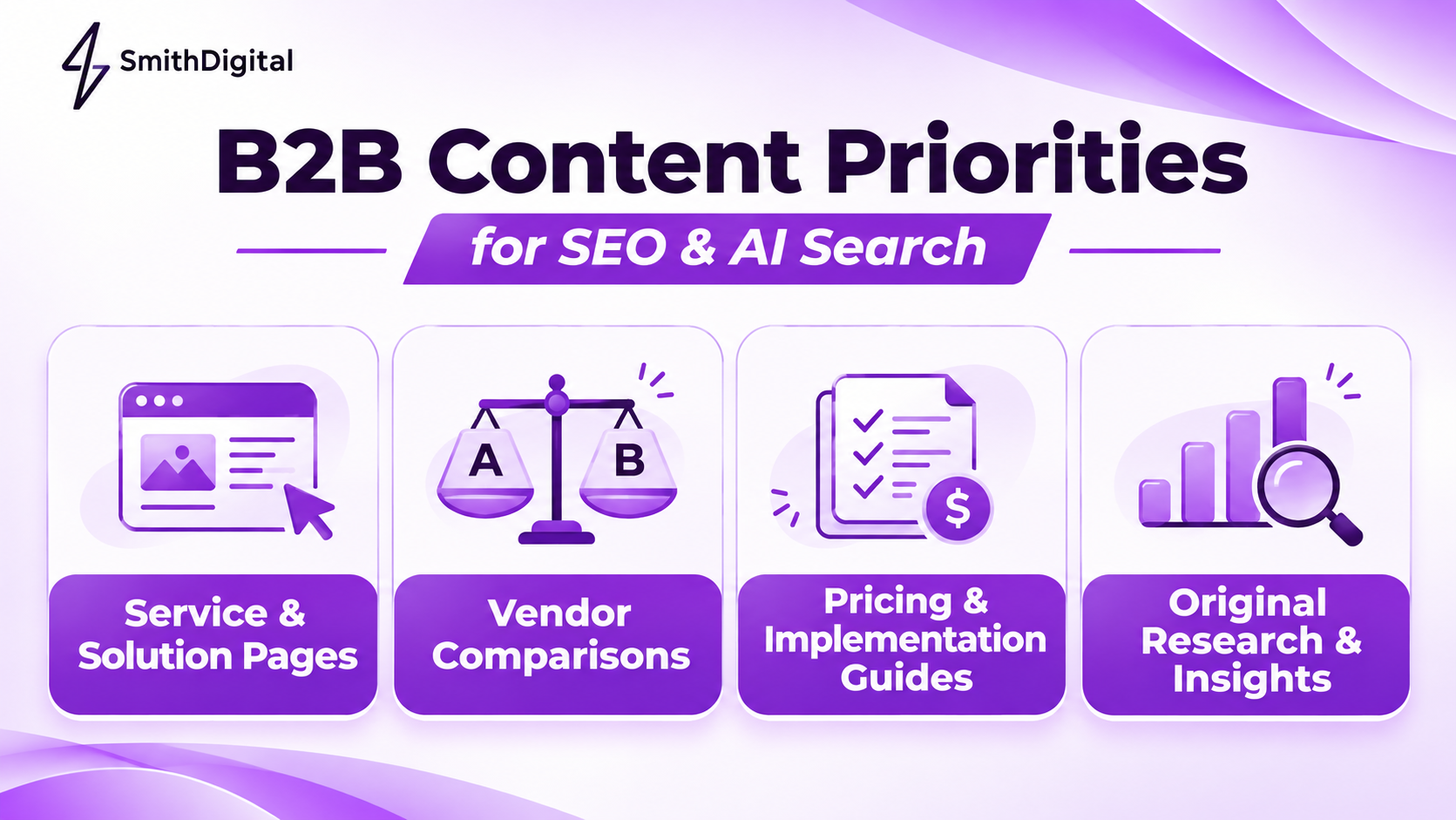
Content investments should reflect the questions prospective customers ask throughout their evaluation process. Four categories deserve particular attention:

Commercial and Service Pages. Clearly explain the services offered, target industries, problems addressed, and engagement process. An ERP consultancy, for example, might create dedicated pages for NetSuite implementation, integration, optimization, and managed services.
Vendor Comparisons and Alternatives. Help buyers assess competing solutions through balanced comparisons such as "NetSuite vs. Acumatica" or "Outsourced SDR vs. In-House SDR." Address differences in capabilities, costs, limitations, and suitable use cases.
Pricing and Implementation Guides. Explain cost drivers, project timelines, requirements, and potential challenges. Providing this information helps buyers evaluate feasibility and prepare for informed sales conversations.
Original Research and Firsthand Expertise. Publish case studies, customer interviews, benchmark findings, and implementation lessons supported by documented evidence. These resources help buyers assess a provider's experience and give search platforms specific information to reference.
Content priorities should be informed by search intent, relevance to the ideal customer profile, and opportunities to support meaningful conversions.
Read Next: Why ERP Lead Generation Is Harder in 2026 and What VARs Can Do About It
A useful reporting framework follows the progression from search visibility to customer acquisition and revenue.
| Measurement Area | Recommended KPIs | What It Helps Evaluate |
|---|---|---|
| Search and AI Visibility | Keyword rankings, impressions, AI mentions, and citations | Whether buyers can discover the company |
| Website Acquisition | Organic sessions, AI referrals, high-intent landing-page visits | Which channels attract relevant visitors |
| Lead Generation | Qualified leads, SQLs, demo requests, conversion rates | Whether content generates meaningful inquiries |
| Sales Pipeline | Marketing-sourced and marketing-influenced opportunities | How marketing contributes to active sales opportunities |
| Revenue and Efficiency | Closed-won revenue, CAC, CAC payback period | Whether acquisition investments support profitable growth |
AI mentions and citations should be treated as directional indicators because results vary across platforms, prompts, and time.
For pipeline reporting, marketing-sourced opportunities are those attributed to marketing as their origin, while marketing-influenced opportunities include deals that received meaningful marketing engagement after originating elsewhere. Reporting these separately helps prevent double-counting.
Revenue reporting also requires consistent attribution windows, particularly for B2B companies with longer sales cycles. Customer acquisition cost (CAC) and CAC payback should be evaluated by acquisition channel and customer cohort where reliable data is available.
The resulting scorecard helps teams identify which content and acquisition activities contribute to qualified pipeline, where conversion performance needs improvement, and which investments warrant continued attention.
When commercially relevant pages attract visitors but generate few qualified inquiries, Conversion Rate Optimization can help identify weaknesses in page messaging, forms, and conversion paths. Improving SEO and conversion performance together can increase the value of existing traffic.
A successful B2B SEO strategy starts with understanding which customers you want to acquire, how they research solutions, and which marketing activities generate qualified opportunities. This practical framework connects technical SEO, content optimization, AI search visibility, and revenue measurement.
Begin by reviewing which pages attract organic traffic and generate conversions. Use Google Search Console, GA4, and website crawl data to identify indexing issues, broken links, duplicate content, and site architecture problems. A reliable SEO foundation helps search engines access important pages and gives prospective buyers a clearer path to relevant services.
Evaluate performance at the landing-page level. Identify which pages attract relevant prospects, which generate qualified inquiries, and where conversion opportunities may be lost. Prioritize improvements to commercially important pages before expanding your content library.
Organize target keywords around the problems your ideal customers are trying to solve and the decisions they need to make.
For example, an ERP consultancy might target searches ranging from "best ERP systems for manufacturers" to "NetSuite implementation partner" and "NetSuite implementation pricing". Assess each opportunity based on its relevance to your services, competitive difficulty, and potential to attract qualified buyers.
Use these findings to build an SEO plan that prioritizes service pages, solution comparisons, and educational resources based on buyer intent and commercial relevance.
Improve commercially relevant pages with clear service descriptions, logical headings, internal links, and answers to specific buyer questions. Review whether existing content addresses practical considerations such as pricing, implementation requirements, vendor selection, and common challenges.
Off-page SEO also contributes to search visibility. Original research, relevant backlinks, expert contributions, and industry mentions help B2B brands establish credibility beyond their own websites. These signals can support organic search performance while making authoritative information more accessible to buyers and AI-powered search platforms.
Read More: Understanding Anchor Text in SEO: Best Practices for 2025
Use Google Analytics 4 (GA4) to track organic landing pages, engagement, conversions, and identifiable AI referral traffic. In HubSpot, connect acquisition data to contact records, lifecycle stages, sales opportunities, and closed-won deals. Consistent source definitions, lifecycle management, and CRM reporting are important aspects of HubSpot Revenue Operations. Clear HubSpot Naming Conventions also help B2B teams maintain reliable attribution data.
Reporting has limitations. A buyer might discover your company through an AI recommendation, later search for your brand on Google, and submit a form. GA4 may record the Google visit without identifying the earlier AI interaction. A simple "How did you first hear about us?" question can provide additional context alongside analytics and CRM reporting.
Evaluate SEO performance regularly using the visibility, conversion, pipeline, and revenue metrics established in your reporting framework.
Compare results across acquisition channels, commercially important landing pages, and customer segments. Account for longer B2B sales cycles when connecting marketing activity to closed revenue. Use these findings to determine which pages need improvement, which keyword opportunities deserve further investment, and where acquisition costs or conversion performance require attention.
A sustainable B2B SEO strategy depends on continuous improvements informed by search performance, buyer behavior, and verified sales outcomes.
B2B companies can strengthen demand generation by coordinating SEO, AEO, paid media, and outbound prospecting around their target accounts.
SEO and AEO help buyers discover a company while researching solutions. Paid media captures relevant demand through targeted campaigns, while buyer intent data and outbound sales development help teams identify and engage potential customers directly.
Consider an ERP consultancy targeting manufacturers planning a software upgrade. Organic content attracts buyers researching implementation options, paid campaigns reach those comparing providers, and outbound teams engage relevant decision-makers at target accounts.
Companies can also scale these efforts through Outsourced SDR Services, which provide dedicated prospecting support to identify potential buyers, initiate conversations, and develop qualified sales opportunities. Coordinating these channels helps businesses reach qualified prospects through multiple touchpoints, maintain a more consistent flow of opportunities, and reduce dependence on any single acquisition source.
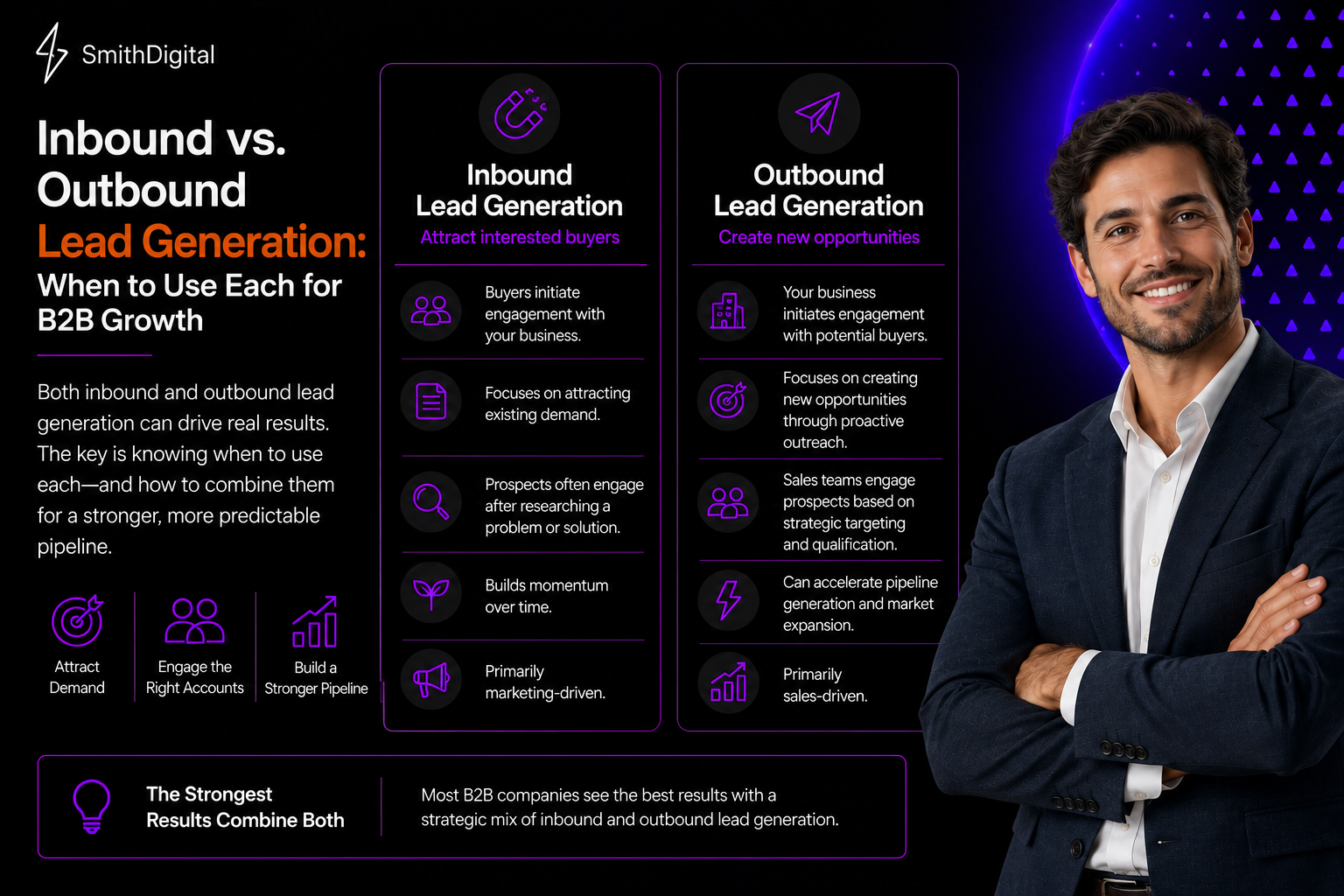
Read Next: Inbound vs Outbound Lead Generation: When to Use Each for B2B Growth
B2B SEO success in 2027 will depend on how effectively companies turn search visibility into qualified sales opportunities. Rankings and organic traffic remain valuable, but their commercial impact must be measured through lead quality, pipeline contribution, and revenue.
Companies that align SEO, AEO, buyer-focused content, and sales performance data will be better equipped to adapt as search behavior evolves. The priority is clear: invest in search strategies that reach the right buyers, support purchasing decisions, and contribute to sustainable revenue growth.
Common B2B SEO mistakes include targeting high-volume keywords with little commercial relevance, neglecting technical SEO, publishing generic content, and measuring success primarily through website traffic. Another frequent issue is failing to connect SEO performance with CRM data. Without reliable lead and opportunity tracking, B2B teams struggle to determine which pages and campaigns generate qualified pipeline.
The most useful B2B SEO tools depend on the company's website, marketing technology, and reporting requirements.
Google Search Console helps monitor indexing and organic search performance, while GA4 tracks website acquisition and conversions. Platforms such as Semrush and Ahrefs support keyword research, competitor analysis, and backlink monitoring. For companies using HubSpot, CRM and attribution reporting can connect SEO efforts to leads, opportunities, and revenue. AI visibility monitoring tools can provide additional insight into brand mentions and citations across AI search platforms.
Link building for B2B helps establish credibility by earning relevant backlinks from industry publications, professional associations, partners, and other reputable websites. Effective off-page SEO focuses on editorial relevance and genuine expertise. Original research, industry contributions, and useful resources can attract links while introducing a brand to audiences beyond its website.
Prioritize the quality and relevance of referring websites over backlink volume.
Read More: 5 Proven Ways to Increase Your Domain Authority in 2026
B2B SEO results depend on website condition, competition, existing authority, and the complexity of the target market.
Technical fixes and improvements to established pages may produce measurable changes within weeks or months. New content and competitive keyword rankings often require several months of consistent work. For companies with long sales cycles, demonstrating revenue impact can take considerably longer because qualified leads must progress through evaluation, procurement, and closing.
SEO ROI measures the financial return generated relative to the cost of SEO investment. A basic calculation is:
SEO ROI = [(SEO-attributed gross profit − SEO investment) ÷ SEO investment] × 100
Relevant costs may include agency fees, content production, technical optimization, and software. B2B companies should also monitor qualified pipeline, opportunity conversion, and customer acquisition costs. Consistent attribution rules and sufficient time for deals to close are essential for meaningful ROI reporting.
Hiring a B2B SEO agency may make sense when a company lacks the internal resources to manage technical optimization, keyword research, content development, and performance reporting.
Look for experience with complex B2B buying processes, relevant industries, and CRM-based measurement. A qualified agency should explain its SEO approach, establish realistic expectations, and demonstrate how its work supports commercial objectives.
Local SEO focuses on improving visibility for searches tied to specific geographic markets, such as businesses looking for an IT provider or consulting firm in their area.
Enterprise SEO typically involves optimizing larger, more complex websites with numerous pages, multiple stakeholders, and extensive technical requirements. B2B companies may need both approaches. A national software provider might prioritize enterprise SEO, while a regional professional services firm may benefit more from location-specific search optimization.
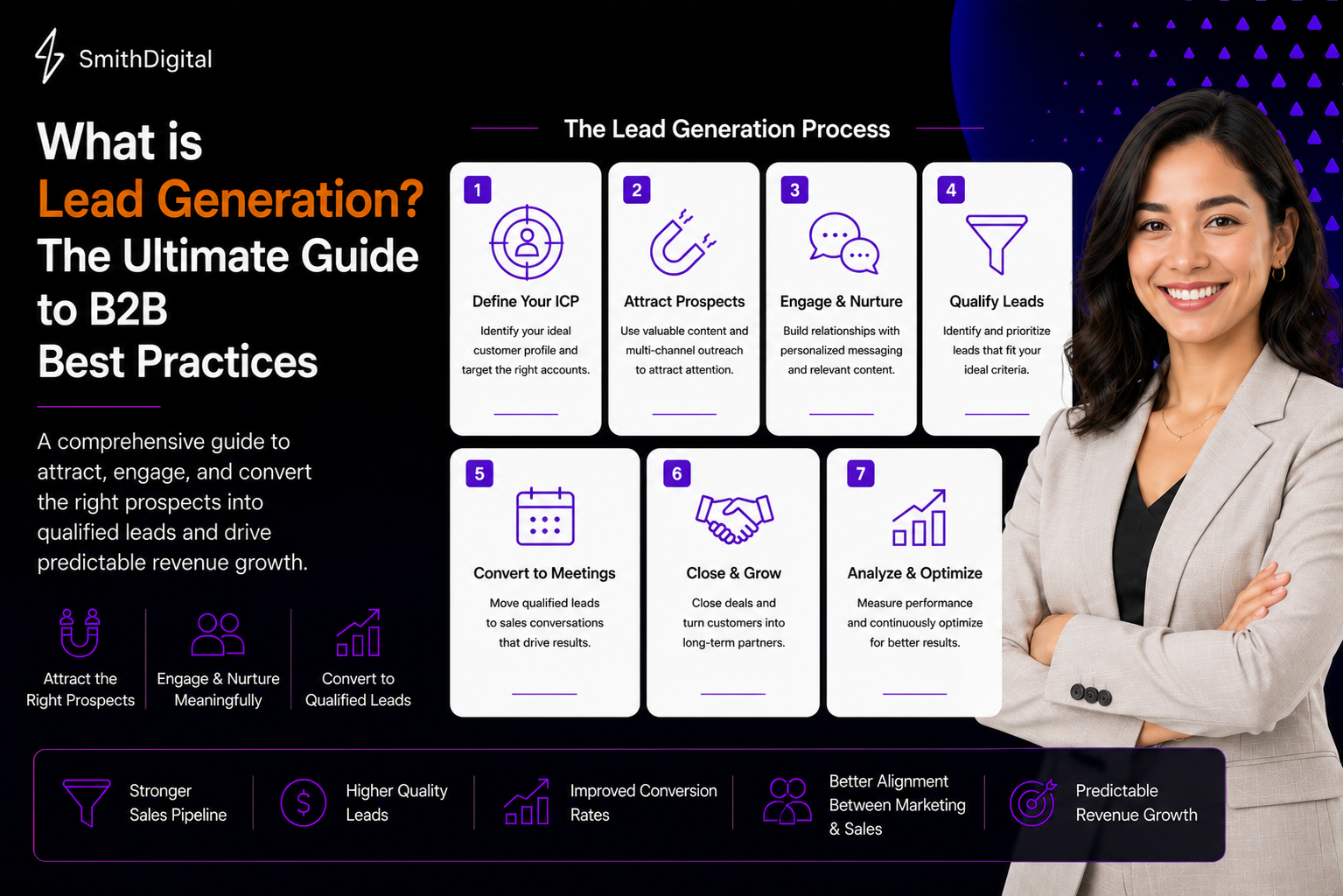
Lead generation is the process of attracting buyers to your product or service. Learn B2B best practices to generate qualified leads & grow your...
Compare inbound and outbound lead generation for B2B across cost, speed, lead quality, and ROI. Learn when to use each or combine both.
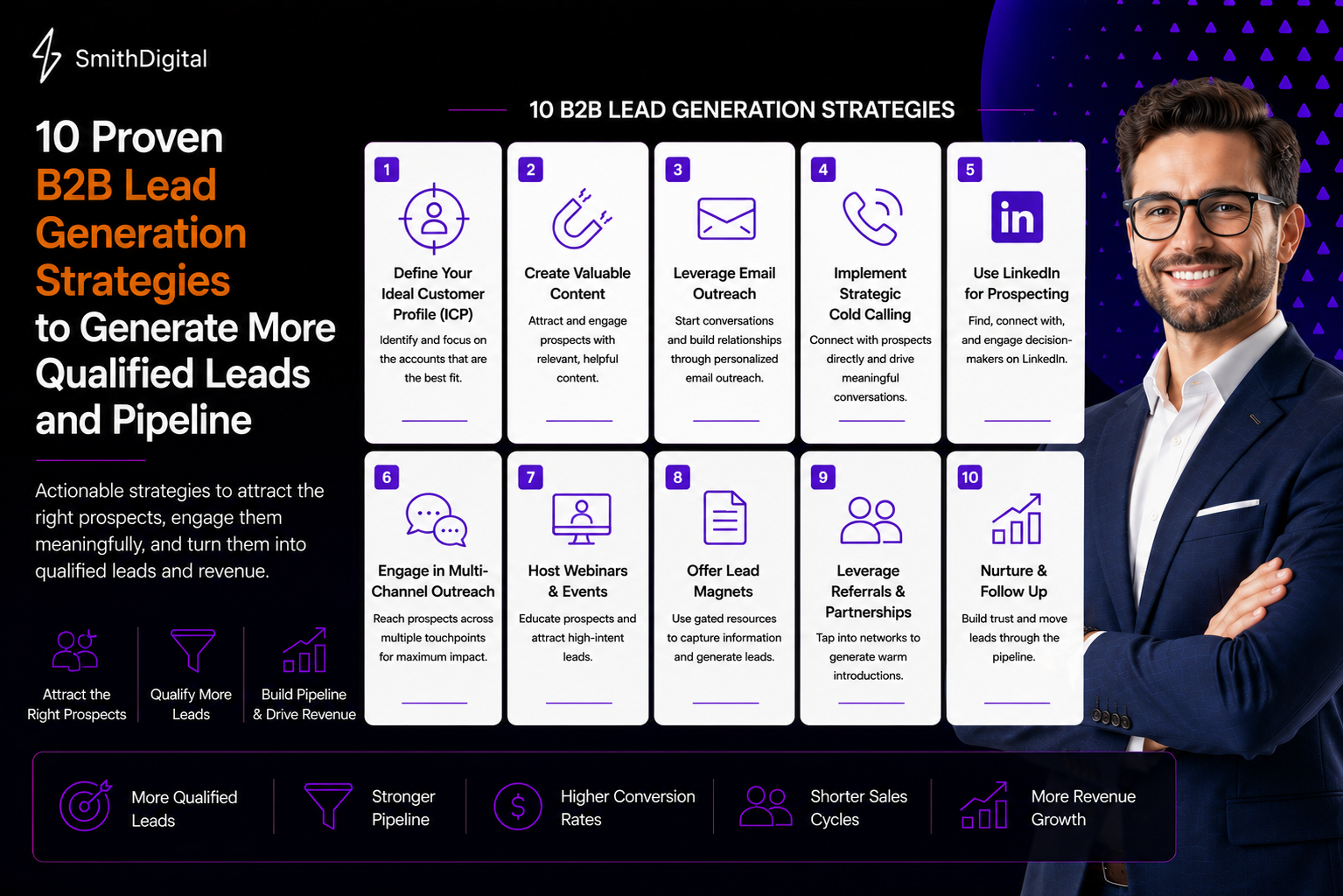
Discover 10 proven B2B lead generation strategies to generate qualified leads, strengthen your sales pipeline, and drive predictable revenue growth.