
21 min read

Do Outsourced SDR Companies Actually Work?

Written by Updated September 23, 2026
Picture of Eric Smith
Eric Smith

Eric Smith is the founder of SmithDigital, a revenue-focused growth partner that helps B2B companies generate qualified pipeline through a combination of SEO, AI discoverability, HubSpot optimization, outbound prospecting, and conversion-focused marketing. Over the past two decades, Eric has worked with software companies, ERP consulting firms, managed service providers, business brokers, technology consultants, and other B2B organizations looking to accelerate growth without building large inte...

Do Outsourced SDR Companies Actually Work?

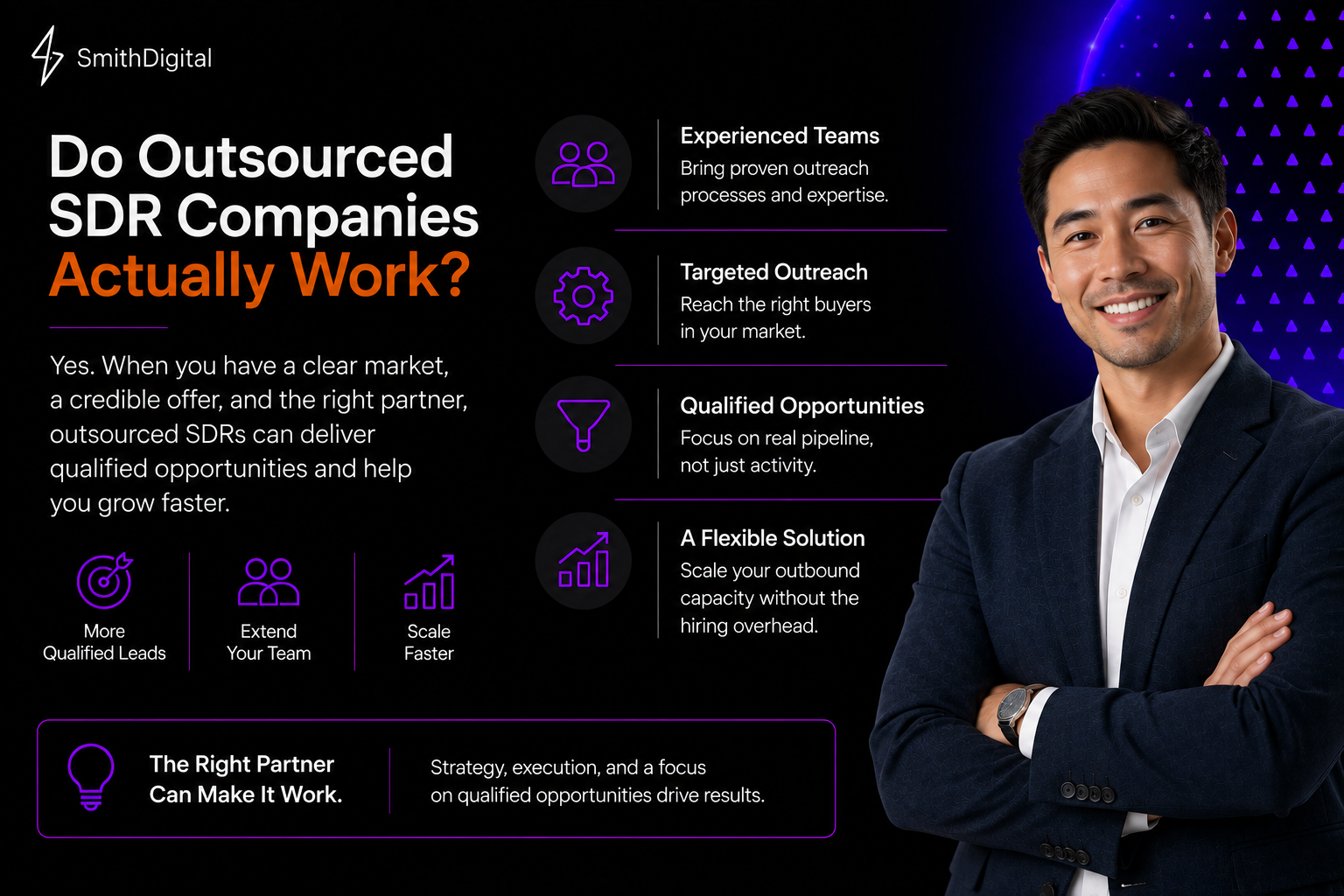
Yes, outsourced SDR companies can work. They tend to perform best when the company already has a clear ICP, a credible offer, defined qualification criteria, and a sales team prepared to handle the conversations they create. When those pieces are weak, adding outsourced SDRs can generate plenty of activity without producing enough qualified pipeline.

That challenge is especially relevant in B2B sales today. Forrester’s 2025 Buyers’ Journey Survey found that 68% of B2B buyers already have a front-runner vendor in mind at the start of the purchasing process, and that vendor wins 80% of the time. For an outsourced SDR program, reaching the right prospect with a relevant message at the right time matters because many buyers already have established preferences before the first sales conversation.

This guide explains why experiences with SDR outsourcing vary so much, how the major delivery models differ, which outsourced SDR companies are worth evaluating in 2026, and what buyers should look for before choosing a provider.

💡 TL;DR: What Buyers Should Know About Outsourced SDR Companies

  • The delivery model matters. A dedicated SDR, shared SDR, specialist pod, and full-service outsourced SDR team provide very different levels of capacity, management, and account knowledge.

  • Outsourcing works best when the sales motion is already reasonably defined. An SDR agency can improve execution, targeting, and outreach, but it cannot create product-market fit or fix an offer prospects do not value.

  • Meeting volume is a weak success metric on its own. Buyers should track meetings held, qualified opportunities, pipeline created, and eventually revenue.

  • An outsourced team can help companies scale faster or test outbound before building an in-house SDR team. It can also provide access to SDR management, prospect data, cold calling, email, LinkedIn outreach, and sales technology without building each capability internally.

  • There is no single best outsourced SDR company for every B2B business. The right provider depends on industry, deal size, sales cycle, target market, internal resources, and how much of the SDR function you want to outsource.

Why Outsourced SDR Results Vary So Much

Outsourced SDR companies tend to produce very different results because the provider is only one part of the sales development system. The quality of the ICP, offer, prospect data, messaging, qualification criteria, sales follow-up, and management all affect whether outreach turns into qualified pipeline. That is why two companies can hire similar SDR providers and come away with completely different opinions about outsourcing.

1. The ICP Is Too Broad

An outsourced SDR team needs a clear definition of who to contact and why those accounts are worth pursuing. “Mid-market technology companies” is usually not specific enough. Strong targeting often includes industry, company size, geography, technology environment, business triggers, relevant job functions, and clear exclusions.

When the ICP is vague, SDRs spend more time contacting prospects who were unlikely to buy in the first place.

Read More: Signal-Based Prospecting: Why It’s Been Table Stakes for Years

2. The Offer Has Not Been Proven

SDR outsourcing works better when the company already understands what prospects respond to. If the offer, positioning, or sales message is still being figured out, outsourcing can generate useful market feedback, but buyers should not expect the provider to solve product-market fit through higher outreach volume.

This is especially important for startups and companies entering a new market. There should be reasonable evidence that the problem, buyer, and offer are aligned before scaling outreach. A managed SDR program can still be useful for testing and refining an outbound strategy before the company builds the function internally.

3. Outreach Quality Is Inconsistent

A large prospect list and high activity levels do not automatically create pipeline. Good SDR outreach requires relevant account selection, accurate contact data, credible messaging, and enough personalization to give the prospect a reason to engage. Cold calling, email, and LinkedIn can all contribute, but execution matters more than simply adding more touches.

Poor outreach can also create a longer-term problem by exhausting a limited target market with messages that do not resonate.

4. “Qualified Meeting” Means Different Things to Different Teams

One of the biggest sources of dissatisfaction with outsourced SDR services is a mismatch between what the provider considers qualified and what the sales team considers worth pursuing. A booked meeting may look successful in a campaign report but have little value if the prospect falls outside the ICP, lacks a relevant need, or has no reason to continue the conversation.

Qualification criteria should be agreed on before outreach begins and reviewed as the program develops.

5. The Internal Sales Team Still Matters

Outsourcing the SDR function does not remove the need for internal sales execution. Account executives still need to follow up quickly, run effective discovery, provide feedback on lead quality, and keep CRM data current. If qualified prospects receive slow or inconsistent follow-up, even a strong outsourced SDR program can appear ineffective.

Where handoffs, follow-up, and sales processes need additional structure, Sales Enablement Services can help strengthen what happens after a qualified prospect reaches the internal sales team.

The better question, then, is not whether SDR outsourcing works in general. It is whether the company, provider, and sales process are set up to make it work.

Major SDR Outsourcing Models in 2026

Comparison of major SDR outsourcing models for B2B companies

Not every outsourced SDR company operates the same way. Some assign a dedicated rep to one client, while others use shared teams, specialist pods, or broader sales outsourcing models. Those differences affect cost, ramp time, account knowledge, management depth, and how closely the outsourced team can function as part of the internal sales organization.

Understanding the model matters because a program can look attractive on paper and still be a poor fit for how your sales team actually works.

SDR Outsourcing Model How It Works Best Fit Main Tradeoff
Dedicated SDR One SDR works primarily or exclusively on your account Companies that want consistent prospecting capacity and deeper product knowledge Results can depend heavily on the quality and tenure of the individual rep
Shared or Fractional SDR SDR capacity is split across multiple clients Startups, smaller markets, or companies testing outbound before scaling Less rep time and account immersion
Specialist SDR Pod SDRs are supported by research, messaging, RevOps, data, and management specialists B2B companies that want a more complete outsourced SDR program Usually costs more than a basic shared-rep model
Hybrid Team Outsourced SDRs work alongside an in-house SDR or sales team Companies scaling outbound without replacing internal resources Requires clear account ownership, CRM rules, and territory management
Hire-to-Own Model A provider recruits and develops SDRs who can later transition in-house Companies that eventually want to build an internal SDR team Works best when internal hiring is part of the long-term plan
Full Sales Outsourcing The provider handles SDR activity and may support later stages of the sales process Companies entering new markets or operating without a complete internal sales function Requires careful control over messaging, handoffs, and sales ownership

Dedicated SDRs

A dedicated SDR model gives one rep, or a small group of reps, responsibility for your account.

This can work well when the sales cycle is complex enough that reps need time to learn the product, common objections, competitors, and buyer language. Over time, a dedicated SDR can develop stronger familiarity with the ICP and provide more useful feedback from prospect conversations.

The main risk is concentration. If one rep accounts for most of the program’s output, turnover or underperformance can have an immediate effect on pipeline. Buyers should ask how the provider handles hiring, onboarding, coaching, backup coverage, and rep replacement.

Shared or Fractional SDRs

A fractional SDR model gives companies access to sales development capacity without committing to a full dedicated rep. This approach can make sense when the addressable market is limited, outbound volume is modest, or the company wants to test a new segment before committing more resources.

The tradeoff is attention. A shared SDR may be working across several accounts, which can reduce the amount of time available for deeper product learning, account research, and campaign refinement. For a straightforward offer with a clear ICP, that may be sufficient. For a highly technical or complex sale, it can become a limitation.

Specialist SDR Pods

A specialist pod assigns different parts of sales development to specialized roles. The SDR may focus on calls and conversations, while other team members handle list building, contact research, messaging, email deliverability, CRM administration, reporting, and campaign strategy.

This model tends to work well when a company wants to outsource a larger portion of the SDR function rather than simply add another rep. It also addresses a common operational problem: expecting one SDR to be equally strong at prospecting, copywriting, data management, technology, reporting, and sales operations.

Hybrid SDR Teams

A hybrid model combines outsourced SDRs with an existing in-house team. Companies often use this structure when they want to expand into a new vertical, test a new sales strategy, add cold calling capacity, or cover accounts that the internal team cannot reach consistently.

The model works best when account ownership is clearly defined. If internal and outsourced reps are working the same accounts without shared CRM rules, prospects can receive duplicate outreach and sales teams can lose time sorting out ownership instead of progressing opportunities.

Hire-to-Own SDR Models

Some SDR outsourcing companies provide a path for clients to eventually bring successful reps in-house. This approach can be useful for companies that want to build an internal sales development team but do not want to manage the early recruiting and training process themselves.

It can reduce hiring risk by giving companies a chance to see how an SDR performs in the role first. The model makes the most sense when the long-term goal is internal ownership of the SDR function rather than permanent outsourcing.

Full Sales Outsourcing

Full sales outsourcing extends beyond traditional SDR activity. Depending on the provider, the outsourced team may handle prospecting, qualification, appointment setting, discovery, opportunity management, and other parts of the sales process.

This can work for companies entering a new market, launching a new business unit, or operating without a complete internal sales organization. It also requires the highest level of operational clarity. The provider may represent the company across several stages of the buyer journey, so messaging, qualification criteria, CRM processes, handoffs, and sales ownership need to be defined carefully.

For most buyers, the decision should start with a simple question:

How much of the SDR function do you actually need to outsource? The answer helps narrow the field before comparing individual providers.

Read Next: Should You Outsource Sales Development? Buyer's Guide for B2B (2026)

Outsourced SDR Companies to Consider in 2026

Outsourced SDR providers vary considerably in how they staff programs, manage outreach, use technology, and support the handoff from prospecting into pipeline. Some center their model around dedicated SDRs, while others use fractional teams, international delivery, proprietary sales technology, or broader sales outsourcing.

The companies below are presented as a fit-based comparison, not a ranking. Each provider serves different types of buyers, sales motions, and outsourcing needs, so the order does not indicate that one company is better than another. We evaluated each provider based on its current delivery model, core SDR capabilities, ideal customer, meaningful differentiators, potential considerations, and publicly available pricing. SmithDigital is included because we provide outsourced SDR services, and we evaluate our offering using the same criteria applied to the other providers.

memoryBlue

memoryBlue outsourced SDR company

memoryBlue provides outsourced sales development primarily for B2B technology companies. Its dedicated SDR teams handle account research, prospecting, qualification, and meeting generation across phone, email, and LinkedIn. The provider also supports inbound qualification, account-based prospecting, and expansion into new markets.

One of memoryBlue’s more distinctive features is its SDR-to-hire model. Clients can transition reps who have already worked on their account into the internal sales team. That gives companies an opportunity to evaluate an SDR in the role before making a permanent hire.

Key features:

  • Dedicated outsourced SDR teams

  • Phone, email, and LinkedIn prospecting

  • SDR recruiting, training, and management

  • Account research and lead qualification

  • CRM integration and performance optimization

  • Option to hire successful SDRs into the internal team

Ideal for:

  • B2B technology companies
  • Organizations expanding into new markets
  • Companies that may eventually want to build an in-house SDR team

Potential considerations:
The SDR-to-hire option is most valuable for companies that see outsourcing as a bridge toward internal sales development. Businesses planning to outsource permanently should evaluate the ongoing managed service on its own merits.

Pricing:
memoryBlue does not publish a fixed dollar rate. It currently offers fixed-fee, pay-for-performance, and hybrid pricing, with fixed-fee described as its most common model. Pricing is customized based on the engagement.

Leadium

Leadium outsourced sales development company

Leadium is a U.S.-based outsourced sales development company focused on managed B2B appointment setting and outbound prospecting. Its programs combine prospect research, contact-data validation, messaging, and SDR execution across cold calling, email, and LinkedIn. Leadium also offers inbound lead qualification and integrates with major CRMs such as HubSpot, Salesforce, and Pipedrive.

A notable part of Leadium’s model is its emphasis on 100% U.S.-based, U.S.-employed SDR delivery and month-to-month engagements. Its current materials position the company as a fully managed, multi-channel SDR partner rather than a calling-only provider.

Key features:

  • U.S.-based SDR team

  • Cold calling, email, and LinkedIn prospecting

  • B2B appointment setting

  • Prospect research and contact validation

  • Inbound lead qualification

  • CRM integration and reporting

Ideal for:

  • B2B companies that prefer U.S.-based SDR execution

  • SaaS and technology companies building or scaling outbound

  • Sales teams looking for managed prospecting with month-to-month flexibility

Potential considerations:
Leadium’s delivery model is centered on U.S.-based SDRs. Companies specifically seeking lower-cost offshore capacity or extensive international SDR coverage should confirm whether that structure matches their requirements.

Pricing:
Leadium currently publishes pricing of $3,500 per month for cold-calling programs and $4,000–$5,000 per month for multi-channel programs covering phone, email, and LinkedIn. Its engagements are offered on a month-to-month basis.

SalesHive

SalesHive outsourced SDR services

SalesHive combines outsourced SDR execution with a proprietary outbound sales platform. Its managed service includes SDRs, a dedicated strategist, prospect data, calling and email infrastructure, list building, coaching, reporting, and CRM synchronization.

The technology layer is a central part of its model. SalesHive runs outreach through its own platform, including a Power Dialer, email tools, smart inbox, list-building capabilities, and AI-assisted workflows. Its core SDR operation is U.S.-based, with an offshore option available for companies seeking a different cost structure.

Key features:

  • Managed U.S.-based SDR teams

  • Offshore staffing option

  • Cold calling and email outreach

  • Dedicated sales strategist

  • Proprietary AI and outbound platform

  • Prospect data and enrichment

  • CRM synchronization and call coaching

Ideal for:

  • B2B companies that want SDR execution and technology from one provider

  • Teams without a fully established outbound tech stack

  • Organizations that prefer month-to-month flexibility

Potential considerations:
Campaigns run on the SalesHive platform. Companies with an established sales-engagement stack should understand how existing systems will integrate with SalesHive and which tools will remain in use.

Pricing:
SalesHive currently uses custom flat monthly pricing based on team model, channel mix, and daily outreach volume. Its pricing page states there are no setup fees or long-term contracts, while annual plans receive a lower monthly rate.

SmithDigitalSmithDigital outsourced SDR services

SmithDigital provides fully managed SDR and BDR programs for B2B companies that need more qualified pipeline without building the entire sales development function internally. Our programs combine experienced sales development reps with the buyer intelligence, prospect research, multi-channel outreach, CRM management, sales technology, reporting, and ongoing optimization needed to run that function consistently.

Our delivery model is flexible and distributed, with sales development capacity primarily based in the Philippines and supported by experienced management, sales technology, buyer intelligence, and CRM infrastructure. We commonly support B2B software, ERP, managed IT, manufacturing, and professional services companies where prospecting needs to stay closely connected to the rest of the sales and marketing operation.

We can incorporate 3rd-Party Buyer Intent Data and account intelligence into prospect prioritization, including data from platforms such as ZoomInfo. Our stack can also support parallel dialing through Koncert. HubSpot and CRM workflows give the internal sales team visibility into prospect activity, qualification, meetings, and pipeline. Because we also work across inbound marketing, SEO, conversion, and demand generation, outbound activity can respond to signals created elsewhere in the buyer journey rather than operating as an isolated channel.

Key features:

  • Fully managed SDR and BDR execution

  • Flexible, fully managed sales development delivery

  • ICP development and account research

  • Buyer intent and account intelligence

  • ZoomInfo-supported prospect data

  • Cold calling, email, and LinkedIn outreach

  • Parallel dialing technology

  • HubSpot and CRM integration

  • Connection between outbound, inbound demand, and pipeline reporting

Ideal for:

  • B2B technology and software companies

  • ERP and managed IT providers

  • Professional services firms

  • Companies that need CRM visibility around outbound execution

  • B2B organizations that want SDR execution integrated with a broader demand-generation and revenue strategy rather than a standalone appointment-setting vendor

Potential considerations:
Our model is designed for organizations that want SDR execution connected with buyer intelligence, CRM visibility, sales technology, and broader demand generation. Companies seeking a narrowly scoped calling-only or pay-per-meeting service may prefer a more specialized engagement.

Pricing:
Our Core Outbound program starts at $4,995 per month and includes email, LinkedIn, and phone outreach. Companies that need a broader channel mix can choose Engage at $6,495 per month or Accelerate at $7,995 per month, depending on the scope of the program.

CallboxCallbox outsourced sales development services

Callbox structures its outsourced sales development around Campaign Pods. A pod includes a dedicated SDR, multi-channel outreach, AI-enriched contact data, campaign management, and performance reporting. Larger engagements can add research, content, quality assurance, and account strategy resources around the core SDR function.

Global delivery is a notable part of Callbox’s model. The company reports serving campaigns across more than 60 countries, making its model relevant for businesses prospecting across multiple regions.

Key features:

  • Dedicated SDR Campaign Pods

  • Phone, email, and LinkedIn outreach

  • AI-enriched account and contact data

  • ICP and buyer-persona development

  • Campaign management and optimization

  • CRM integration and reporting

  • International prospecting coverage

Ideal for:

  • Mid-market and enterprise B2B companies

  • Organizations targeting multiple geographic regions

  • Companies that need a larger managed team around the SDR

Potential considerations:
A Campaign Pod provides considerably more infrastructure than a shared or fractional rep. Companies with a small target market or limited outreach requirements should determine whether they need that level of capacity.

Pricing:
Callbox currently estimates $15,000 to $30,000 per month for one Campaign Pod. The company describes this as an estimated range, with exact pricing determined after consultation.

Belkins

Belkins outsourced SDR services

Belkins builds dedicated SDR programs around the client’s ICP, sales motion, and growth goals. The SDR is supported by specialists across prospect research, messaging, RevOps, deliverability, campaign management, and HubSpot.

The service covers prospect research and validation, copywriting, cold calling, email, LinkedIn outreach, appointment booking, no-show recovery, reporting, and ongoing campaign refinement. This gives the dedicated rep a larger operational team behind the day-to-day prospecting work.

Key features:

  • Dedicated SDR recruited for the engagement

  • Prospect research and validation

  • Email, LinkedIn, and cold calling

  • Messaging and copywriting support

  • Deliverability management

  • RevOps and HubSpot support

  • Appointment booking and no-show recovery

Ideal for:

  • B2B companies with an established go-to-market motion

  • Organizations that want specialists supporting the SDR

  • Companies scaling multi-channel outbound

Potential considerations:
Belkins positions the outsourced SDR model primarily for companies ready to scale an established sales motion. Businesses that are still determining their ICP, offer, or outbound strategy should account for that during evaluation.

Pricing:
Belkins' outsourced SDR service page currently lists an average starter price from $5,000, with final pricing based on company size, TAM, revenue goals, digital footprint, and required channels. Its 2026 provider-comparison guidance separately lists email-only campaigns from $6,500/month and omnichannel packages from $7,995/month, illustrating how pricing changes with program scope.

Martal Group

Martal Group sales outsourcing services

Martal Group uses a broader Sales-as-a-Service model that can extend beyond traditional SDR prospecting. Its current service tiers range from outbound lead generation through programs that also support sales, customer onboarding, and account management.

For outbound programs, Martal combines sales executives, research support, sales operations, prospect data, persona-based messaging, email, LinkedIn, calling, appointment setting, and reporting. Higher tiers can continue supporting opportunities after the initial meeting and through additional stages of the sales cycle.

Key features:

  • Outbound lead generation

  • Target-account research

  • Email, LinkedIn, and phone outreach

  • Sales Operations support

  • Appointment setting and discovery

  • Options for later-stage sales support

  • Broader fractional sales-team model

Ideal for:

  • B2B technology and services companies

  • Organizations looking for fractional sales capacity

  • Companies that need support beyond top-of-funnel prospecting

Potential considerations:
The service can cover more of the sales cycle than a conventional outsourced SDR engagement. Buyers should establish clear ownership for discovery, opportunity progression, closing, onboarding, and account management before launch.

Pricing:
Martal does not publish fixed dollar amounts for its managed programs. Tier 1A Outbound Lead Generation uses a flat monthly fee with a three-month pilot, while Tier 2 and Tier 3 use four-month pilot periods and a flat monthly fee plus sales commission. Exact rates require a custom quote.

SalesRoads

SalesRoads outsourced SDR services

SalesRoads provides dedicated SDRs backed by what it calls a Pipeline Acceleration Team. The support structure includes a client strategist, SDR performance coach, optimization specialist, and research and data team. Its SDRs are dedicated to client accounts rather than shared across multiple programs.

Programs include prospect research, a custom demand-generation playbook, outbound calling, personalized email, CRM integration, call recording, coaching, and a live dashboard tracking activity, opportunities, show rates, and pipeline created.

Key features:

  • Dedicated SDRs

  • Client strategist and SDR performance coach

  • Research and data support

  • Cold calling and personalized email

  • Custom outbound playbook

  • CRM integration

  • Live pipeline and performance reporting

Ideal for:

  • B2B companies with a clear ICP and established offer

  • Organizations that want dedicated outbound calling capacity

  • Sales teams that value structured coaching and quality assurance

Potential considerations:
The dedicated-team model carries a larger investment than fractional or shared SDR services. The economics are easier to justify when deal value, conversion rates, and available market size support consistent dedicated prospecting.

Pricing:
SalesRoads currently lists $9,950 per four-week period for one dedicated SDR. Two SDRs are listed at $16,750 per four weeks, or $8,375 per rep, with the per-rep cost continuing to decline as team size increases. The company states there is no long-term commitment.

The range of models explains why selecting an outsourced SDR company based on reputation or meeting volume alone can be misleading. The provider still has to fit the company’s market, sales motion, internal resources, economics, and definition of a qualified opportunity. Those factors have a direct effect on whether the outsourced SDR program ultimately produces useful pipeline.

Read Next: How to Choose the Right Outsourced SDR Company in 2026

Need an SDR Program Built Around Your Sales Motion?


What to Evaluate Before Choosing an Outsourced SDR Company

Two providers can offer similar SDR services and still produce very different results. Before choosing one, look closely at how the program will be staffed, targeted, managed, integrated with your sales process, and measured.

What to Evaluate What to Ask Why It Matters
SDR Staffing Is the rep dedicated or shared? Who manages and coaches them? Rep quality, continuity, and account knowledge directly affect execution.
ICP and Targeting How are accounts selected, validated, and prioritized? Weak targeting wastes outreach and produces poor-fit meetings.
Outreach Quality Who writes the messaging, and can we review it before launch? The provider will be representing your brand to the market.
Qualification What exactly counts as a qualified meeting? Meeting volume means little if the sales team rejects the opportunities.
CRM Integration How will activity, notes, ownership, and pipeline be tracked? Your internal sales team needs visibility and a clean handoff.
Optimization What happens when a segment or campaign underperforms? Strong providers adjust targeting, messaging, and channel mix instead of simply increasing volume.
Success Metrics How do you measure meetings held, opportunities, pipeline, and revenue? Pipeline performance gives a clearer picture than activity alone.

A prospective provider should be able to answer these questions clearly before outreach begins. If the definition of a qualified meeting, account ownership, reporting, or optimization process is vague during the sales process, that uncertainty can become a much bigger problem once the SDR program is live.

Read More: Outsourcing BDR Checklist: How to Outsource BDRs and Accelerate Pipeline

In-House SDR Team vs. Outsourced SDR Team

An in-house SDR team gives you more direct control over hiring, training, management, and how reps represent the business. An outsourced SDR team can add prospecting capacity faster while reducing the internal work required to recruit reps, manage them, and assemble the supporting data and technology.

The better model depends on what your company already has in place. Salesforce’s 2026 State of Sales found that sales reps spend almost a full workday each week prospecting, yet 47% say their teams still lack the bandwidth to do adequate cold outreach. That capacity gap is one reason companies consider outsourcing, particularly when account executives or sales leaders are absorbing prospecting work themselves.

Consideration In-House SDR Team Outsourced SDR Team
Time to Launch Requires recruiting, onboarding, training, and system setup Existing people and processes can shorten ramp time
Management Requires internal leadership, coaching, and performance management Day-to-day SDR management is typically handled by the provider
Product Knowledge Reps can develop deep expertise over time Depends on onboarding quality, rep tenure, and account dedication
Control Greater control over hiring, messaging, processes, and culture Requires alignment with the provider on messaging, qualification, and execution
Data and Technology Company builds and manages its own prospecting stack Data, dialing, outreach, and reporting tools may be included
Scaling Capacity Additional coverage usually requires more hiring Capacity can often be added without another internal recruiting cycle
Cost Structure Includes salary, benefits, management, software, data, and recruiting costs Usually packaged as a recurring service fee based on scope and staffing
Long-Term Ownership Sales knowledge and SDR infrastructure stay inside the company Much of the delivery infrastructure remains with the provider

When Outsourcing Makes Sense

Outsourcing is often practical when the sales motion is defined, but prospecting capacity is limited. A company may already know its ICP, have an offer that converts, and have account executives capable of closing opportunities, yet still struggle to maintain consistent cold calling, email, LinkedIn outreach, list building, and follow-up.

It can also give companies a lower-commitment way to test a new market or add SDR capacity before hiring and training additional employees.

When an In-House SDR Team Makes Sense

Building internally becomes more attractive when sales development is already proven, and the company has the leadership and infrastructure to support it. Internal SDRs can develop deeper product knowledge, work closely with account executives, and become part of a longer-term sales talent pipeline. This can be especially useful for technical or complex sales where early conversations require substantial product knowledge and ongoing access to internal subject-matter experts.

When a Hybrid Model Works

Some organizations use both. An in-house SDR team might focus on strategic accounts while outsourced SDRs support a new territory, vertical, campaign, or additional outbound capacity.

Whichever model you choose, the economics should ultimately be judged against the same outcome:
How much qualified pipeline does the SDR function create relative to the cost and internal resources required to run it?

How to Measure Whether an Outsourced SDR Program Is Actually Working

An outsourced SDR program should be measured by the quality of the opportunities it creates and the pipeline those opportunities generate. Activity still matters, but it should help explain performance rather than serve as the main definition of success.

  1. Track meetings held, not just meetings booked. Start with how many scheduled meetings actually happen, then look at how many the sales team considers worth pursuing. A large drop-off can point to weak qualification or low prospect intent.

  2. Measure opportunity creation. Track how many SDR-sourced conversations become legitimate sales opportunities. If meetings are happening but few progress, review the ICP, qualification criteria, and outreach.

  3. Connect opportunities to pipeline. Measure the dollar value of pipeline created from SDR-sourced opportunities and how those deals move through the sales process. Calls, emails, reply rates, and connect rates are useful diagnostic metrics, but pipeline shows whether the program is creating business value.

  4. Compare results against program cost. Determine what the SDR program needs to produce based on your deal size, close rate, sales cycle, and monthly investment.

The practical measure is simple:

Does the outsourced SDR program create enough qualified pipeline to justify the cost and resources required to run it?

That answer should become clearer over time. Early on, the focus may be on whether the provider is reaching the right accounts, generating conversations, and producing meetings that sales considers credible. As the program matures, the evaluation should move further downstream toward opportunity creation, pipeline contribution, and closed revenue.

This also helps separate a program that needs optimization from one that is fundamentally misaligned. If the right prospects are engaging but conversion is weak, there may be room to improve messaging, qualification, or follow-up. If the program consistently produces poor-fit meetings and little pipeline despite repeated adjustments, the issue may be the provider, the targeting, or the broader sales motion itself.

Read More: BDR Success Metrics: Lead Qualification KPIs for B2B Sales

What the First 90 Days of an Outsourced SDR Program Should Look Like

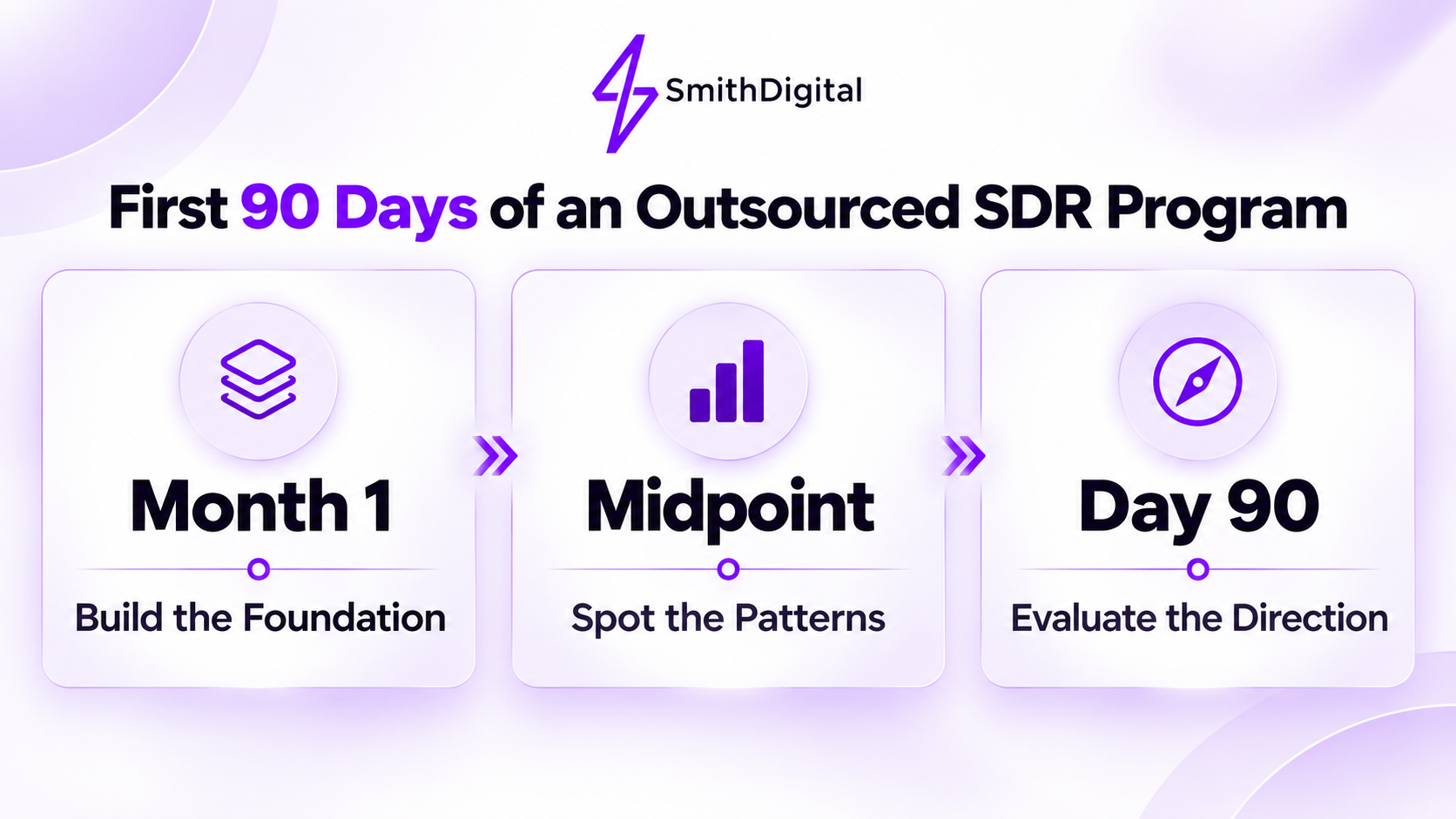
First 90 days of an outsourced SDR program from setup through pipeline evaluation

The first 90 days should give you a clear read on whether the provider can turn your market, offer, and sales process into a workable outbound motion. Some programs will generate meetings quickly, while others need more time to refine targeting and messaging. What matters is whether the quality of execution improves as real prospect feedback comes in.

The first month should establish the foundation. This is when the provider should be learning your ICP, building target lists, developing messaging, defining qualification standards, setting up CRM workflows, and launching outreach. Early performance should be treated as directional. The important question is whether the team is reaching the right people and learning from their responses.

By the middle of the engagement, patterns should start to emerge. Certain industries, job titles, pain points, or messages may be producing stronger conversations than others. The provider should be using that information to refine account selection, call approaches, email copy, and follow-up rather than continuing with the original campaign unchanged.

By day 90, there should be enough evidence to evaluate the direction of the program. Look at the quality of meetings, sales-team feedback, opportunities created, and early pipeline. For companies with longer sales cycles, it may still be too early to judge the program on closed revenue, but there should be evidence that it can consistently create conversations with a realistic chance of becoming business.

The first 90 days do not need to prove the entire economics of the SDR program. They should prove that the provider can learn, adjust, and build toward a repeatable source of qualified pipeline.

Read Next: 90-Day Sales Pilot Template: Sales Team Planning & Onboarding Strategy

When Outsourced SDR Companies Are Probably the Wrong Fit

Outsourced SDR companies tend to struggle when the underlying market and offer are still unclear. If the company does not yet understand who buys, what problem it solves, or why prospects should care, outsourcing can create activity without producing much meaningful pipeline. An unproven outbound strategy is different: with a credible offer and defined market, a managed SDR program can help test and refine the motion before the company invests in building it internally.

The economics also need to make sense. Companies with very low deal values, weak close rates, or long sales cycles may find it difficult to justify the cost of a sustained outbound program, even if the SDR team is executing well.

Internal readiness matters too. If qualified meetings are handed off slowly, account ownership is unclear, or the sales team lacks the capacity to follow up consistently, the value of the outsourced program will be limited.

Outsourcing is usually a better fit when the company already has a credible offer, a reasonably defined target market, and a sales process capable of converting opportunities. In that situation, the provider can focus on what it is there to do: add prospecting capacity, improve execution, and create more qualified conversations.

Do Outsourced SDR Companies Actually Work?

Yes, they can. The strongest results usually come when the fundamentals are already in place: a clear ICP, a credible offer, defined qualification criteria, and a sales team prepared to convert the opportunities being created.

The biggest mistake is treating outsourced sales development as a shortcut to pipeline. It works better as a way to add structure, capacity, and expertise to a sales motion that has already shown it can generate viable opportunities. That is why staffing, targeting, qualification, management, CRM visibility, and pipeline reporting matter more than headline activity numbers.

At SmithDigital, our Outsourced SDR Services combine prospect research, buyer intelligence, cold calling, email, LinkedIn outreach, CRM management, and ongoing optimization to help B2B teams build a more consistent outbound motion.

If you are evaluating outsourced SDR companies in 2026, focus on finding a partner that understands your market, represents your company well, and can consistently turn prospecting activity into qualified sales opportunities.

Ready to Build a More Consistent B2B Pipeline?


Frequently Asked Questions

How do you choose the best outsourced SDR companies for B2B sales?

Start with fit rather than brand recognition. The right SDR outsourcing company should understand your market, have a clear process for targeting and qualification, and be able to show how SDR activity connects to pipeline.

When comparing SDR vendors or outsourced SDR agencies, look at who will actually work on your account, how experienced the SDR team is, how performance is managed, and what happens when a campaign needs to change. The company you choose should also integrate cleanly with your existing CRM and work effectively with your in-house sales team.

How do outsourced SDRs qualify leads and build sales pipeline?

Outsourced SDRs typically combine account research, cold calling, email, LinkedIn outreach, and follow-up to identify prospects worth advancing into the sales process.

A strong SDR service should have agreed qualification criteria before outreach begins. The sales development representative can then qualify leads based on factors such as account fit, buyer role, business need, timing, and opportunity potential. That gives the sales team a better chance of turning SDR-generated conversations into qualified sales pipeline.

Is SDR outsourcing better than building an in-house sales team?

It depends on what the business is trying to solve. SDR outsourcing services can make sense when a company needs outbound capacity without immediately hiring and managing additional SDRs, sales technology, data providers, and SDR leadership.

An in-house sales team provides greater direct control and can build deeper institutional knowledge over time. Outsourcing can offer faster access to an established prospecting process. Some companies use both, keeping strategic accounts in-house while using an outsourced service for additional markets, campaigns, or scaling needs.

What types of B2B companies are a good fit for an outsourced SDR firm?

Outsourcing tends to fit B2B companies that already have a defined market and credible offer but need more consistent prospecting capacity. That often includes B2B technology companies, SaaS businesses, IT and professional services firms, manufacturers, and other organizations with enough deal value to support outbound sales development.

The delivery model can vary. Some providers offer a dedicated SDR, while others operate more like a full-service SDR team or a fractional SDR department for mid-market B2B companies. The right structure depends on sales complexity, internal resources, and growth goals.

How should companies compare outsourced SDR companies for 2026?

When evaluating outsourced SDR companies for 2026, look beyond meeting volume. Compare the provider’s staffing model, prospecting channels, data quality, qualification standards, CRM integration, reporting, and optimization approach.

Some outsourced SDR vendors focus primarily on appointment setting, while others provide broader sales outsourcing services or operate more like a lead generation agency with research, outbound execution, and sales operations support. For companies focused on sustainable pipeline growth, the better fit is usually the provider whose model aligns with how their buyers are reached, qualified, and handed over to sales.

5 Best Outsourced SDR Providers for ERP Partners in 2026

1 min read

5 Best Outsourced SDR Providers for ERP Partners in 2026

Choosing the best outsourced SDR provider starts with finding a partner that can generate a qualified pipeline for complex B2B sales. For ERP...

Read More
How to Choose an Outsourced SDR Partner in 2026

1 min read

How to Choose an Outsourced SDR Partner in 2026

Choosing the right outsourced SDR partner starts with finding a provider that can support your sales strategy, engage the right prospects, and create...

Read More
When to Hire a Lead Generation Company: 7 Signs Your Business Is Ready

1 min read

When to Hire a Lead Generation Company: 7 Signs Your Business Is Ready

Hiring a lead generation company makes sense when your sales team can't consistently generate enough qualified pipeline to support your growth goals....

Read More